Tuesday, June 17, 2014

The Wild Druids of Vitu Daru


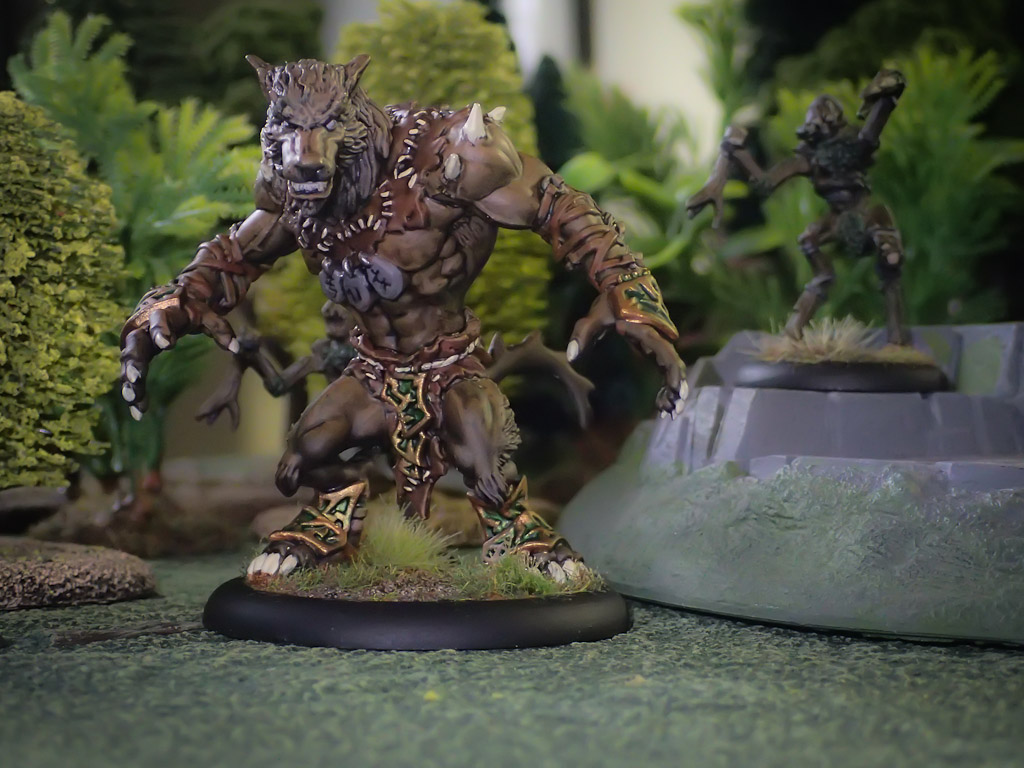
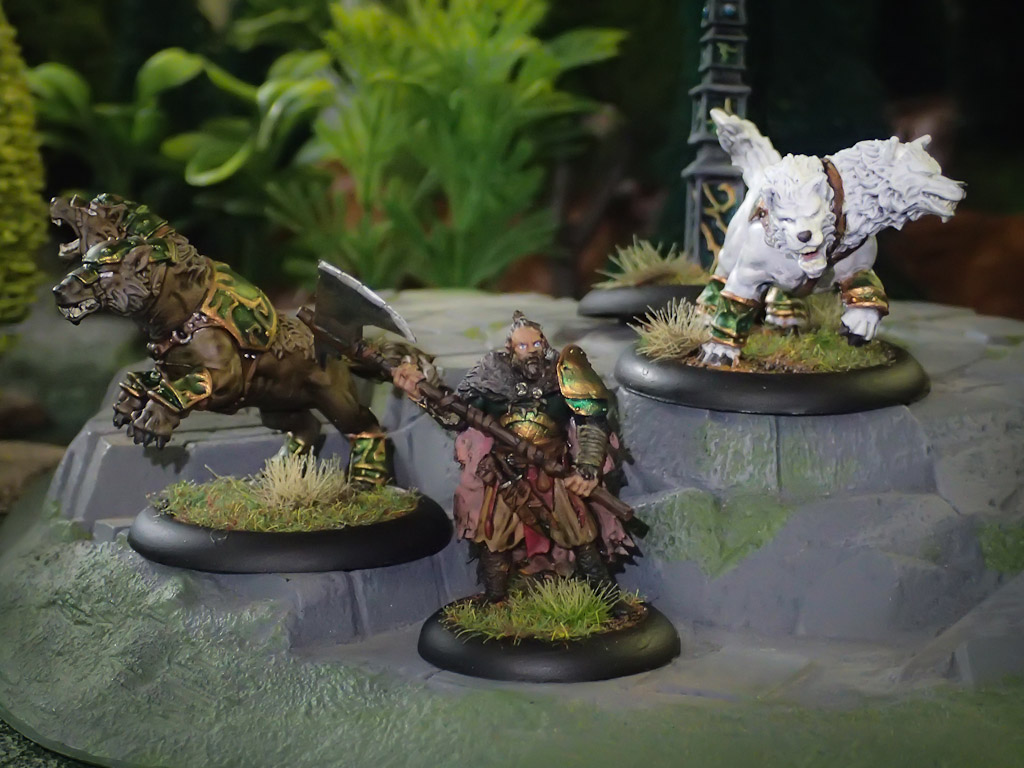
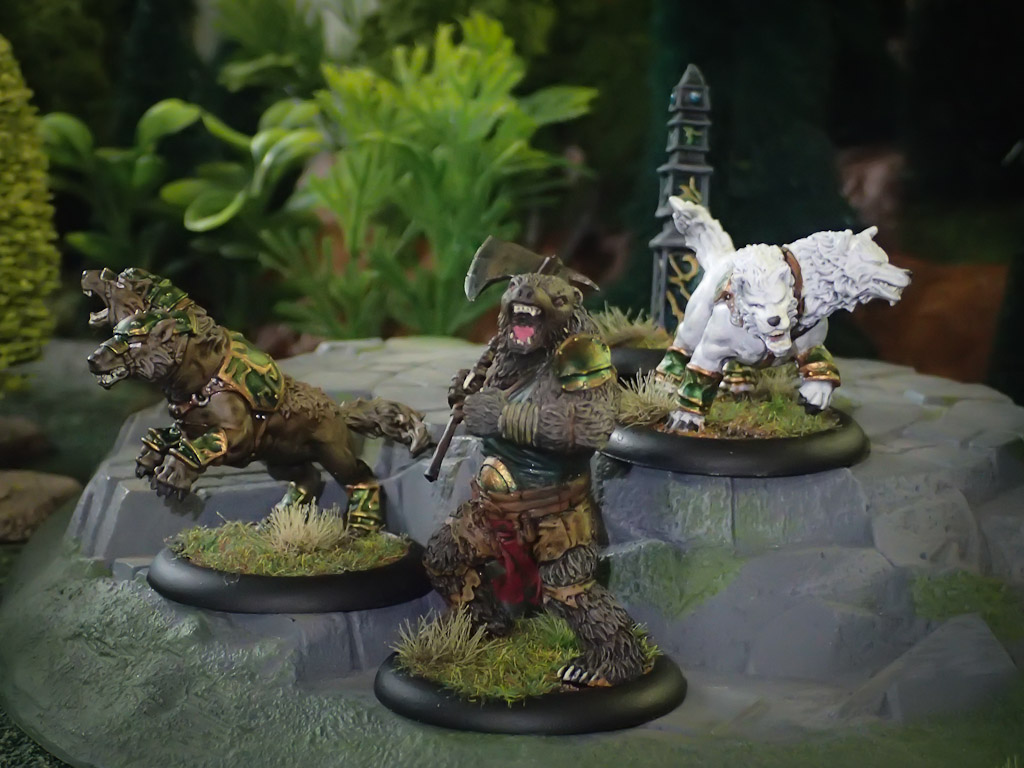
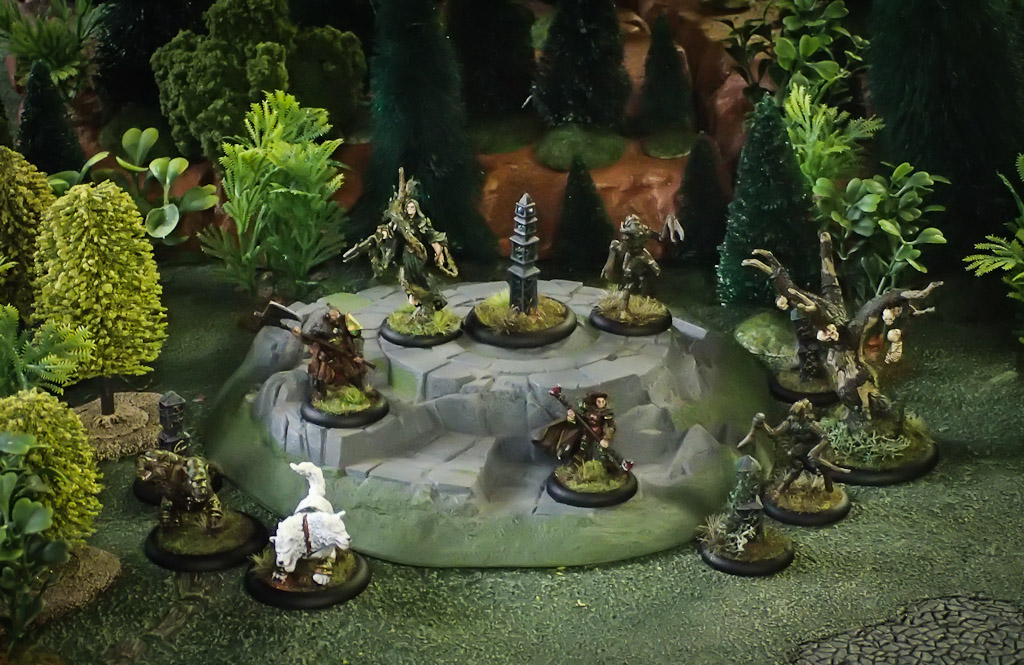
Here is my warband for our upcoming Song of Blades & Heroes campaign. I painted most of these guys toward the end of last year and have been slowly adding to the warband ever since.

The Arboria of Vitu Daru is the oldest forest in all of Qaarra, and it is protected by an ancient sect of powerful druids. Though most members abhor violence, they will stop at nothing to protect their woods.


As the darkness fell over Qaarra, the trees began to wither and die. The Vitu Darunian Druids consulted the ancient Scrying Stones at the glade in the center of their lands, and decided that something must be done.

They left the woodlands to uncover the truth behind the darkness, and stop it at all costs.


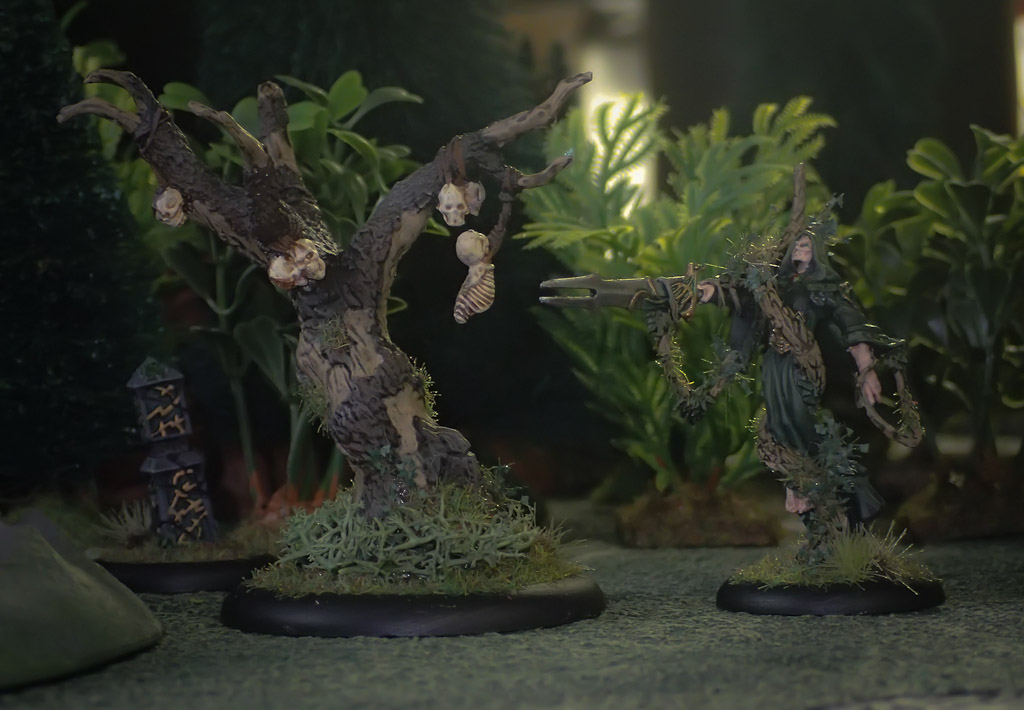
Arborius is the ancient and powerful leader of the Druids. His age-old powers grant him control over nearby flora. Whenever Arborius appears, the mysterious Tree of Fate will be nearby. Some say that the druid is but a branch of that ancient tree.


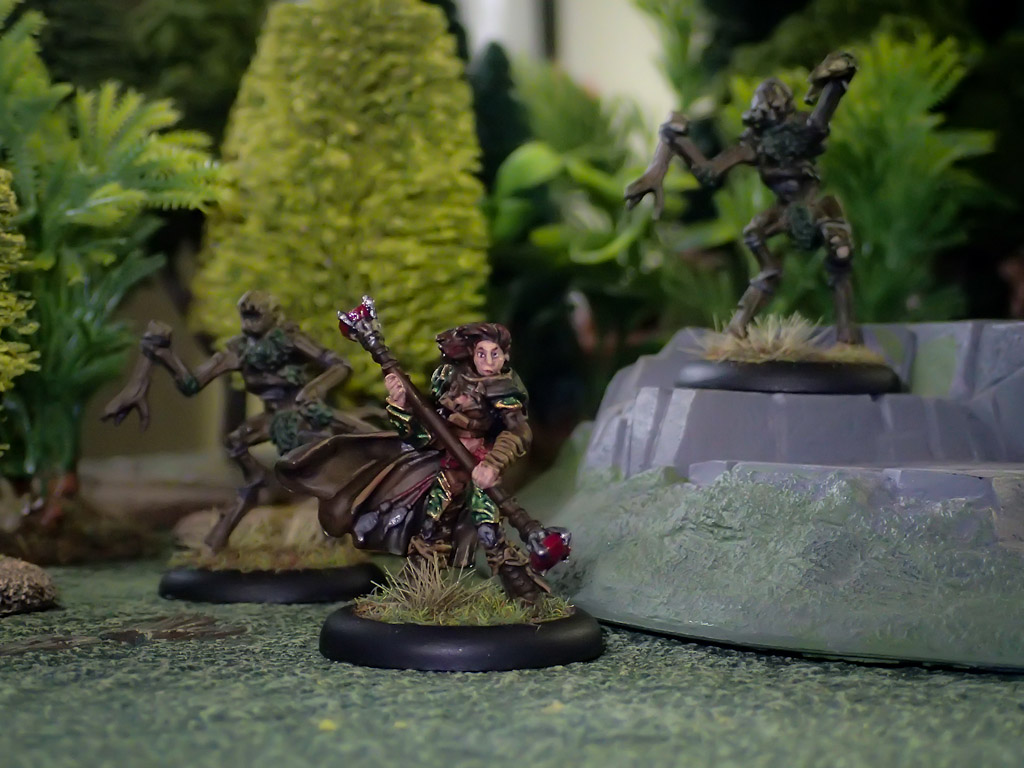
Florifera the Wild has been studying under Arborius since she was a child. Her Tree-kin constructs are never far behind her.


You wouldn't like Florifera when she gets angry...


Ursun Fur Walker was a warrior from across the Western Seas. He was shipwrecked 15 years ago near Port Windspiel, and the druids nursed him back to health. He found that he enjoyed the calm of the forest. He trained two wolves, Summer, and Winter, to help protect the druids. As thanks, he was given a mystical bear pelt. Now he is ready to pick up his rusted axe to defend his new family.


Ursun's fur protects him from more than the cold winters...

Check back for photos of these guys in action when our summer campaign gets underway.

-- Josh, Chicago Skirmish Wargames club member

Thursday, June 12, 2014

Barbed Wire from Plastic Army Men Playsets


I picked up barbed wire stands a couple months ago at a game store auction. They're from a plastic army men kit similar to what you might find in the toy section of your typical drugstore. They were half-finished, with two pieces glued to 16 large tongue depressors, with sand on the base.

I'd been meaning to create something similar with some fencing I had, but this project was already halfway done and I probably spent less than $5 to complete these barbed wire strips.

I sprayed them heavily with Krylon Fusion Camo Flat Black, which bonds to soft plastics. Then it was a simple matter of dark and light brown drybrushing on the sand, dark metallic gunmetal dry brush on the fences and a bit of rusty orange (it came out looking brown, but whatever…), followed by a matte spray.


Even though they are all identical, it's a nice useful bit of terrain for any of the sci-fi or post-apoc games we play, and with 16 of them, I can surround just about any large bit of terrain I have.

-- Karl, Chicago Skirmish Wargames club member
Wednesday, June 11, 2014

Swatting Bugs on Talumbach's World: An ITEN Game Report


After months of painting and gaming various fantasy games, Josh and I cleansed our palates last week with a nice game of In the Emperor's Name, the small-scale sci-fi ruleset designed for (but not limited to) skirmish gaming in the Warhammer 40,000 universe.

As we have been gaming lately in our own homebrew sci-fi universe, we decided to set the game on Talumbach's World, a mostly unexplored forested planet. Here's the capsule Josh came up with for the scenario:

Long ago, Talumbach's World was colonized by Talumbach Enterprises as a mining resource. The corporation allowed the Terran Federation to house a small military base in return for tax credits. One year later, both colony and military base were deserted. Records were sealed, and the planet was declared dangerous, uninhabitable, and off-limits by the Terran frontier government. Years passed,  and the forest took back the land.


More recently, a trade ship crash-landed on the planet's surface carrying valuable data cores about the disposition and movement of Subathi Empire forces in the system. Moving quickly, the Subathi dispatched an extraction team to infiltrate the planet and secure the data cores.

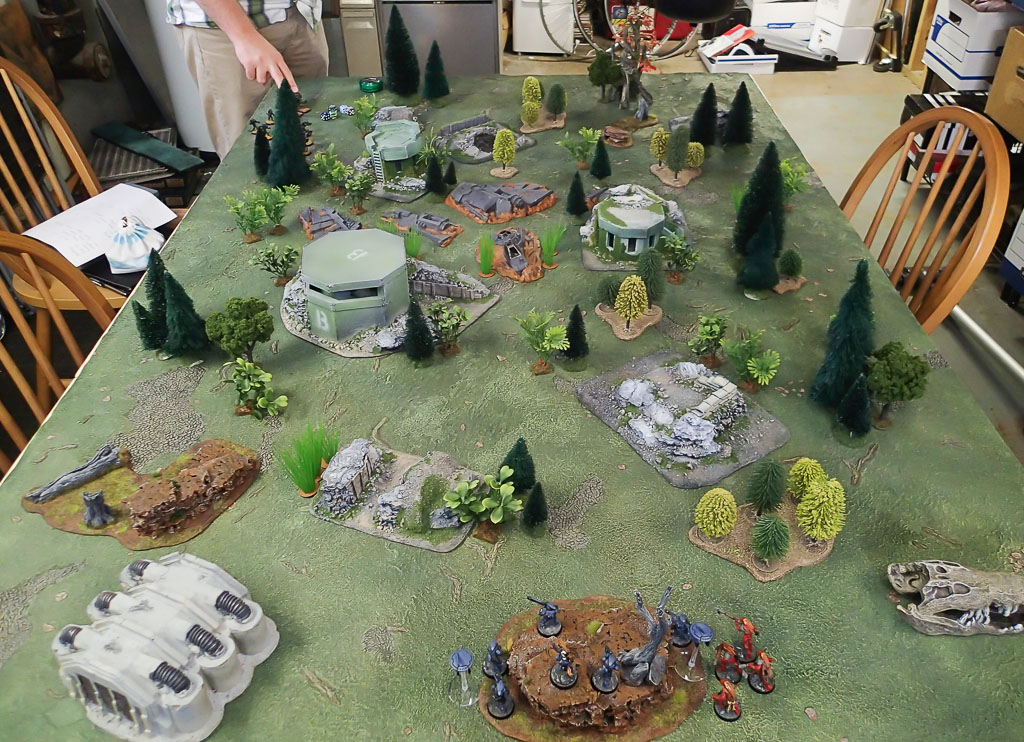
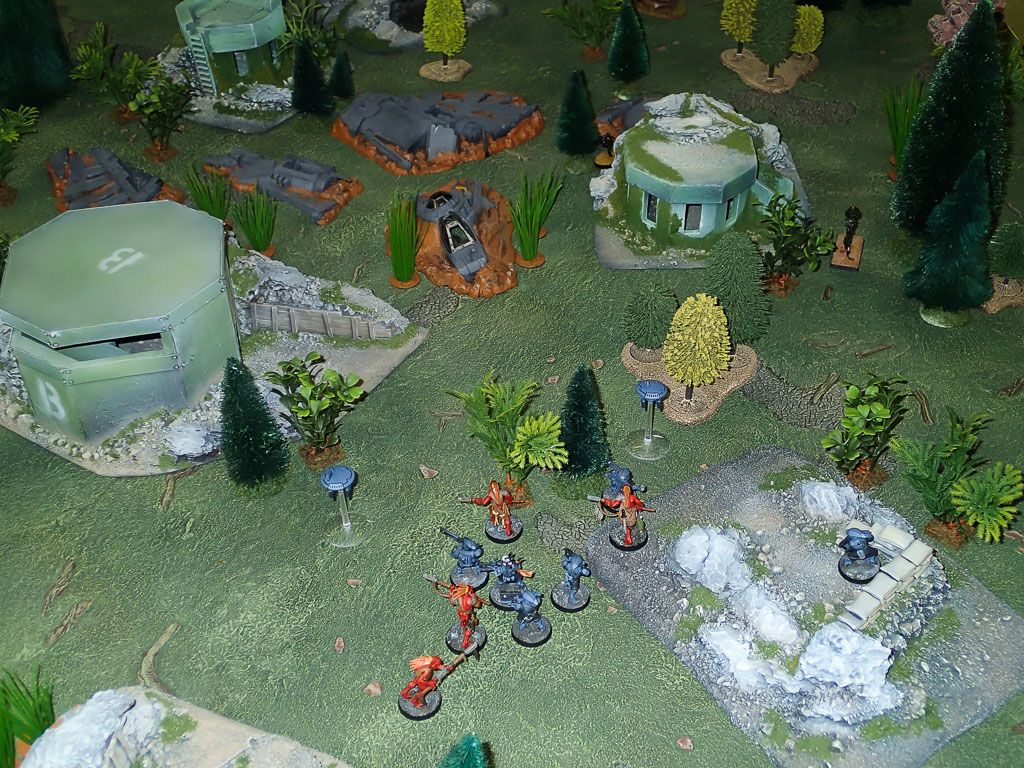
Here's the battlefield at the beginning of the game, with the crashed spaceship located near the abandoned military base. 


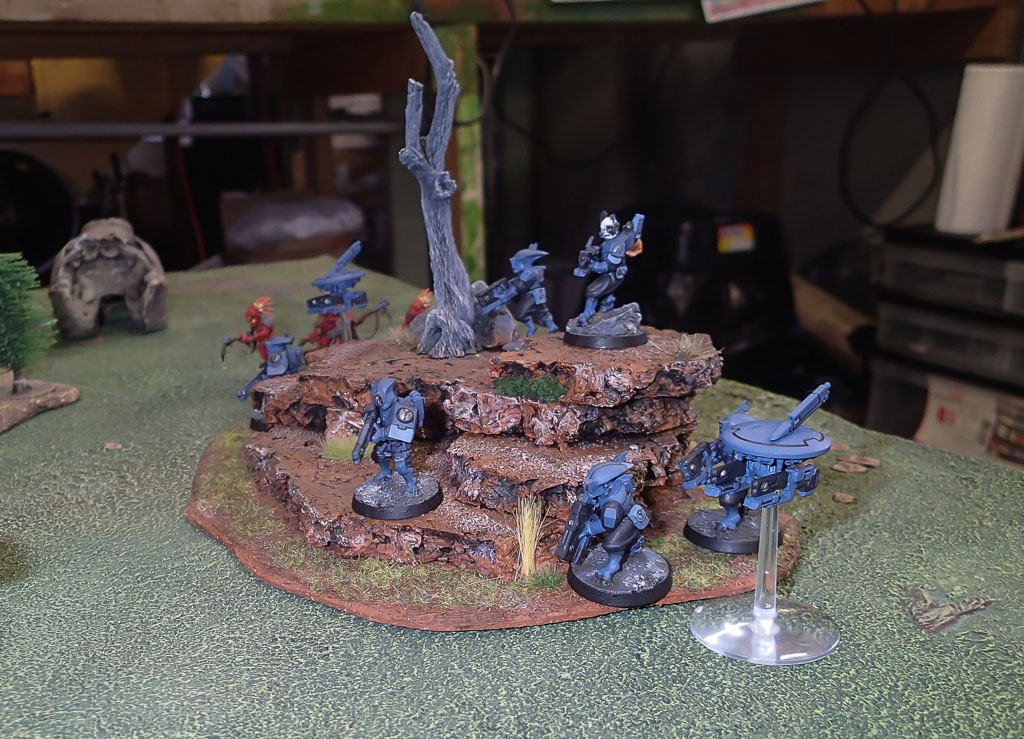
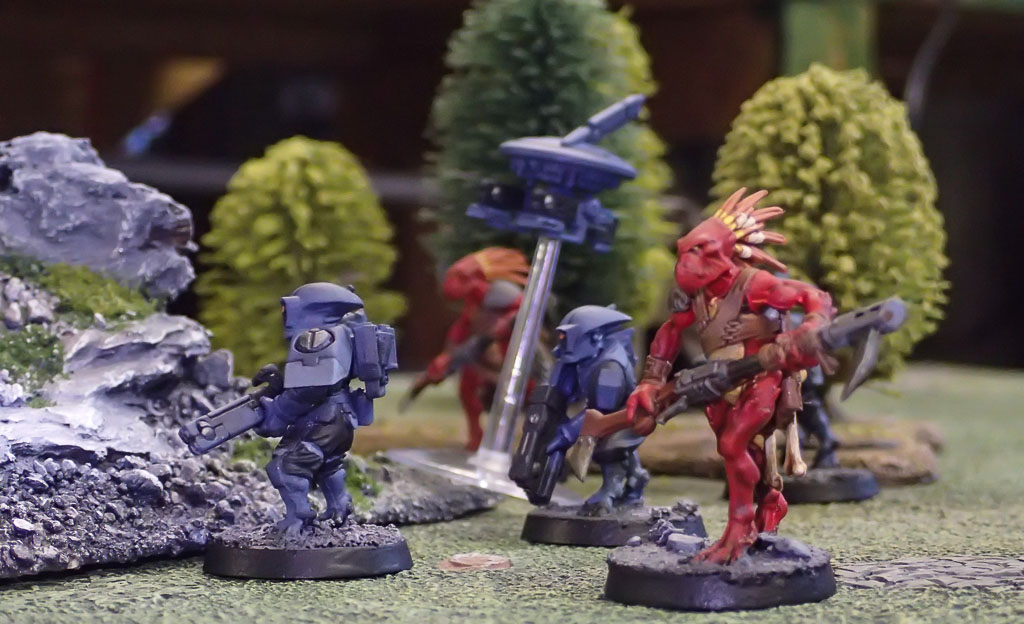
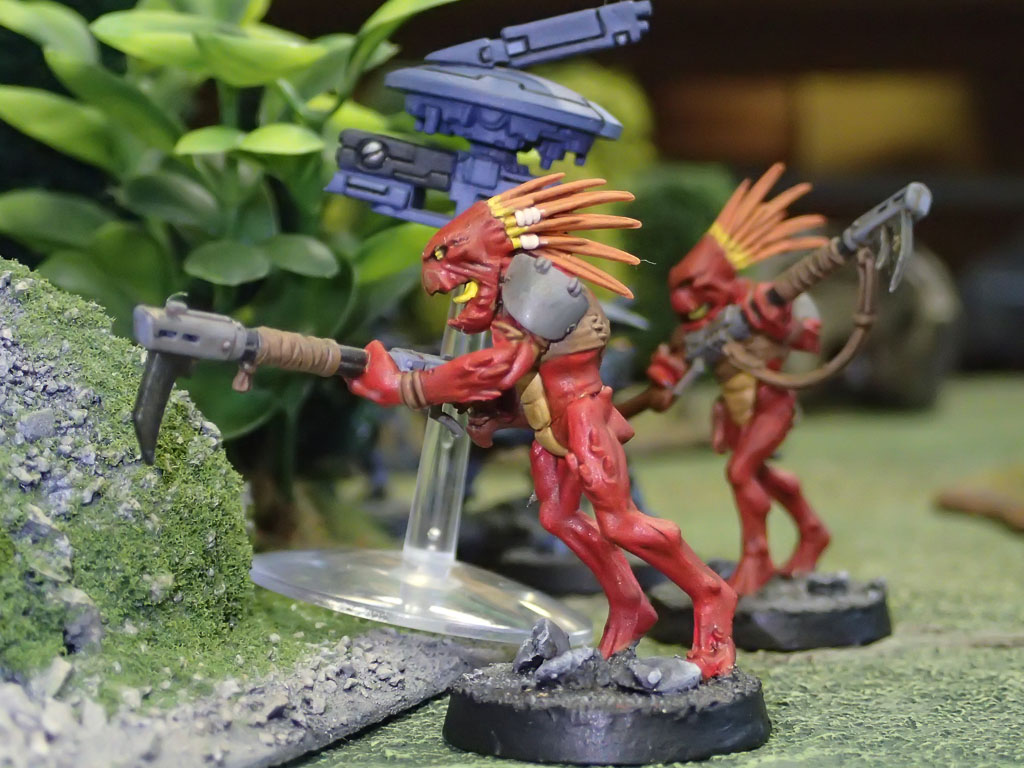
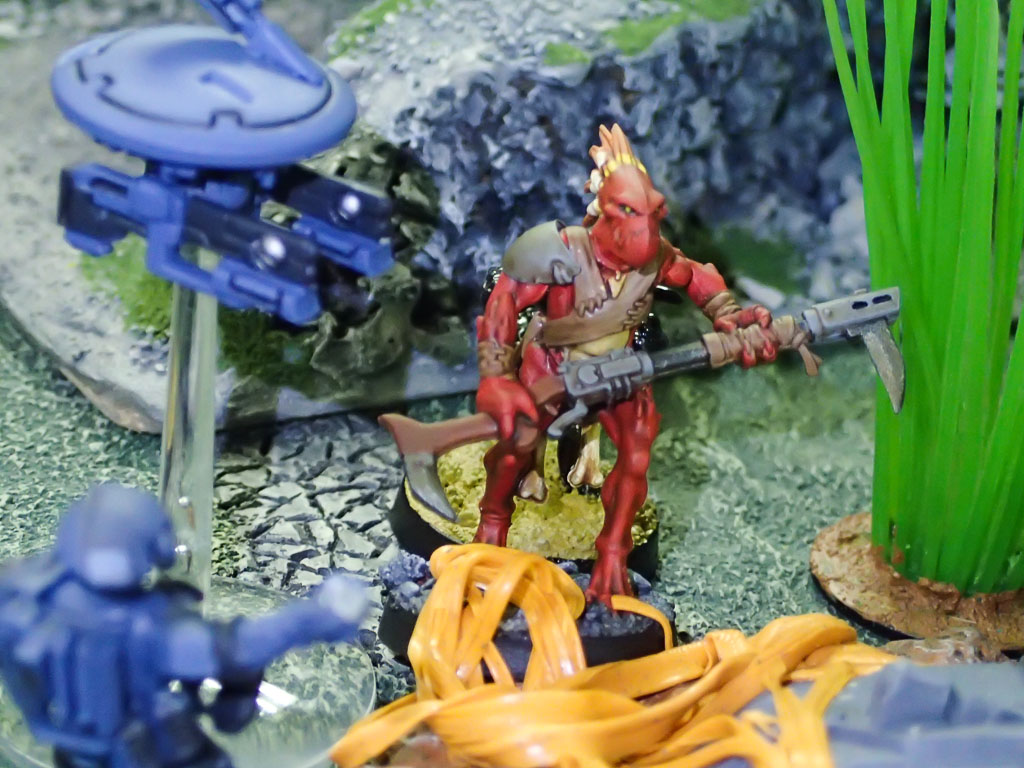
Josh's Subathi troopers (actually Tau) were joined by some Kroot warriors for this expedition. Here they are at their jumping-off point.


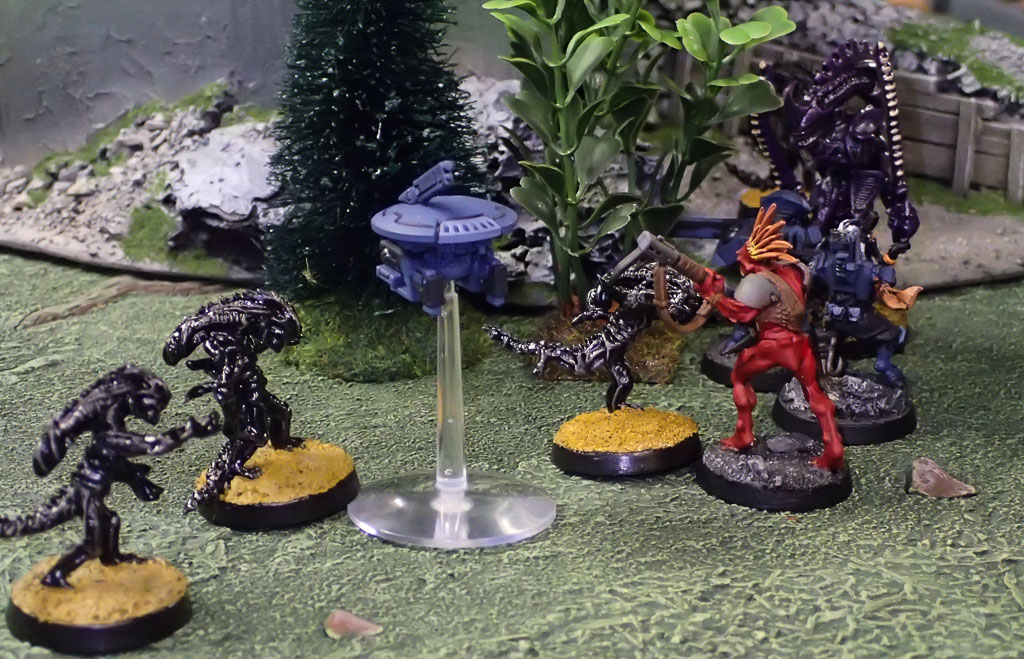
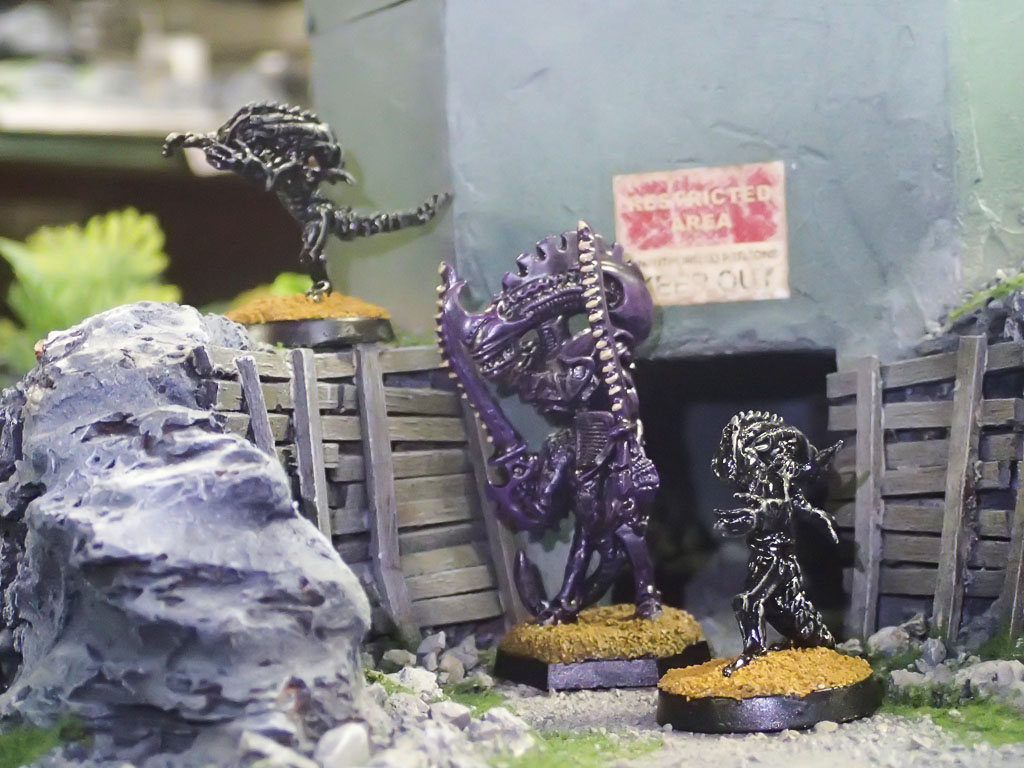
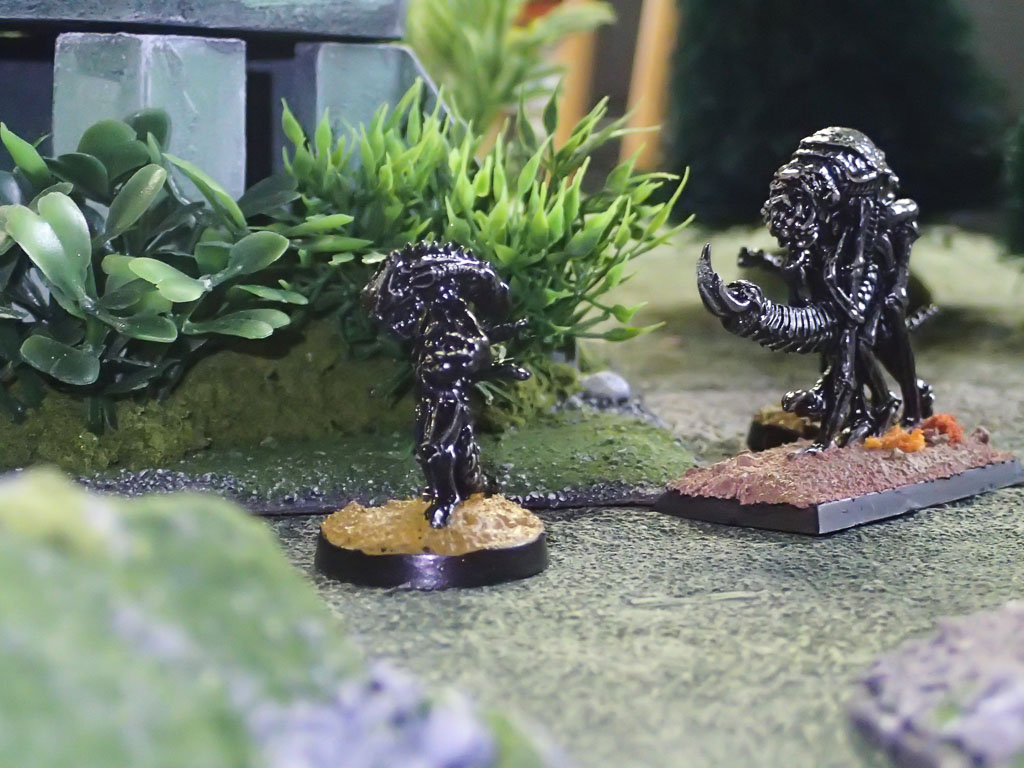
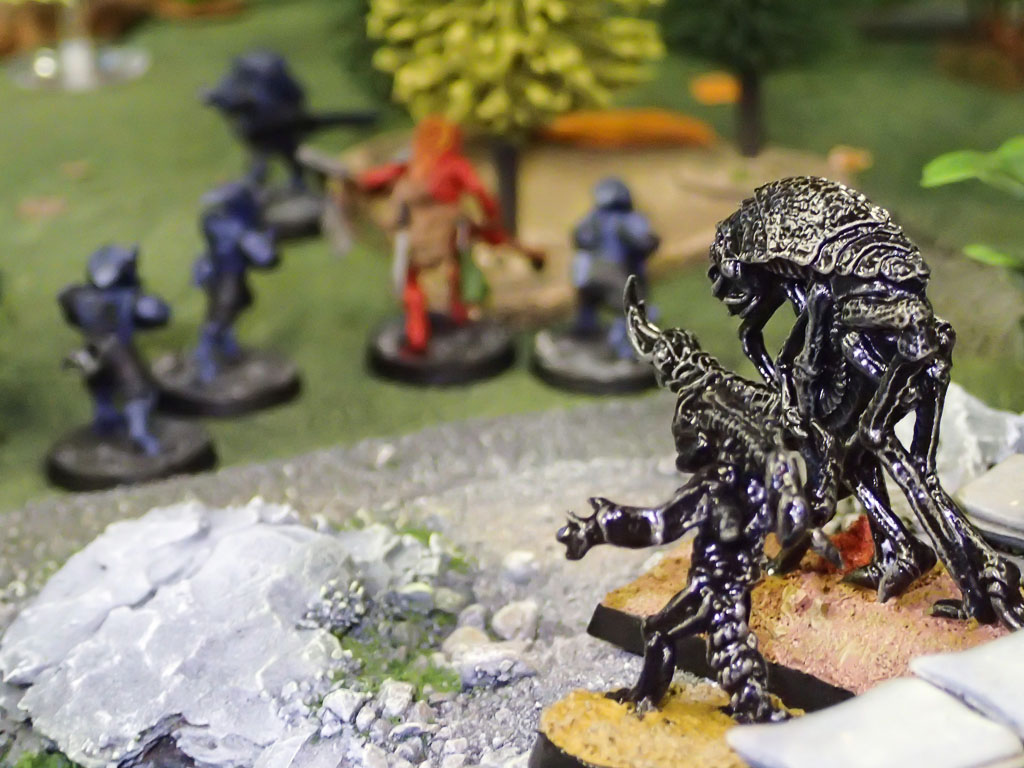
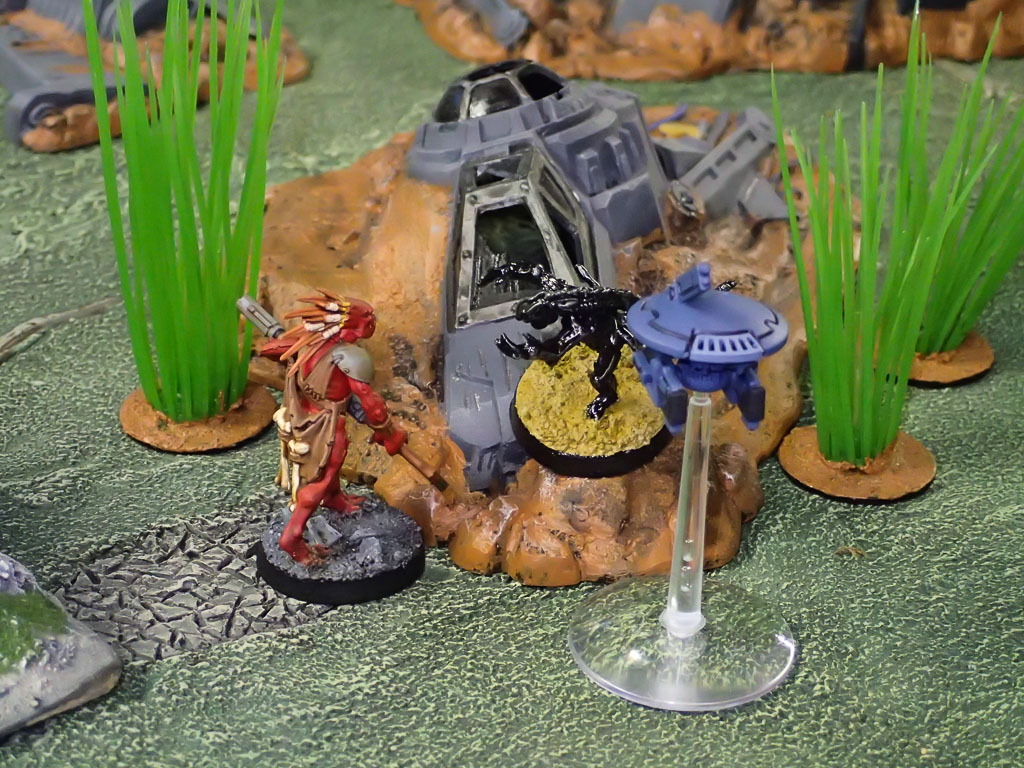
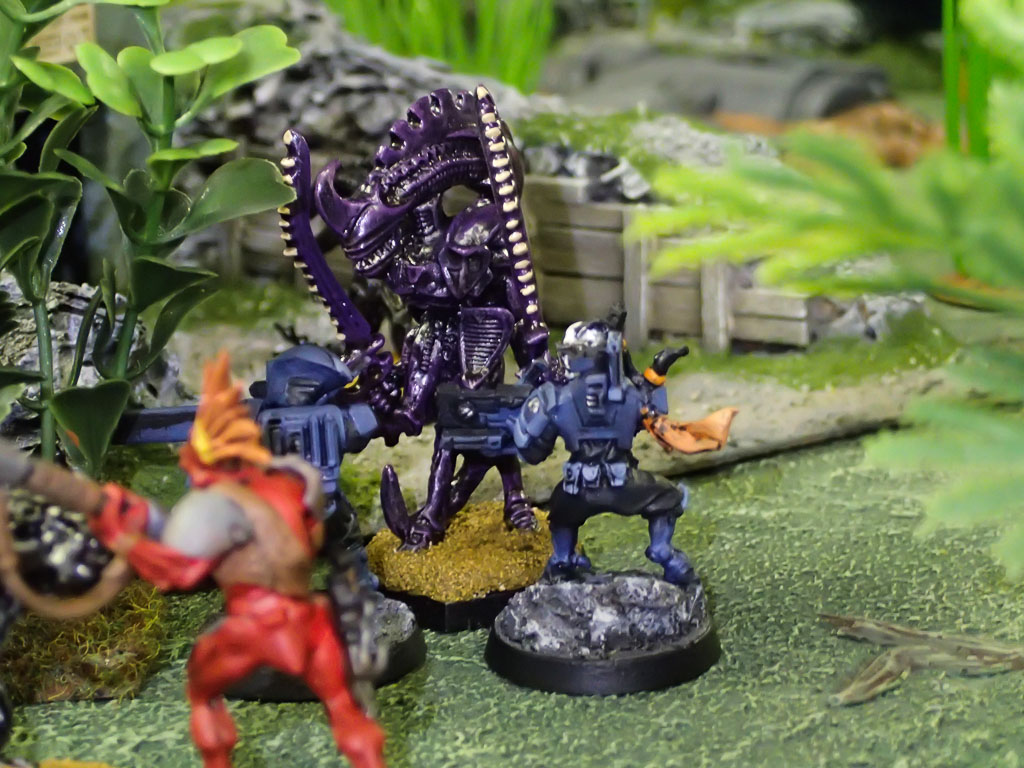
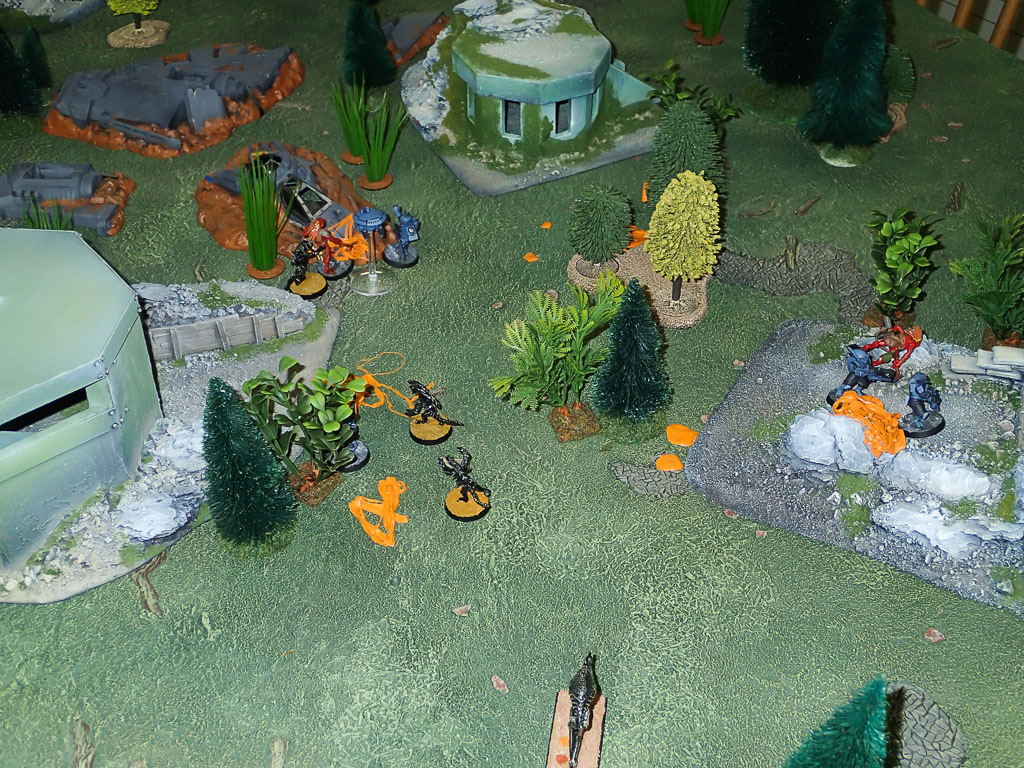
I know you're all wondering what army I put on the table to threaten Josh's advance. Maybe you guessed it from the scenario or the teaser photo up top. The truth is, Talumbach's World, at least this abandoned firebase, is infested with xenomorphs! Here's what's lurking in the ruins, waiting to feast on Subathi flesh...


The big guy in the center is from Kryomek, and the smaller xenos are from Reviresco.


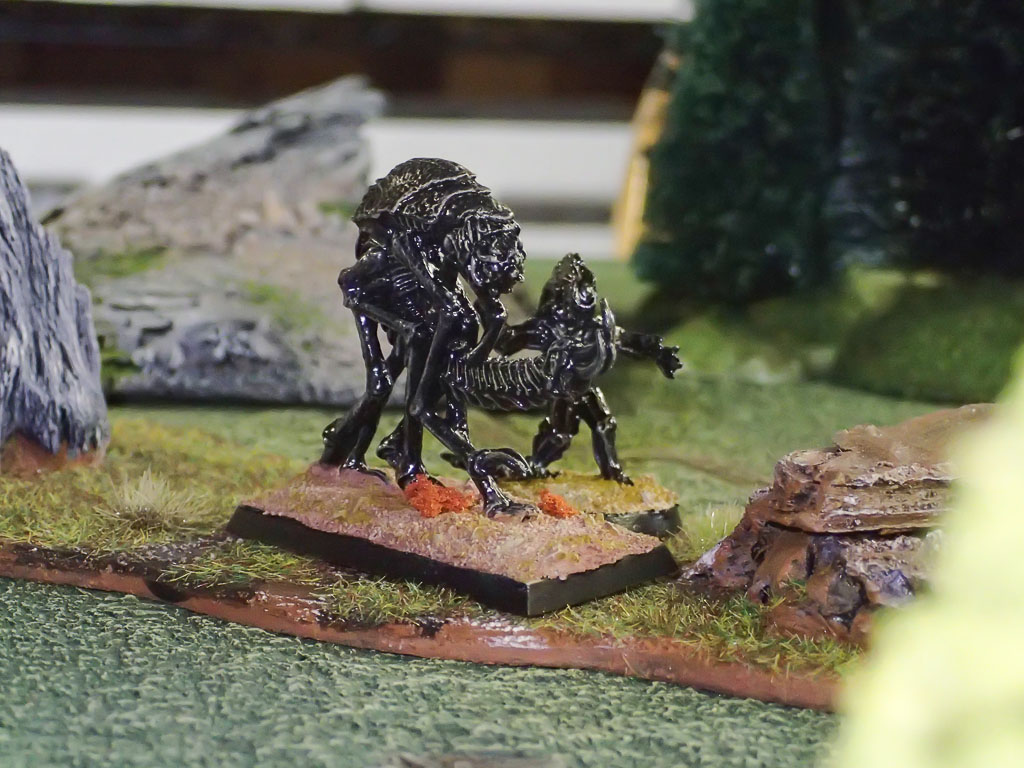
The weird bug critter is from Grenadier, alongside a Reviresco "homphage" figure.


Oh boy! Aliens everywhere!

We came up with some fun movement rules for the xenomorphs. Small groups could forfeit their activation for one turn in order to re-appear the next turn inside any terrain piece on the battlefield. Leaders were required to use this terrain-to-terrain movement, and this special rule really heightened the tension on the battlefield and kept Josh on his toes.

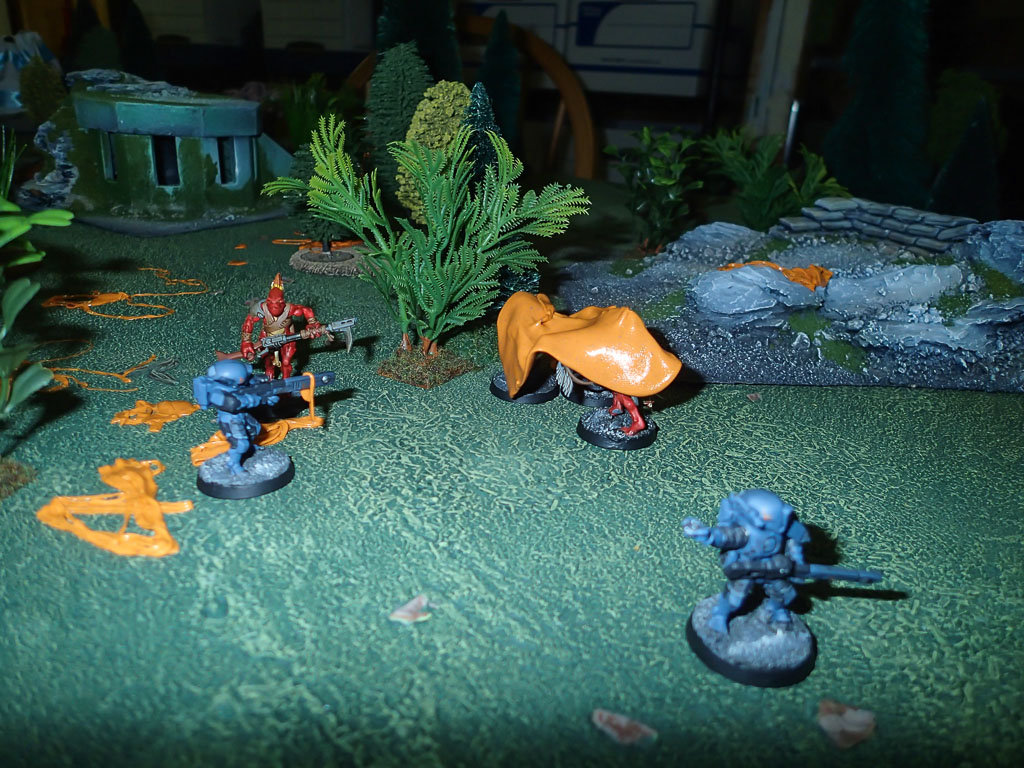
Here's his cautious advance.


I maneuvered my xenos so they were sort of encircling the crash site, ready to pounce as soon as the Subathi troops got close. They were custom-built from the ITEN rulebook to be close combat monsters. 


Finally, Josh's guys were close enough that I sprang the trap, sending my xenos rushing in from all sides to slaughter his forces.


Close combat in ITEN is fairly simple: roll to hit, then the target rolls his/her Grit stat to avoid dying. My guys had no problem whatsoever scoring hits (they are close combat monsters, after all) but Josh's Grit rolls were frustratingly successful. I was planning to kill two or three of his guys for every one of mine, but the dice were in his favor, and my guys bore the brunt of the assault.


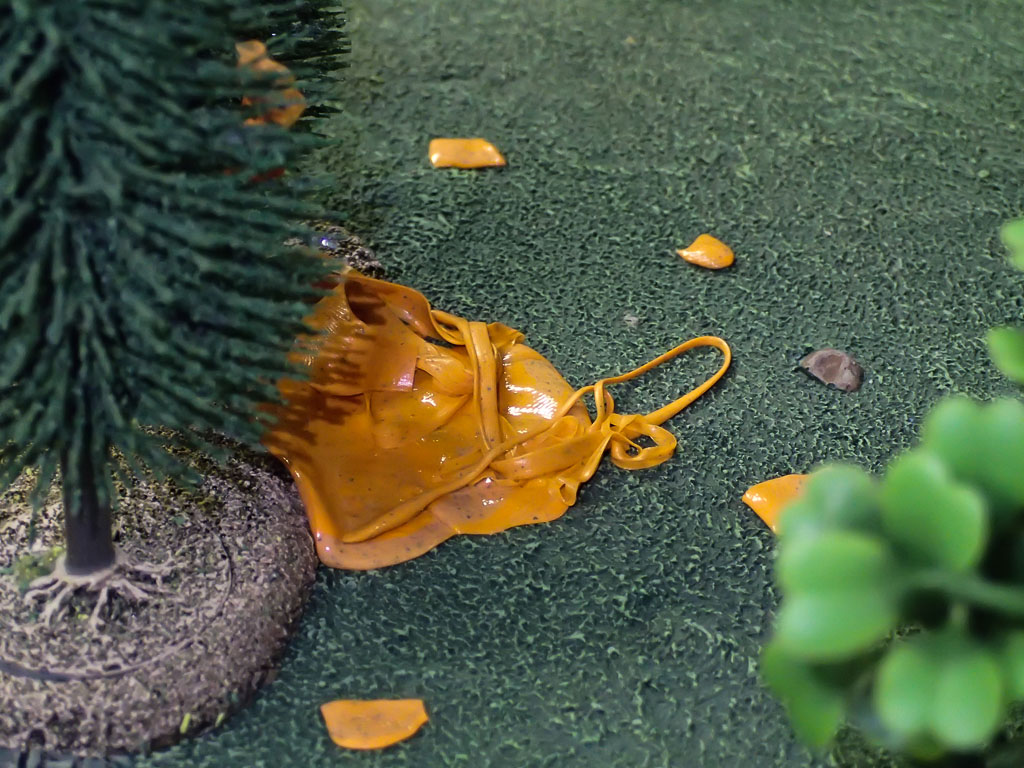
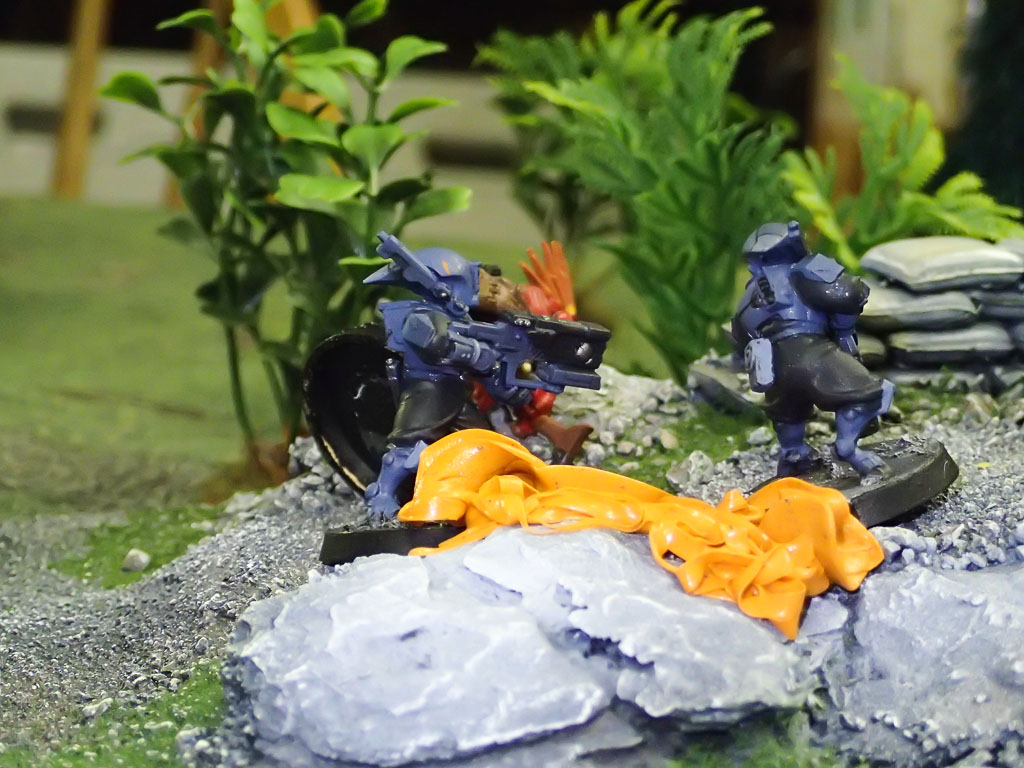
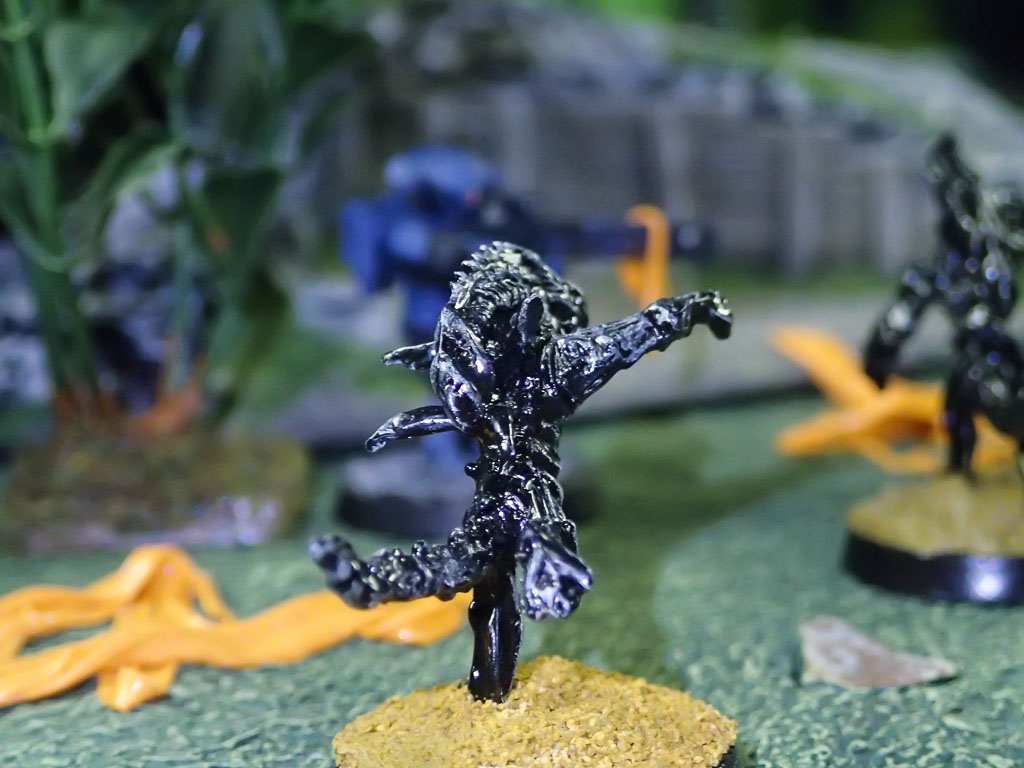
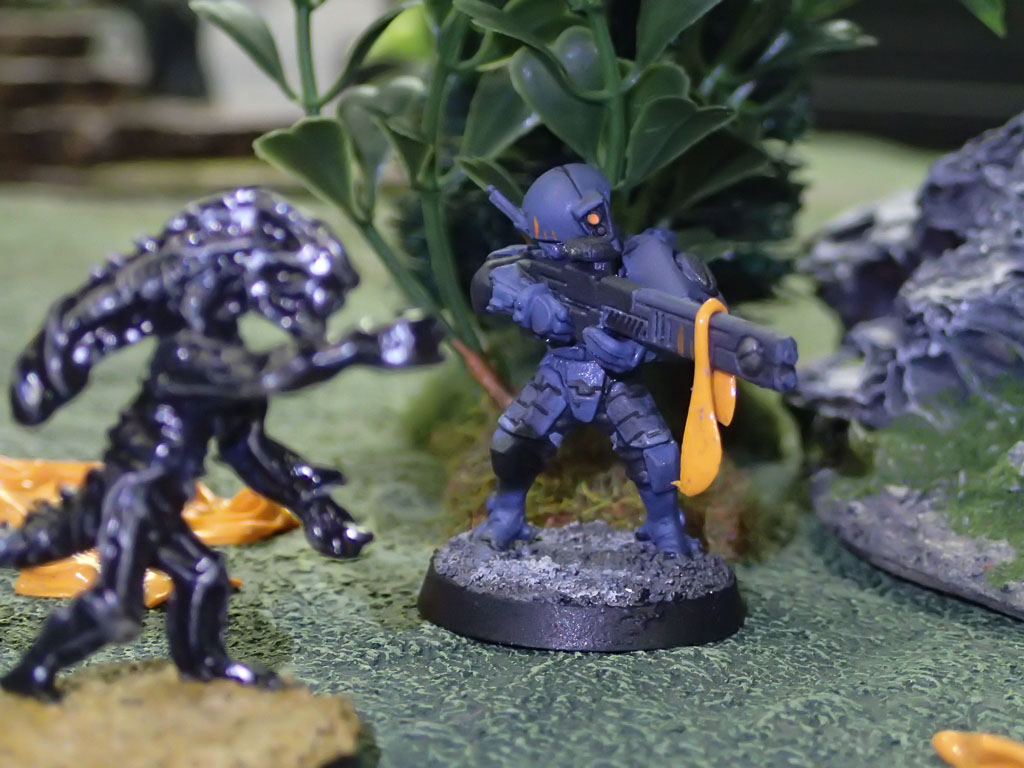
At this point in the game, we got a bit loopy. Josh had a wad of Silly Putty at the table (he uses it to mask off areas for airbrushing), so on a whim we decided to put together some gruesome battlefield effects for the dying xenos. Anyone who's ever seen Aliens knows that these guys spray giblets everywhere when they die. Here are the best shots of the carnage on Talumbach's World.


Yep, guts everywhere. I killed some of his guys, but not enough. The orange Silly Putty puddles soon outnumbered the remaining xeno warriors. Ultimately Josh was able to secure the data cores and fight his way back to the evac site. In retrospect we agreed that perhaps I should have had more xenomorphs to really make his life miserable out there. But then again, we might have run out of orange Silly Putty!


What a mess! 

Next week we'll play the first session of our summer fantasy campaign, so stay tuned for more CSW game reports!

-- Patrick, Chicago Skirmish Wargames club member

Tuesday, June 10, 2014

Sci-fi Industrial Buildings from Old Plastic Toys


Last weekend I finally got around to painting a couple of industrial terrain pieces that I had built some time ago. You can see the finished product above, along with an old 25mm chaos knight for scale. The top of his axe is about the same height as a Games Workshop Space Marine on a slotta base.

Both of these pieces started life as broken and cast-off toys I found at local resale shops. Some of the parts were made of soft plastic that required epoxy, and I even used plumbers PVC cement (truly nasty stuff) to attach the space capsule (more on this later).


The tower is some sort of a dumping toy or playset. I added a barrier to the front made from a piece of plastic scavenged off a classroom mathematics toy set. There are several versions of this kind of gridded counting aid toys, and I highly recommend picking them up when you find them at resale shops. They're great for sci-fi terrain. I also added some cross-stitch mesh to make the floor, and the bucket on the side was epoxied in place.


On the back, I added some bits of wood, toy greebles and a lamp made from a piece of plastic.


The top section is stock, and it's just full of nice places to put figures for my games. It's also wide enough to hold an entire squad for larger games. I've got plans to use it as part of an elevated terrain system I'm planning out.


The chemical plant piece is based primarily around a car launcher playset and and a toy lunar spacecraft.

 
Though Krylon's Fusion and Camo spray paints has made it easy to paint, I've still run into difficulty gluing large pieces of the soft (possibly polyethylene?) plastics that toy soldiers and others are often made of. The lunar module is made of just such a plastic. First I I tried plumbers PVC solvent adhesive to attach it to the hard plastic launcher. It is probably the harshest and worst-smelling glue/solvent I've ever useed, but it worked really well. Just be sure to use it somewhere that is well ventilated.


The vents and pipes sticking out from the side are plastic medical bits, maybe part of an IV or oxygen system. In the rear we have part of a smaller scale rocket toy stuck inside, a couple of copper elbow pipes and the drain from a contact lens case.

 
Painting was my usual speed method which I've used countless times over the years. The process gives good results in no time flat.

  • Prime black 
  • Wet/drybrush on the base colors 
  • Apply two heavy brown washes 
  • Dry brush metallic in a few places 
  • Tan dry brush all over
  • Matte varnish spray

Check back soon, as I'll be blogging about several more DIY projects this month.

-- Karl, Chicago Skirmish Wargames club member
Sunday, June 8, 2014

Grind Them to Dust: An OGAM Battle Report


Last month Karl and I got together at our regular club night for another game of Of Gods and Mortals, the game of mythological battles based on our favorite fantasy skirmish rules engine. It was my second game and Karl's first, but he was very excited to try out the game after hearing about the high marks Tim and I gave the game after our initial outing.

I only ended up with a handful of photos from the game, but we had a good time. As we did with our initial game earlier this month, we eschewed the mythological flavor and instead just built some fantasy warbands using the stock army lists in the book. We found in our first game that the game plays perfectly well as a straight-up fantasy skirmish as long as you stick to the army lists provided in the book and don't bend the rules too much.

Karl brought a warband composed of chaos warriors and cavalry led by a dragon, built using the mythological Japanese army list. I brought a dwarven warband led by a big ol' frost giant, built using the Norse pantheon in the OGAM rulebook.

Here are a few pics of our game. In the first turn, I used my giant's frost breath (or thunderbolt, depending on how you'd like to interpret the ability) to kill Karl's dragon. Since that dragon was Karl's god, he was able to summon it back to the battlefield again on his turn, using the summoning rules in the OGAM rulebook.


That was probably my last tactical victory on the battlefield that day. Karl pressed his advantage, slaughtering my infantry and legends until I had just a handful of figures left on the field.


My frost giant gave as good as he got (his lightning strike ability was particularly useful) but ultimately my depleted dwarves were routed from the battlefield. Here is their final stand.


We discussed the game afterward and agreed that gives a very playable "big skirmish" experience that really bridges the gap between Song of Blades & Heroes (designed for 6-12 figures) and Kings of War (designed for 40+ figures). We're very keen on using OGAM to play out some larger-scale battles in our upcoming summer fantasy campaign, so stay tuned!

-- Pat, Chicago Skirmish Wargames club member
Thursday, May 15, 2014

Oxiddon Alpha: A Troubled World on the Galactic Frontier

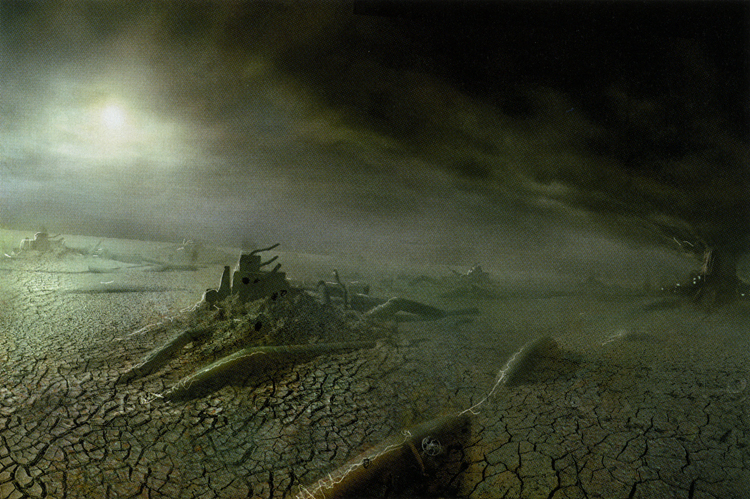
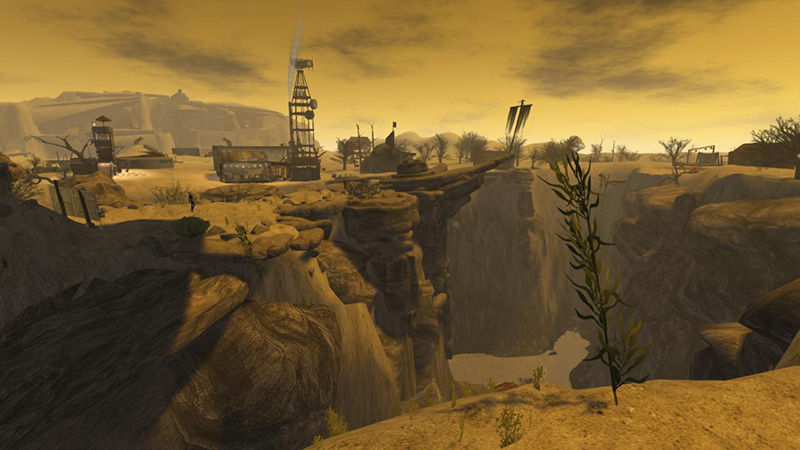
Nearly a century ago, Terran survey teams declared Oxiddon Alpha -- the lone planet in the Oxiddon system -- uninhabitable and unfit for human settlement. A marker satellite was placed in orbit, the survey details were recorded in the archives, and the teams moved on. Nonetheless, the discovery of massive mineral deposits 57 years later led to the Maersk-Tesla corporation's successful bid to be the lead agency for resource development. In exchange for a 60-year renewable contract for exclusive mineral extraction rights, the conglomerate corporation was tasked with terraforming of the planet for later human colonization.

Eager to exploit this new source of material, Maersk-Tesla hastily agreed -- though terraforming would prove to be low on the corporation's agenda. Thus, they were only too happy to let University of Noonien Professor Xian Peterson use the planet as a testbed for his own experimental techniques.


The terraforming of Oxiddon Alpha would take 45 years, and Xian would pass away before seeing the results of his labor, but in the meantime the colonization would far outpace the speed of terraforming. Mineral deposits on Oxiddon Alpha were greater than anyone had predicted, but the process of terraforming -- now watched with great interest by various politically connected educational institutions -- meant that the planet could not simply be strip-mined away or fracked into submission.

The mines themselves stretched for miles underground, with periodic above-ground facilities to extract and process the mineral wealth. Growth brought manufacturing to Oxiddon Alpha. Mining domes could not expand outward for fear of damaging the delicate terraforming process, so they expanded upward.


The Birth of the Bridge Cities 

As a result of this growth, mining domes that averaged only two miles in diameter became towering cities reaching high into the sky. Fueled by a seemingly endless flow of credits and in the spirit of friendly competition, these cities were more than functional sealed towers of living. The "city managers" -- each wishing to be more awe inspiring than their neighbor -- commissioned the galaxy's finest architects to make the cities a marvel inside and out.

To connect these cities, great sealed bridges, often stretching dozens -- or in a few cases hundreds -- of miles long were constructed. And thus were born the Bridge Cities. Some areas of the planet, too remote to be connected by bridges, would remain small mining outposts, and other less mineral rich regions would remain undeveloped. On the resource rich continent of Sealand Major, it took human settlers built less than four decades to develop beautiful spires, towers and cityscapes across the landscape, all connected by immense carbon-fiber bridges.


The last of the Bridge Cities was completed a decade before the terraforming effort was finished. It was nearly two generations since landfall, and the Bridge Cities had developed without any real confidence that terraformation would be successful. These self-sufficient spires contained everything that a population would need and almost as much as they could want.


Before terraforming was complete, the bridge cities decided on a radical course of action. Within a decade, they knew, a massive influx of colonists would arrive on Oxiddon Alpha. To head off this potentially imbalancing threat, the Bridge Cities declared themselves the "independent and contiguous nation of Uberbrucken." Terran authorities quickly granted a charter and a new kind of nation was born on less than 800 square miles (not counting bridge supports) of actual land occupied by the Bridge Cities.

One Planet, Two Worlds
A decade after the completion of the last Bridge City, Oxiddon Alpha was reborn. Unblemished by pollution from the self-contained Bridge Cities, the planet was ripe for colonization, soon developing into a thriving breadbasket for the Galactic Frontier.

The colonists set about establishing their egalitarian settlements around the newly formed nation of Tenuta. Uberbrucken, on the other hand, kept to the more corporate and top-down methods that had served them well for decades. Though there were many opportunities for trade, Uberbrucken's governing board decided instead that a nearly complete embargo on contact with the settlers would best preserve their way of life.

And so, these two nations remained, both more geographically intertwined and yet more culturally separate than perhaps any two nations in human history.

The Bridger-Broadlander Wars 
No side has been quite willing to take responsibility for the conflict known as the Bridger-Broadlander wars, but the results are well known. Some 85 years after terraforming wrapped up on Oxiddon Alpha, Uberbrucken and Tenuta existed peacefully, but with little contact besides the most minimal levels of diplomatic communication.

In the late planting cycle of 2406, the sleeping citizens in the Tentua settlement of Brinsk awoke to the sound of the ground beneath their feet splitting open. A minute later, the entire settlement was swallowed up in a giant man-made sinkhole, created by over-mining on the part of the Bridge City megacorporations. There were no survivors.

 
Outcry was swift and loud, but tempers were restrained as representatives of Uberbruken and Tenuta quickly entered into intensive discussions. An agreement regarding reparations had almost been reached when the second sinkhole collapsed part of the city of Hondon, which sits between the Bridge Cities of Parvassa and Inverness. Affecting only a small outlying neighborhood, it was not the tragedy that Brinsk was, but it set off alarm bells as leaders in both factions realized the continent could be riddled with potential sinkholes.

Indeed, secret documents showed that fully two-thirds of the populated areas of Sealand Major lived within a mile of a potential sinkhole, and several major Tenutan cities were located directly over such danger zones. The Bridge Cities, of course, bore no such risk, located as they were far from the mining operations that sprawled across the planet.

One morning in 2406, an extremist Tenutan faction struck at the Bridge City of Uman. After gaining entry to the city, suicide bombers with tactical nuclear devices detonated themselves at key support structures throughout. Its structural integrity compromised, the miles-tall city commenced a slow-motion implosion and collapse over the course of several hours. Thousands died, and Uman's death throes dislodged the bridges tethering it to its sister cities.


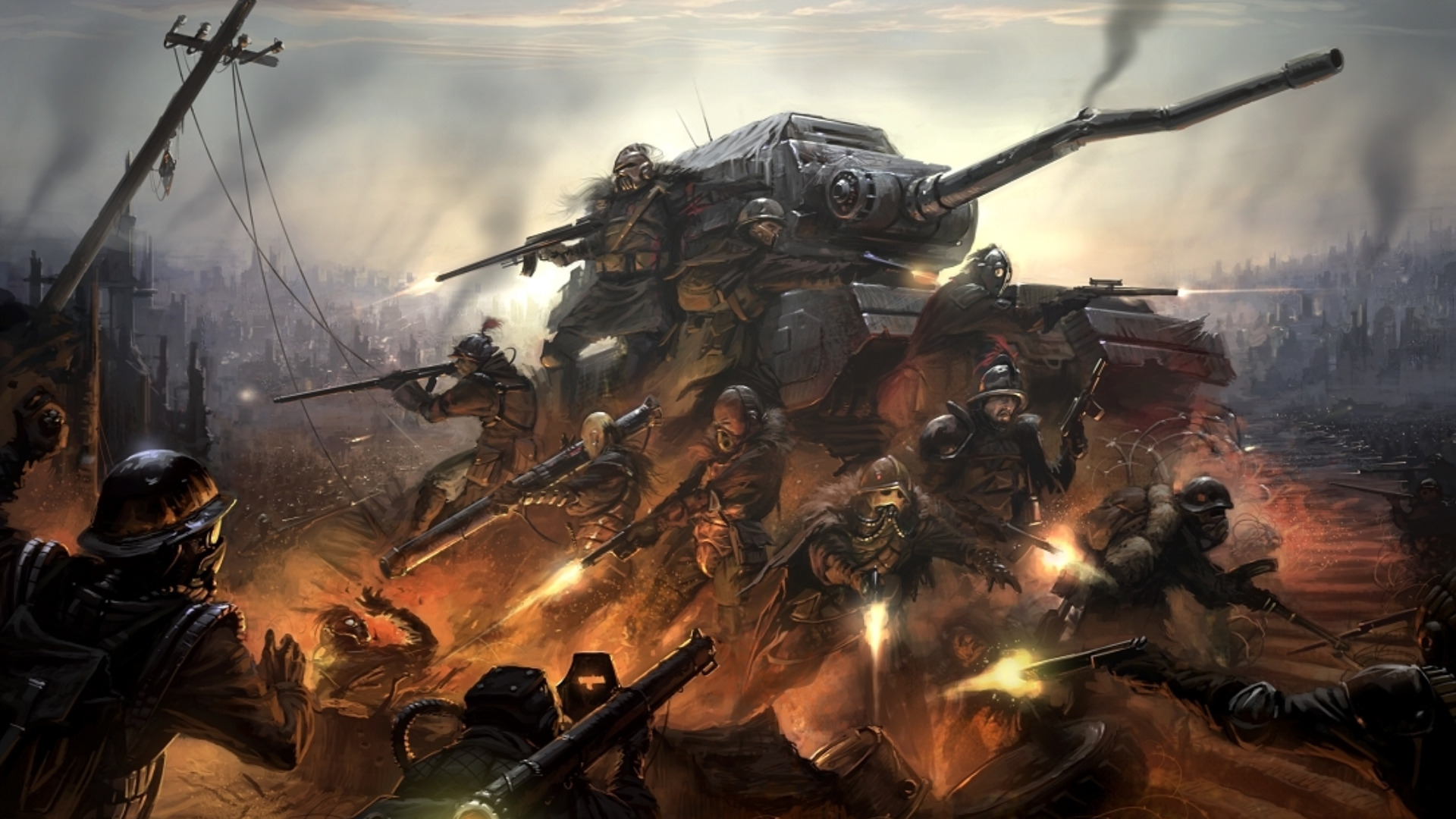
The first Bridge City to fall would not be the last. Within days, Maersk-Tesla corporate marines were fighting pitched battles with Khiff mercenary brigades hired by the Tenutans and possibly funded by other corporations. The bloodshed increased as more Bridger cities fell...one, three, then dozens.

  
Uberbruken retaliated by deliberately collapsing the underground mines beneath Tenutan military bases ... many of which were located near settlements and cities. The conflict might have torn the planet apart, but Oxiddon Alpha was too important for Terran Authorities to abandon. After eight months of fighting and the loss of hundreds of thousands of lives, it took only Terran threats of sanctions against Maersk-Tesla to bring an immediate withdrawal of nearly all fighting forces.

In a Terran sponsored deal, Uberbruken paid for the relocation and resettlement for almost the entire non-Bridger population, as well as grants and low-interest financing for additional development. Maersk-Tesla also ceded the rights to mining on the other continents, though this was not seen as a notable penalty since it is Sealand Major where the richest resources were -- and still are -- located.

Since then, the new colonies elsewhere on Oxxidon Alpha have maintained a unified identity and government known as New Tenuta.

The Remnant
Despite the destruction of their entire society, and instability of a land where underground mining is now conducted with no concern for above-ground dwellers, a few Old Tenutans refused relocation. Known to themselves as "Broadlanders" or "The Remnant," they chose to stay.

Their lives are best described as pastoral, or even primitive. Uberbruken currently maintains a complete embargo on communication and transit on Sealand Major. The Broadlanders thus scavenge leftover equipment and technology from the war-torn former Tenutan settlements or collapsed Bridge Cities.

 
The Remnant inclues hardy settlers who have banded together to stake out land claims and work out their living on vast plots of still-virgin farmland, along with bands of marauders who pillage across the continent preying on the weak. Nomads scavenge the wastes and the fallen Bridge Cities and trade their finds all over Sealand Major.

All these groups live our their lives in the sometimes anarchic and often apocalyptic Broadlands. Despite the deprivation and constant possibilities of new sinkholes, it is a vibrant place with danger and opportunity present in equal measure.


As long as they stay in the Broadlands, Uberbruken takes little notice or responsibility for these peoples. They will not aid the needy, nor will they punish evil deeds so long as they occur out of view of Uberbruken citizens. It is essential that Uberbruken people not disturbed by the Broadlanders, so atrocities (or other potentially aggressive acts) committed within sight of a Bridge City will result in swift justice from an Uberbruken Enforcement Team.

The Gates
There is an exception to the odd sort of of paternal neglect that has risen up between the Uberbruken population and the Broadlanders. Every Bridge City has a clearly marked portal at its base. These "gates" are always open to any Broadlander -- in fact, the bridge cities will respond with surprising force to any attempt to block access to the Gates. It is perhaps the only truly shared and universal agreement of New Tenutan, Bridger and Broadlander law that any Broadlander has the right to enter a Bridge City.


Upon entrance, they will immediately receive full medical attention (if necessary) as well as interviews and possible interrogation. They will then be relocated to anywhere Tenutans have been resettled, usually being reunited with existing family if possible. A select are offered a place within the Maersk-Tesla Corporation. W

Wherever they end up however, it is an inflexible rule that once a Broadlander enters the gates, they leave the Broadlands forever. It is commonplace for orphans and the very ill to make use of these portals, as they are often a literal gateway to a new life.


However criminals, and those with a price on their heads may also attempt to make use of the gates as well. If a refugee Broadlander with a criminal record enters a gate, he may be sentenced to a period of time in the Terran Penal Legions, or may be exiled forever into the windswept wastes, their gate privileges revoked forever. In this way, the Broadlands act as a sort of open-air prison for the planet's worst offenders.

-- Karl, Chicago Skirmish Wargames club member