I've completed the seven buildings made from modified Dust Tactics Warzone Tenement kits that I showcased in a previous post. I tried a number of different painting ideas with these, so be sure to let me know what you think in the comments section below.
Building 1 - Boarded-Up Building
I built this one with no interior access. The printed card flooring pieces that are included in each kit were used to cover the windows and doors.
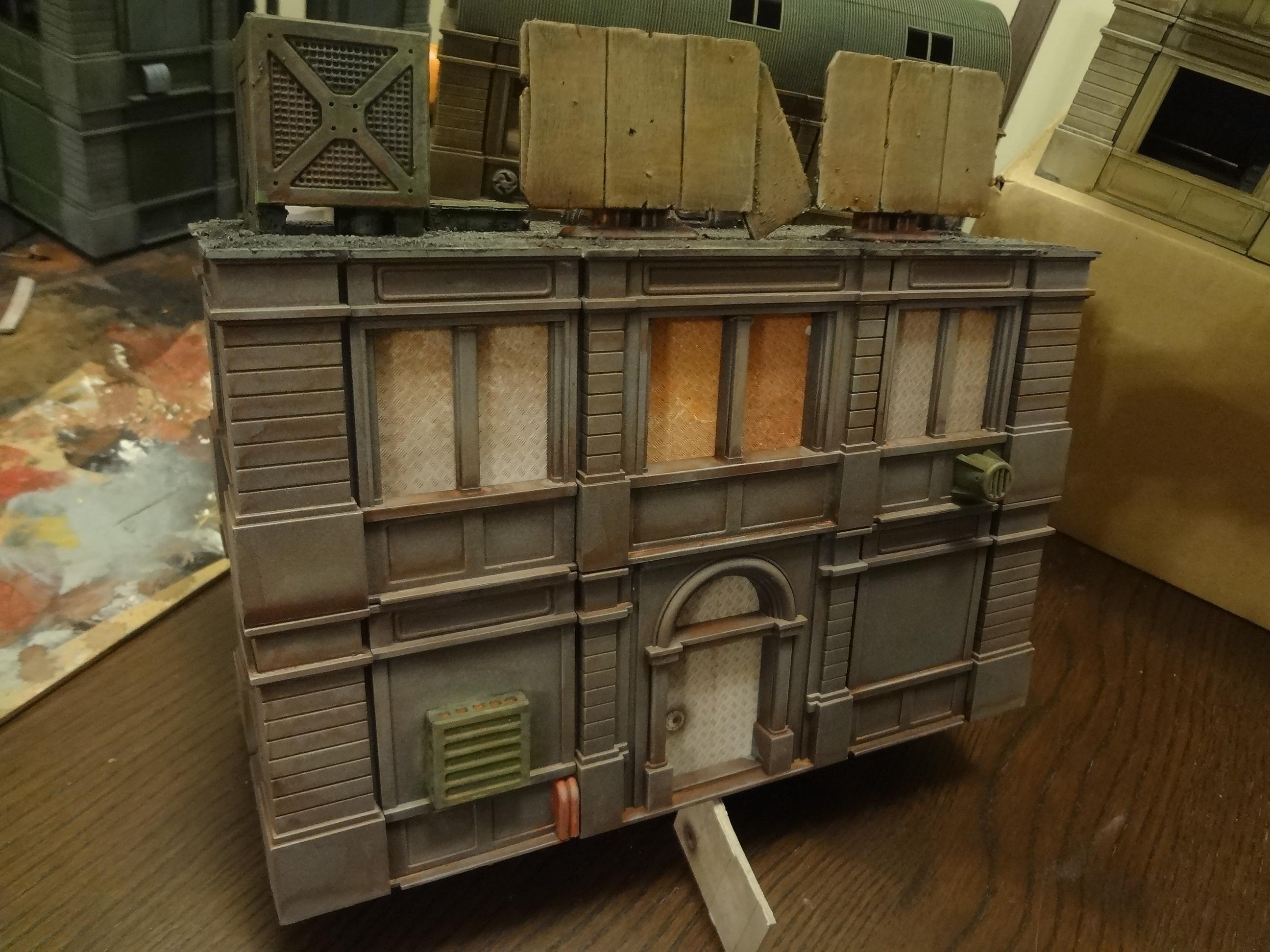
The recessed rear entrance was made by cutting apart the interior brick corner pieces.
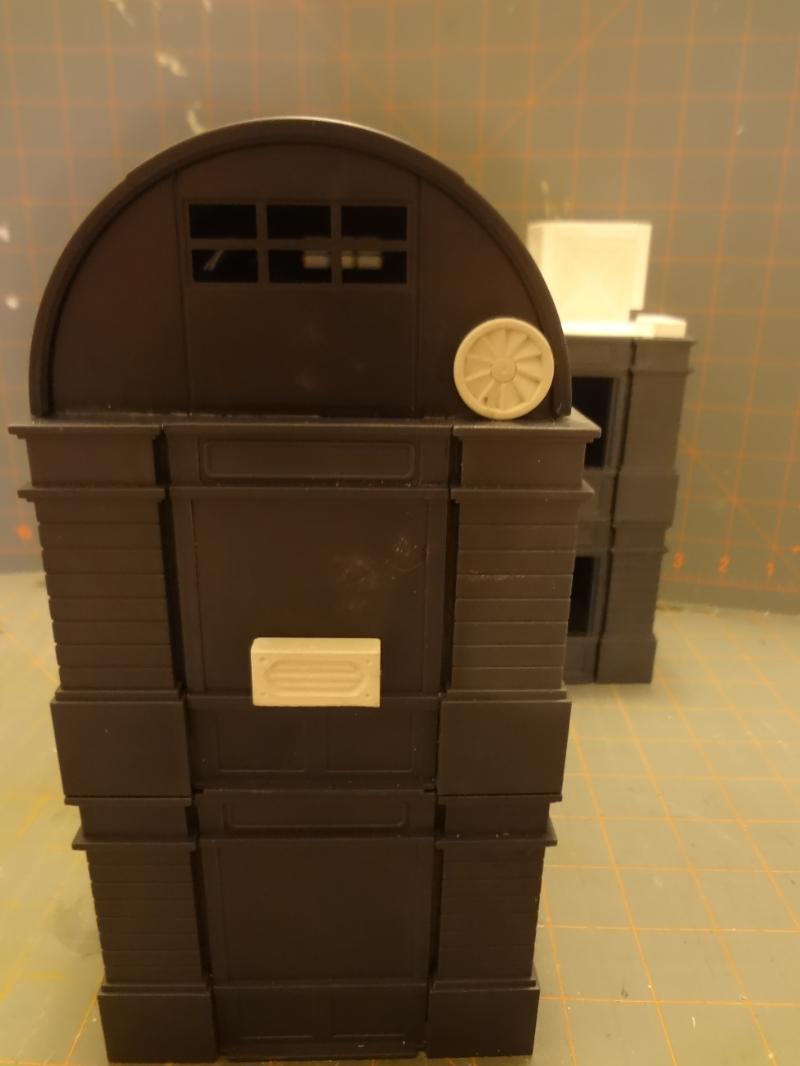
I added various greebles and used my typical gravel-and-tar-style roofing texture. The a/c unit is built from Hirst Arts blocks.
Building 2 - Small Apartment Block
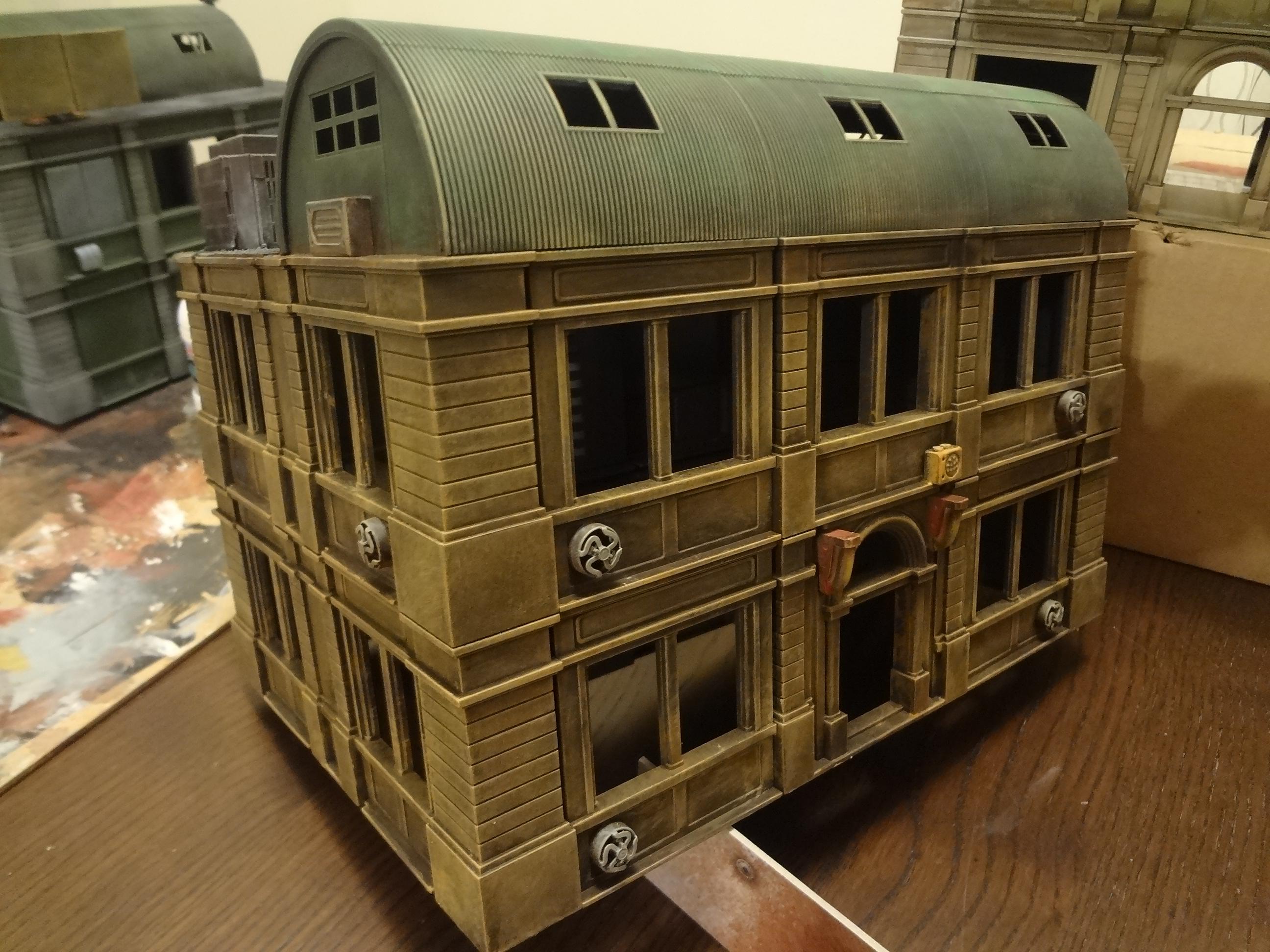
Here's a similiar building. On this one, however, I experimented with brush-dipping the building using Minwax Polyshades Tudor. It's the only one painted this way, and the results are fine, but this method increased the drying time, which is annoying, and the difference isn't enough to replace my usual washes.
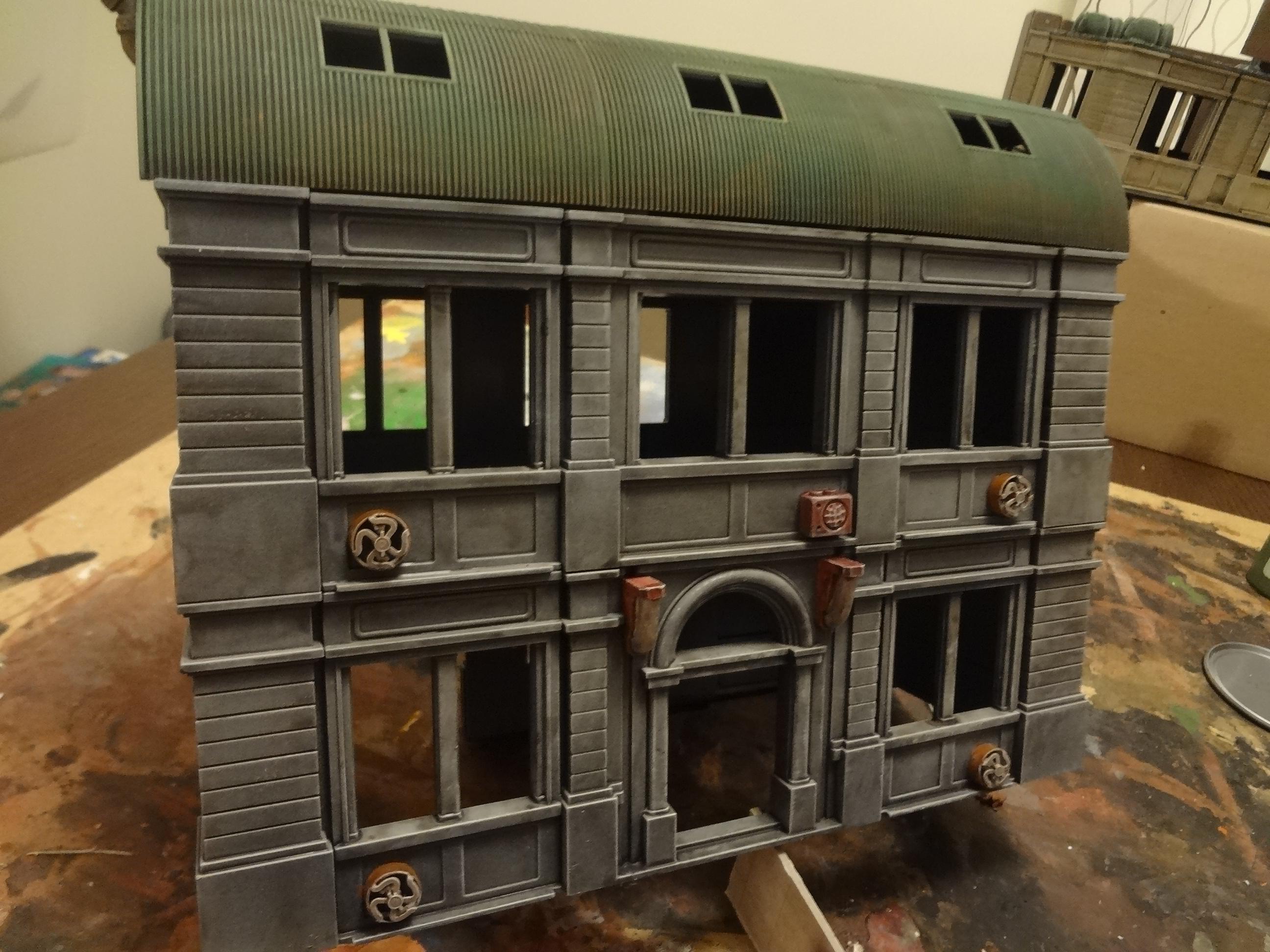
The roof is made from Dust Tactics Quonset Huts and removes for interior access.
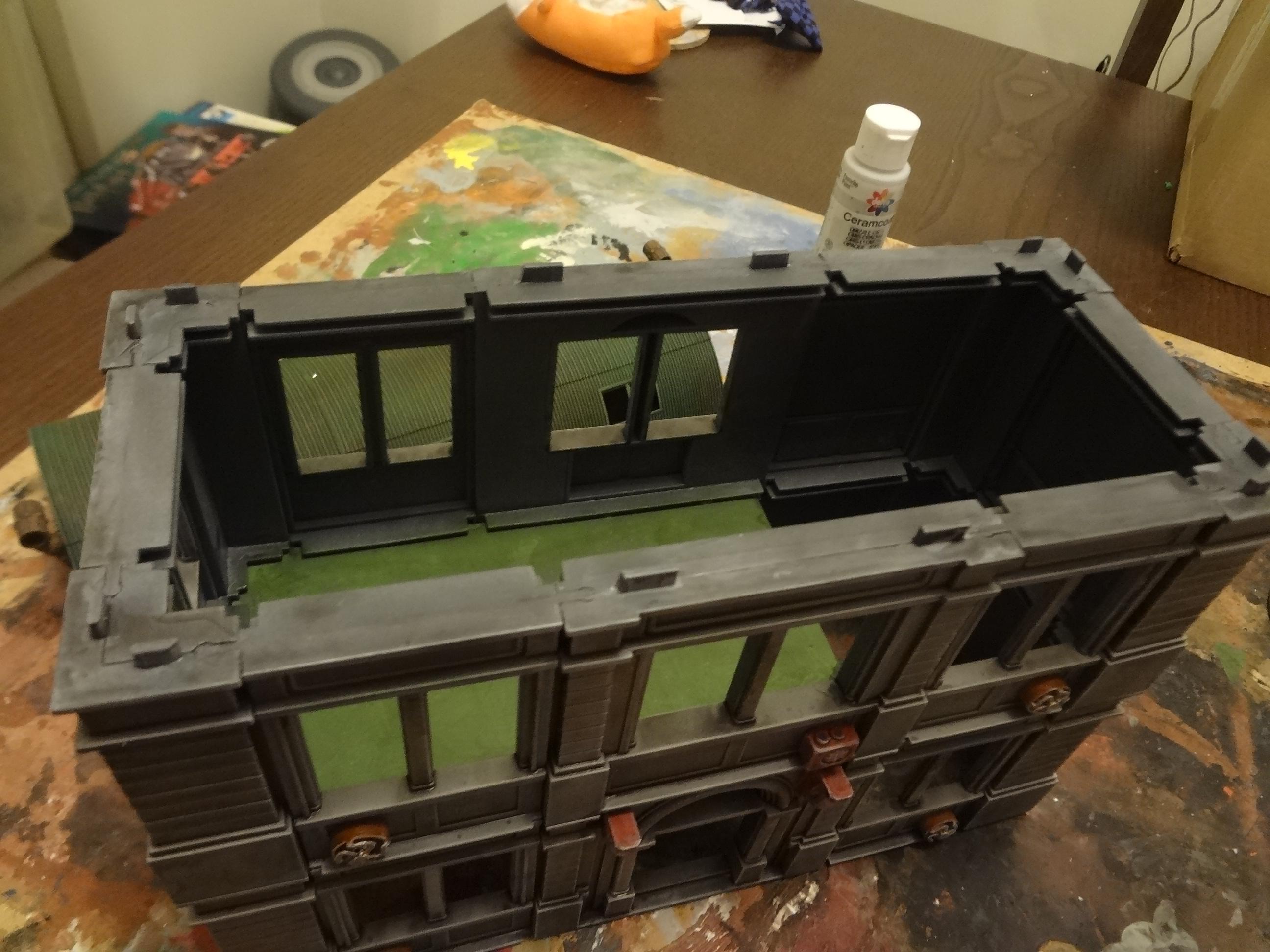
Here's the rear view.
Building 3 - Medium Apartment Block
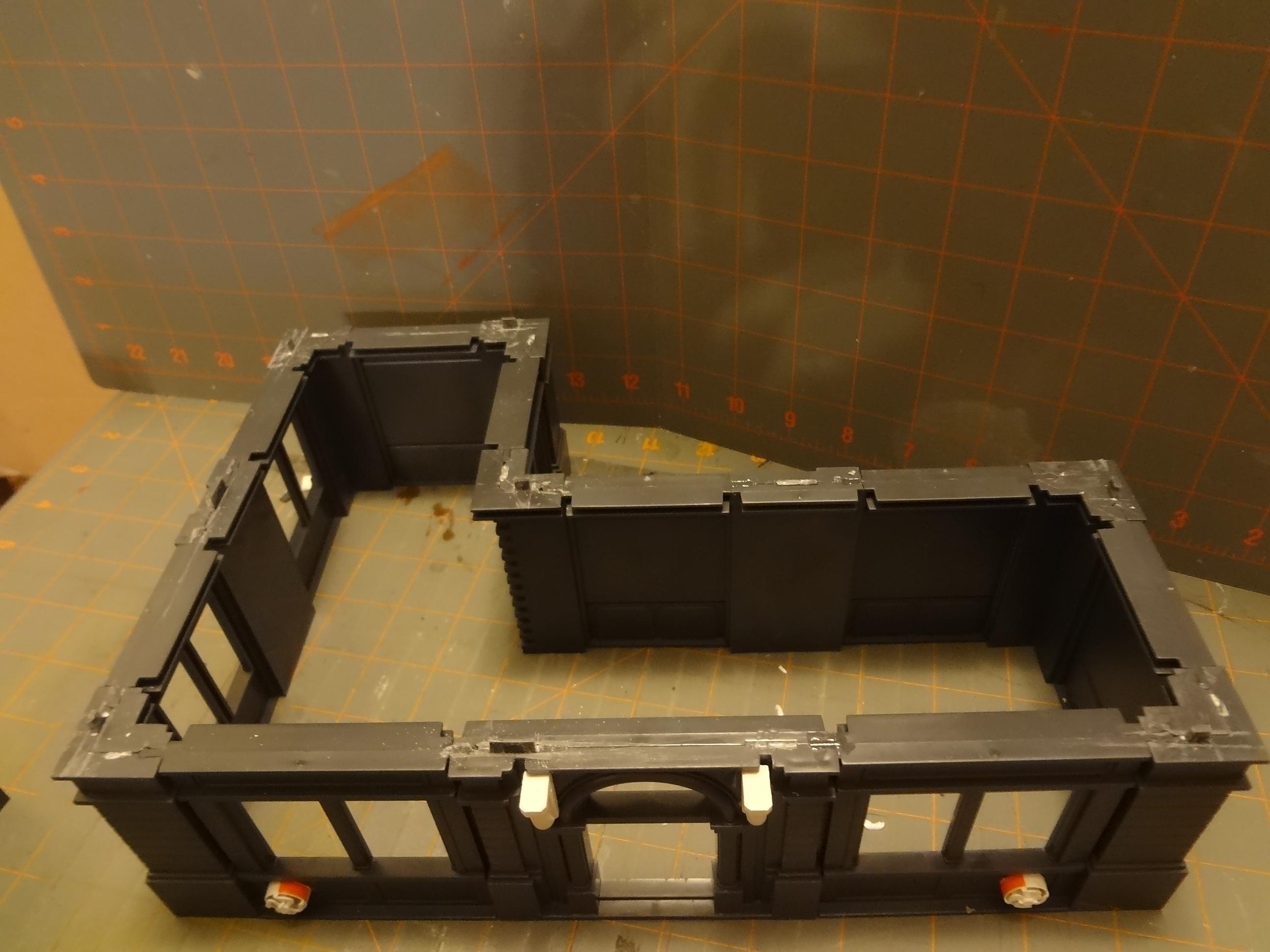
L-shaped buildings are a great way to increase the amount and direction of cover that a building offers.
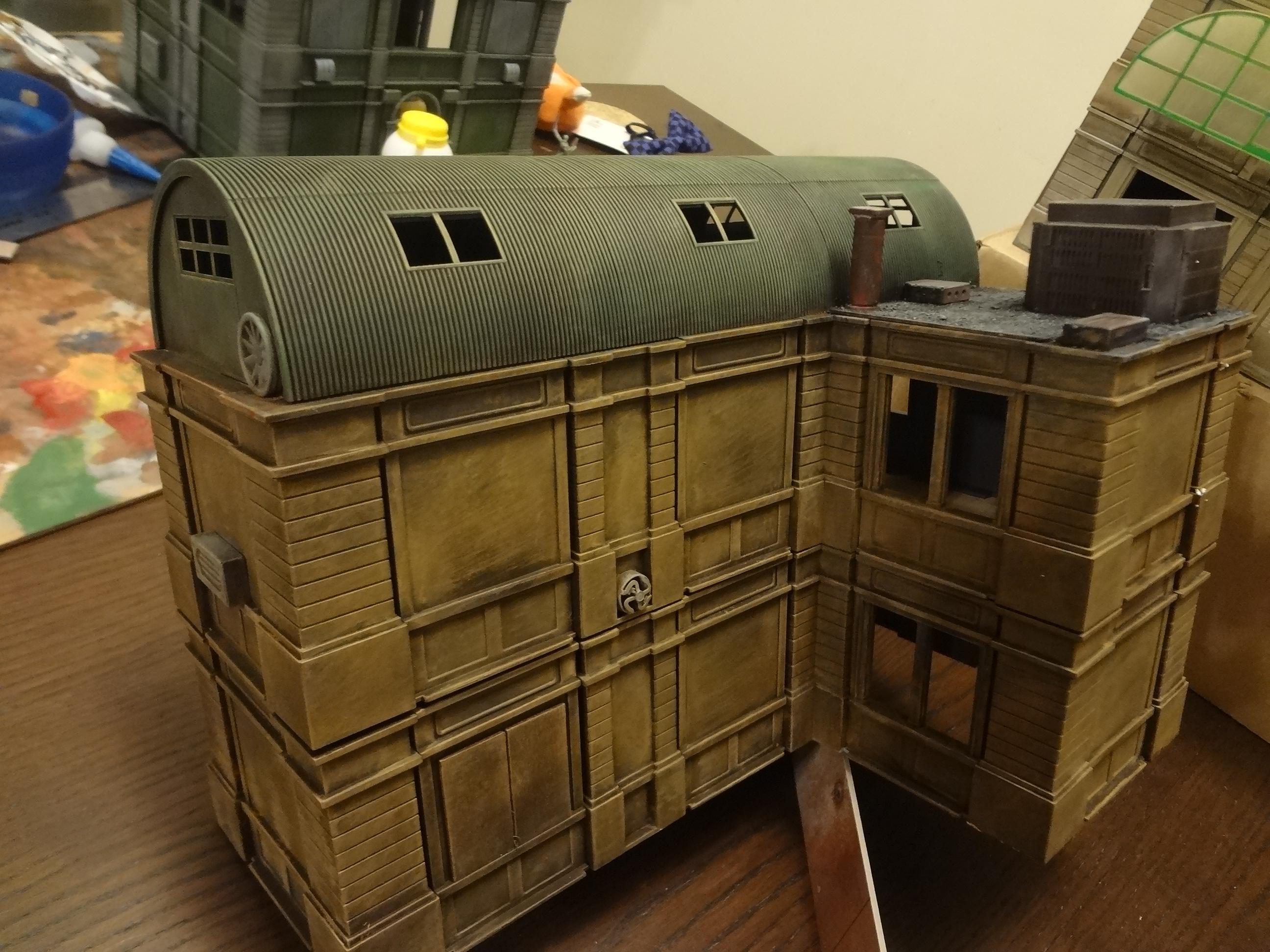
This a/c unit is built from five medical specimen cases.
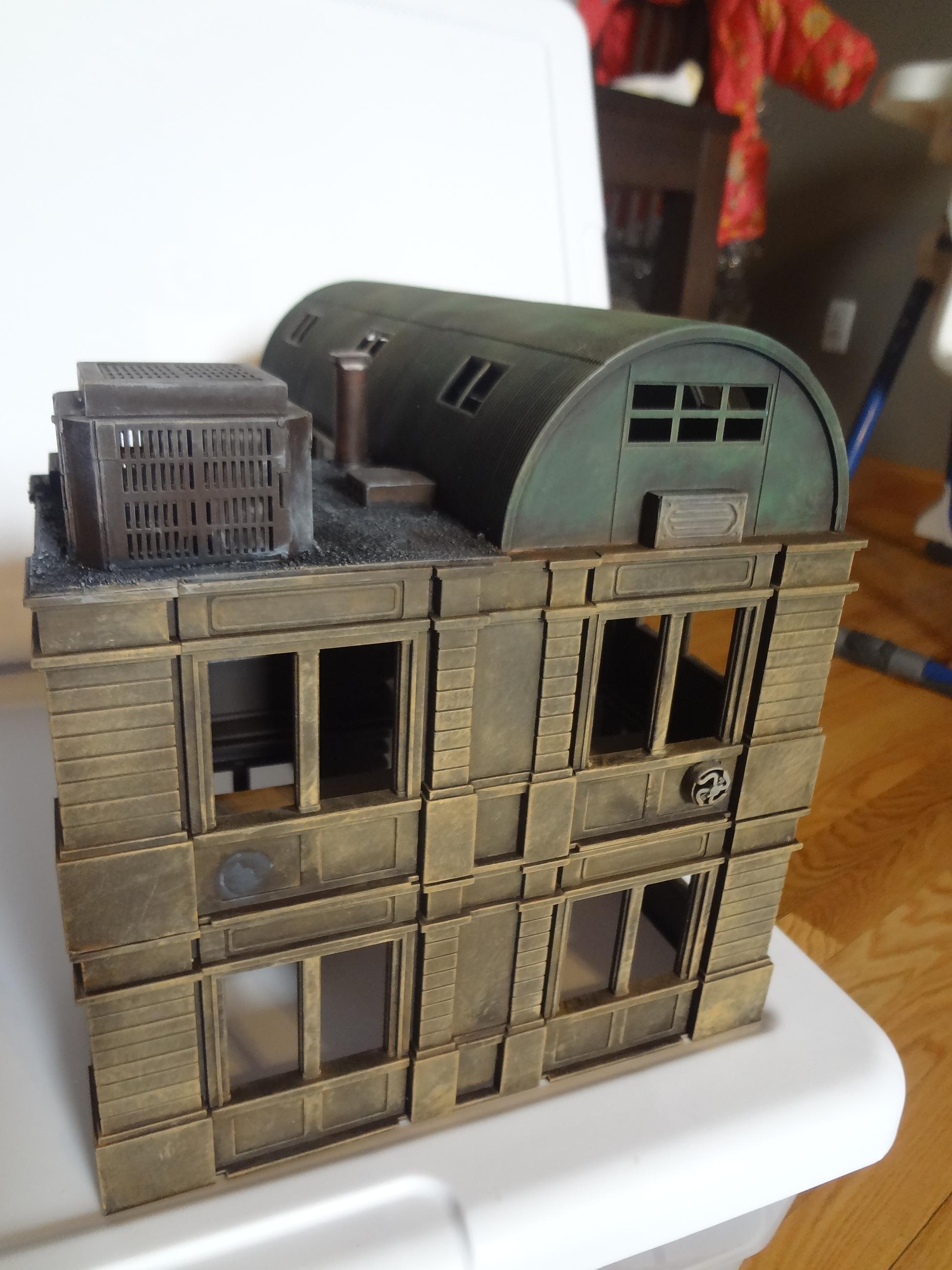
By removing most attachment tabs, I made the second floor removable for access. It works OK but sticks sometimes, so I probably should have just made the roof removable.
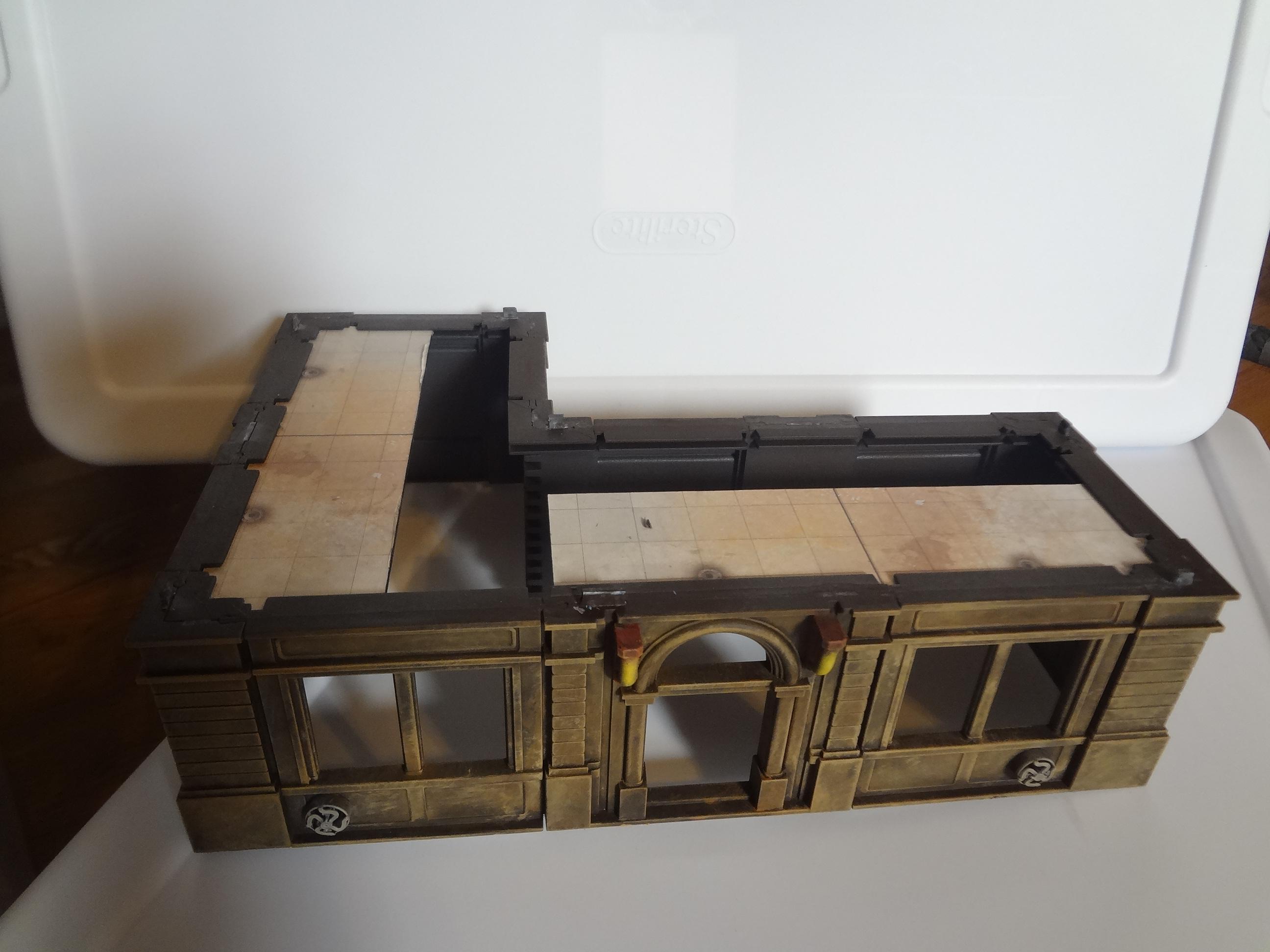
Building 4 - Repair Shop
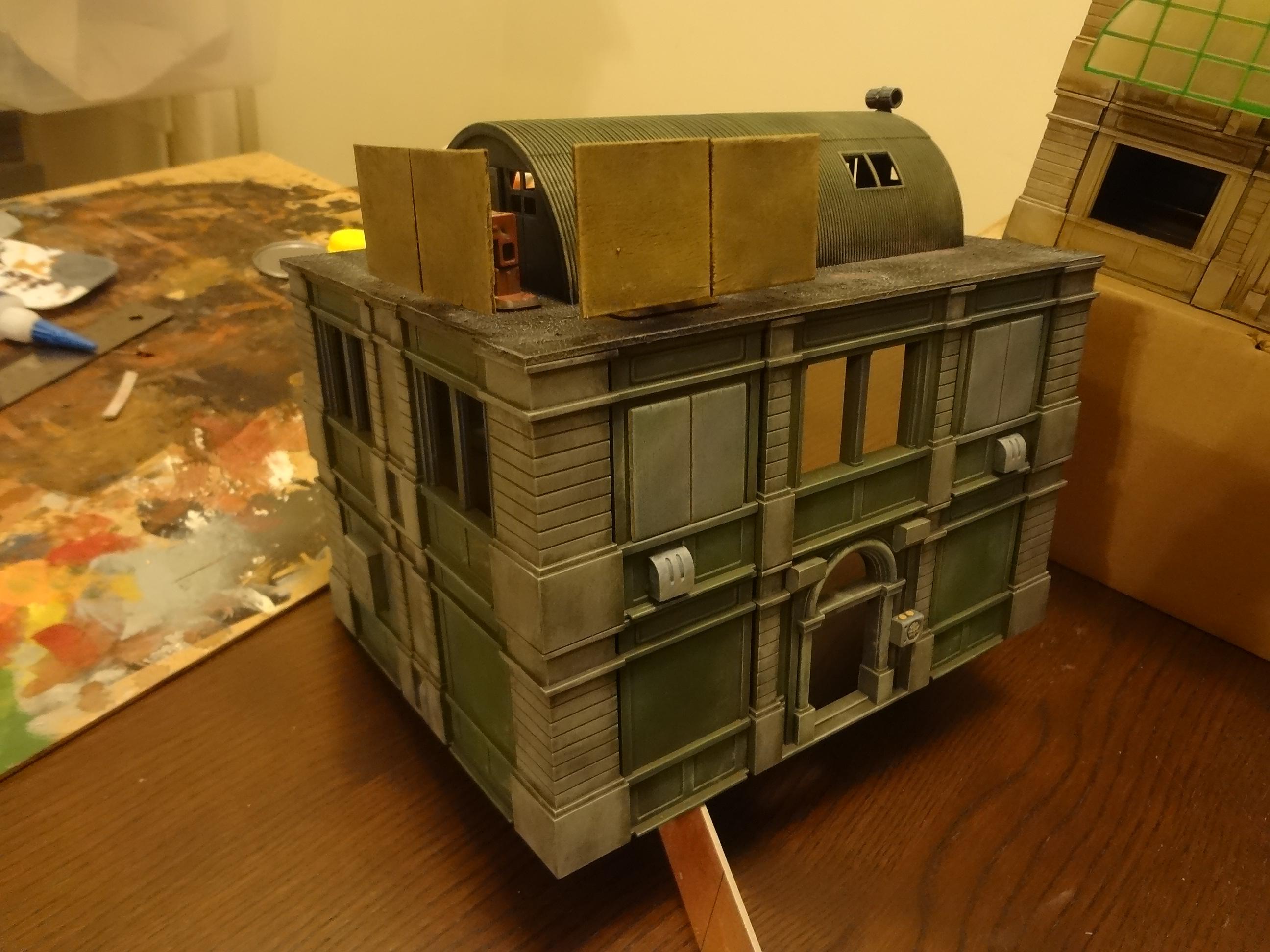
This represents my only attempt at a two-tone building, and I kind of wish I'd painted more like this.
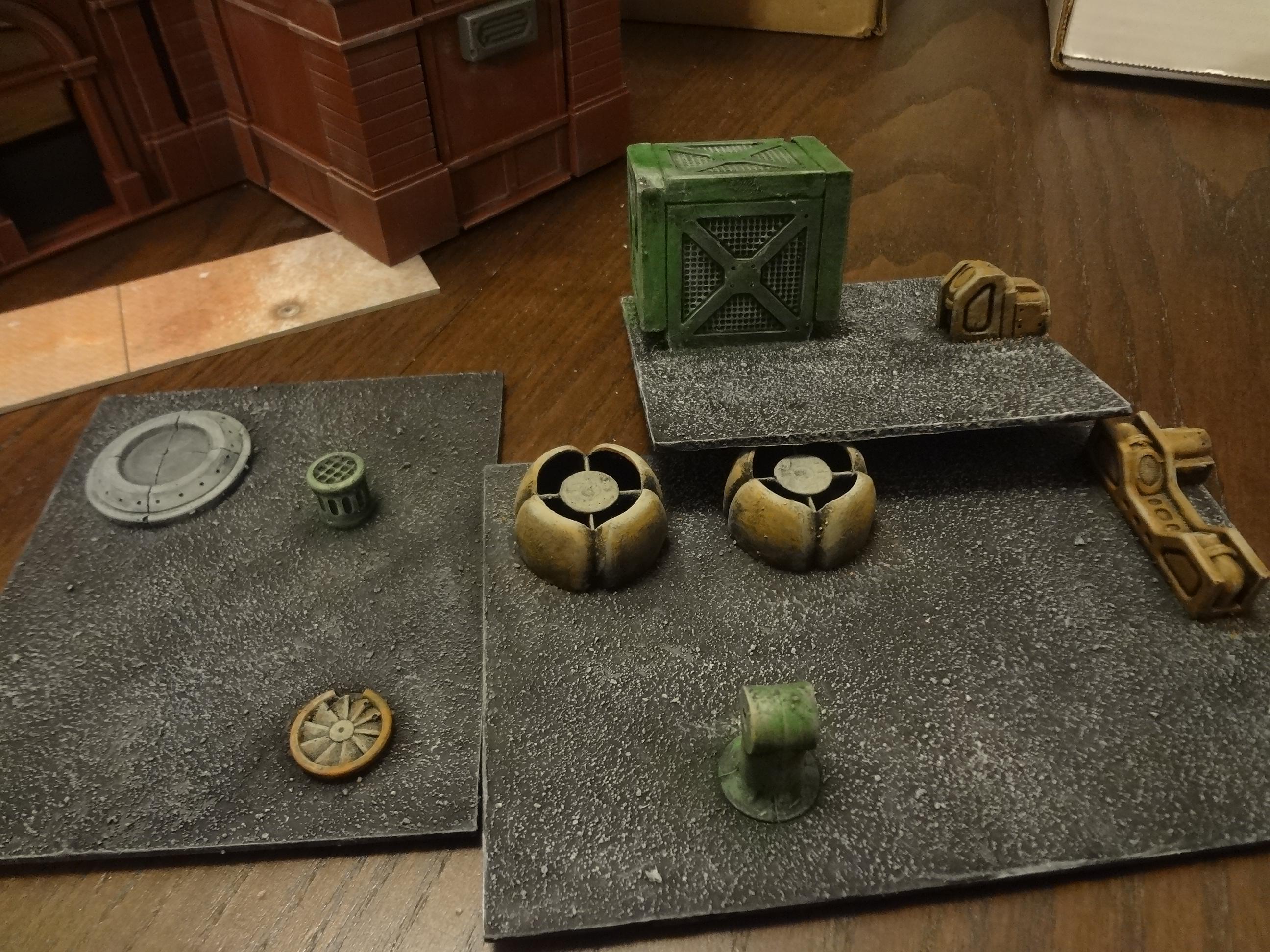
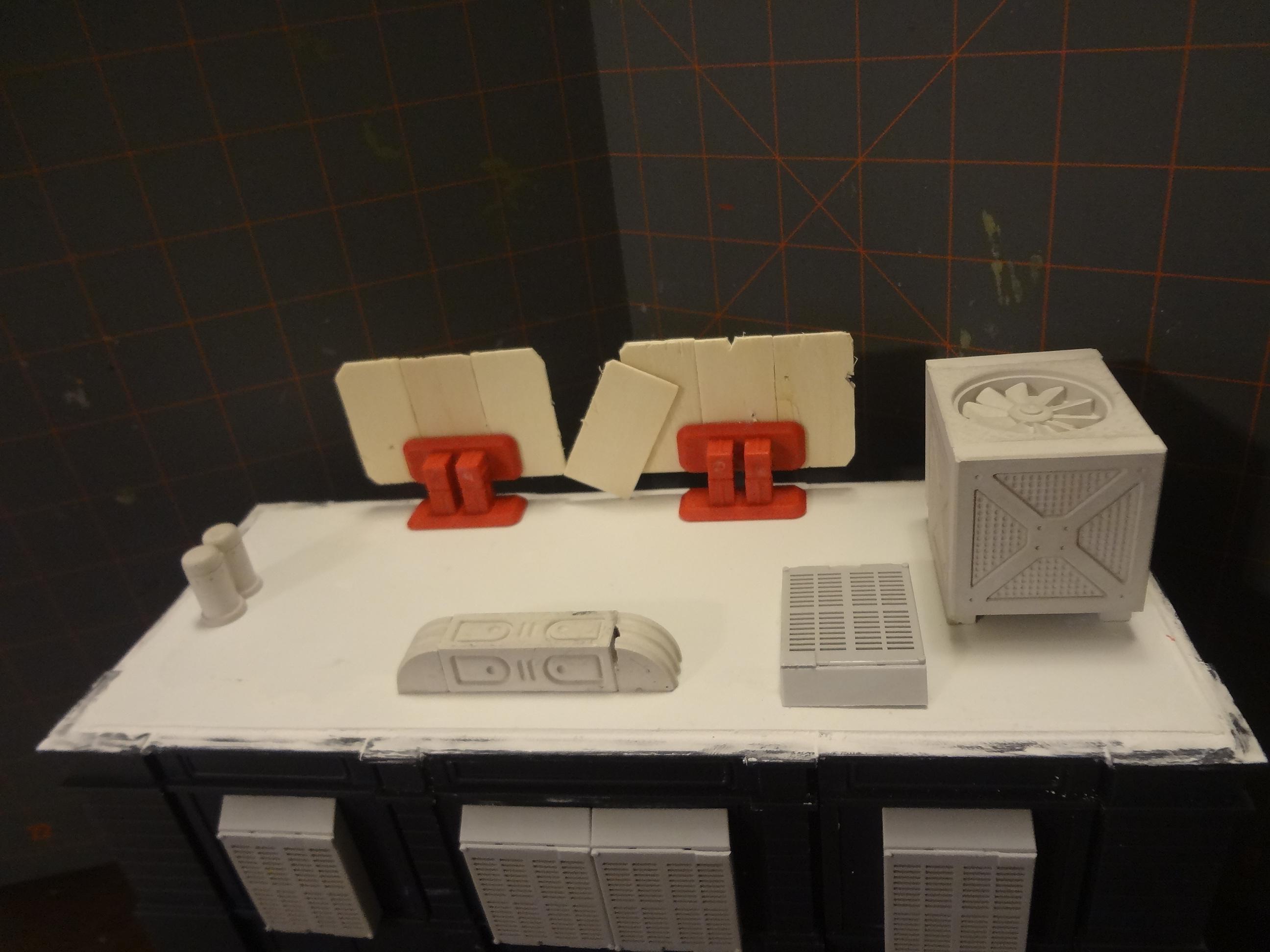
It has a piece of self-adhesive vinyl composite tile (VCT) glued to the top. The signs, Quonset hut, bits and gravel on the roof were simply pressed onto the sticky side of the tile with no additional glue needed.
VCT is really easy to score and break, though I recommend sanding the slick top side if you're going to glue or paint it.
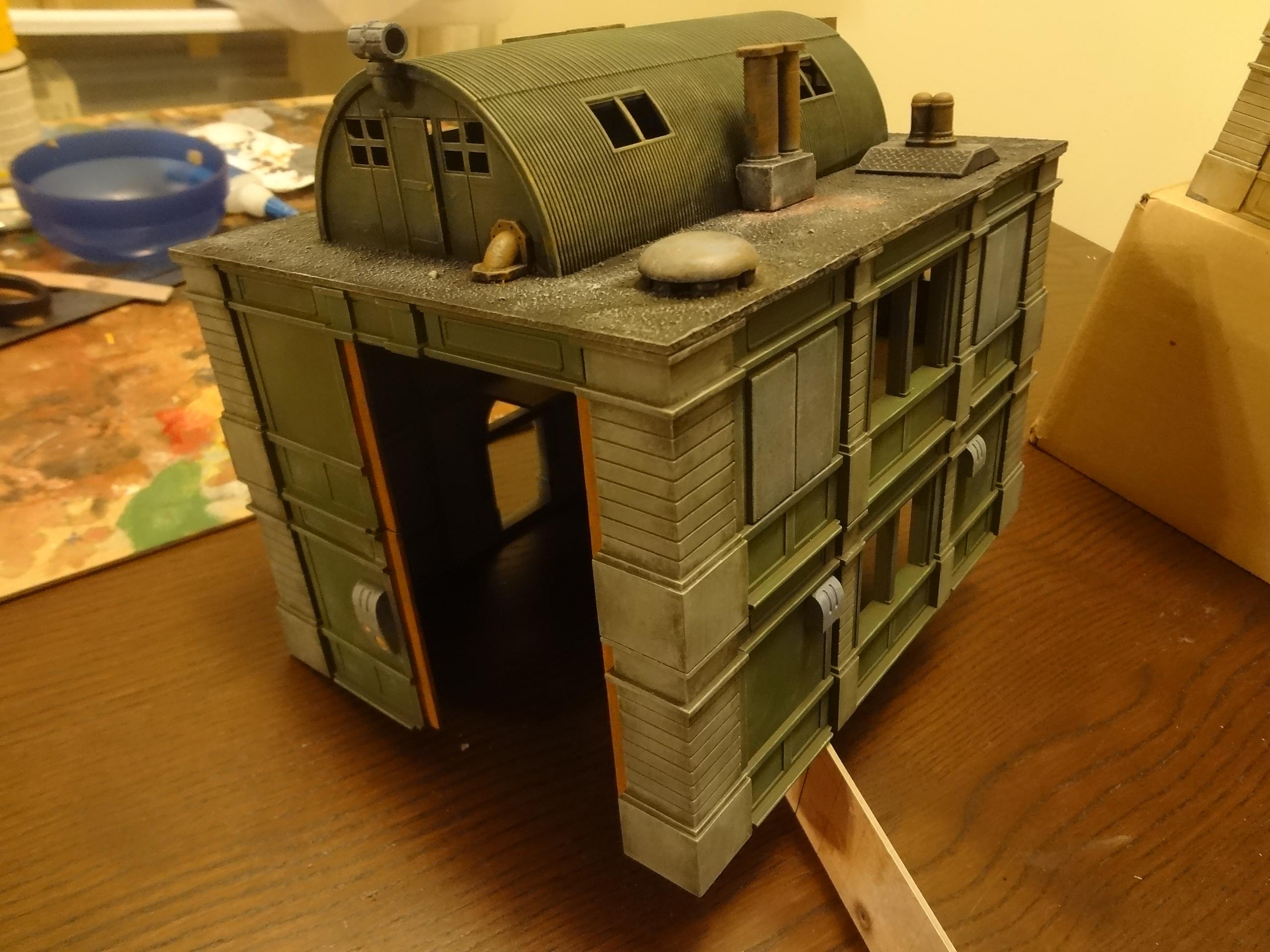
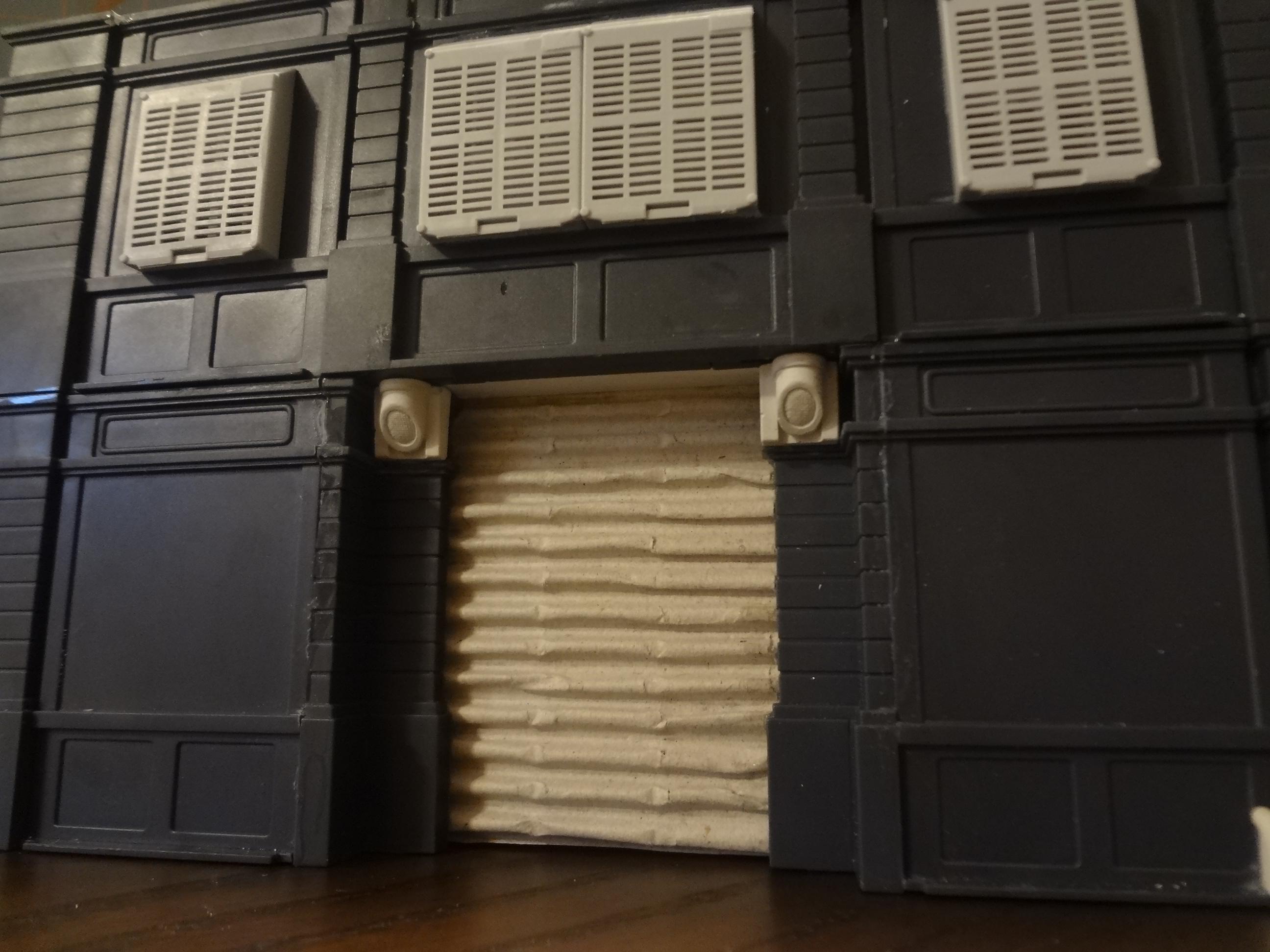
The large rear opening allows for interior access without a removable roof and is big enough to accommodate many vehicles and mechs. The retracted doors are just pieces of cardboard stuck into the side grooves of the wall pieces.
Note the header over the doorway. This is made from the top parts of wall sections, which were relatively easy to cut away. I think it looks much better than simply leaving an empty space.
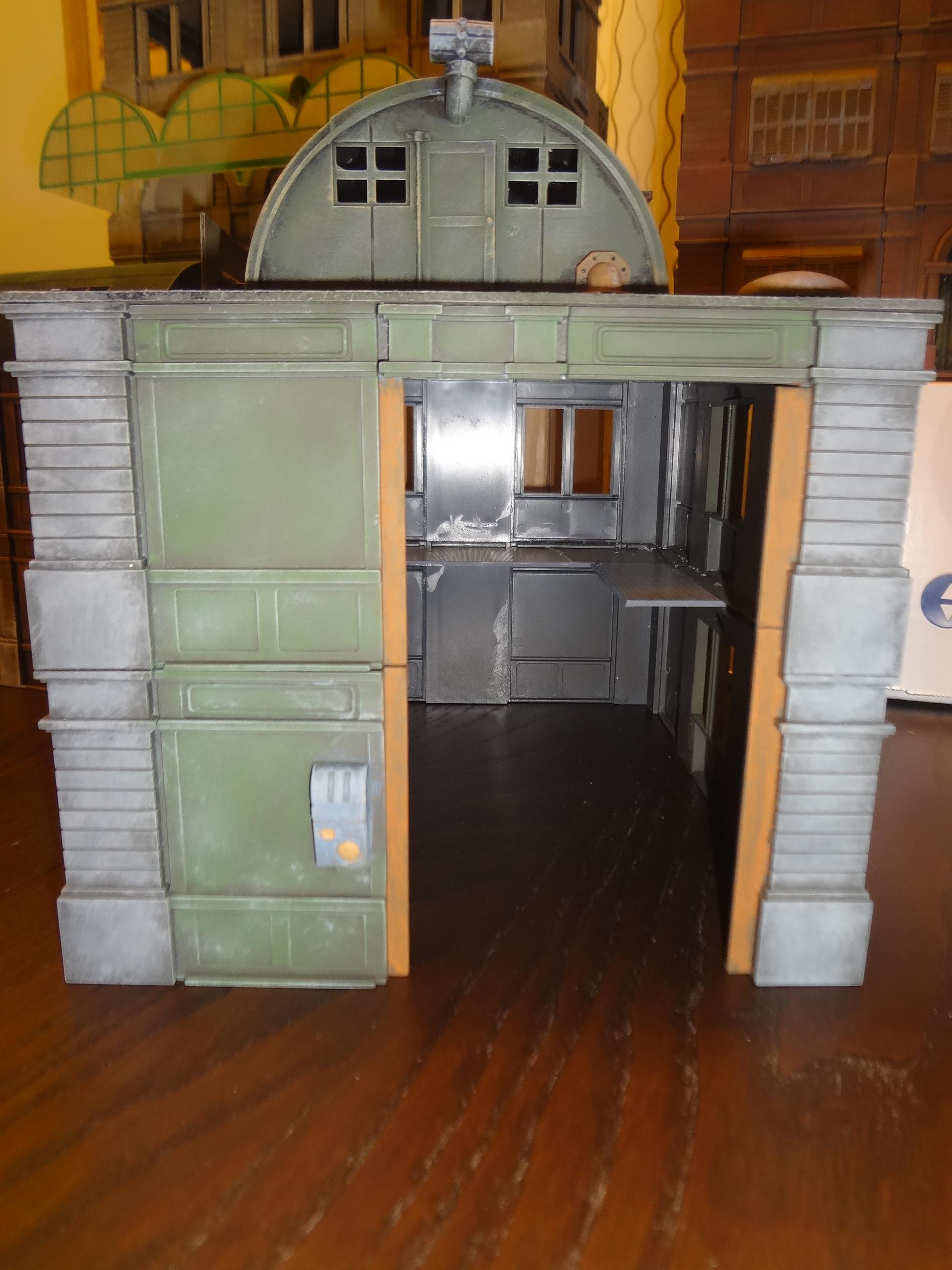
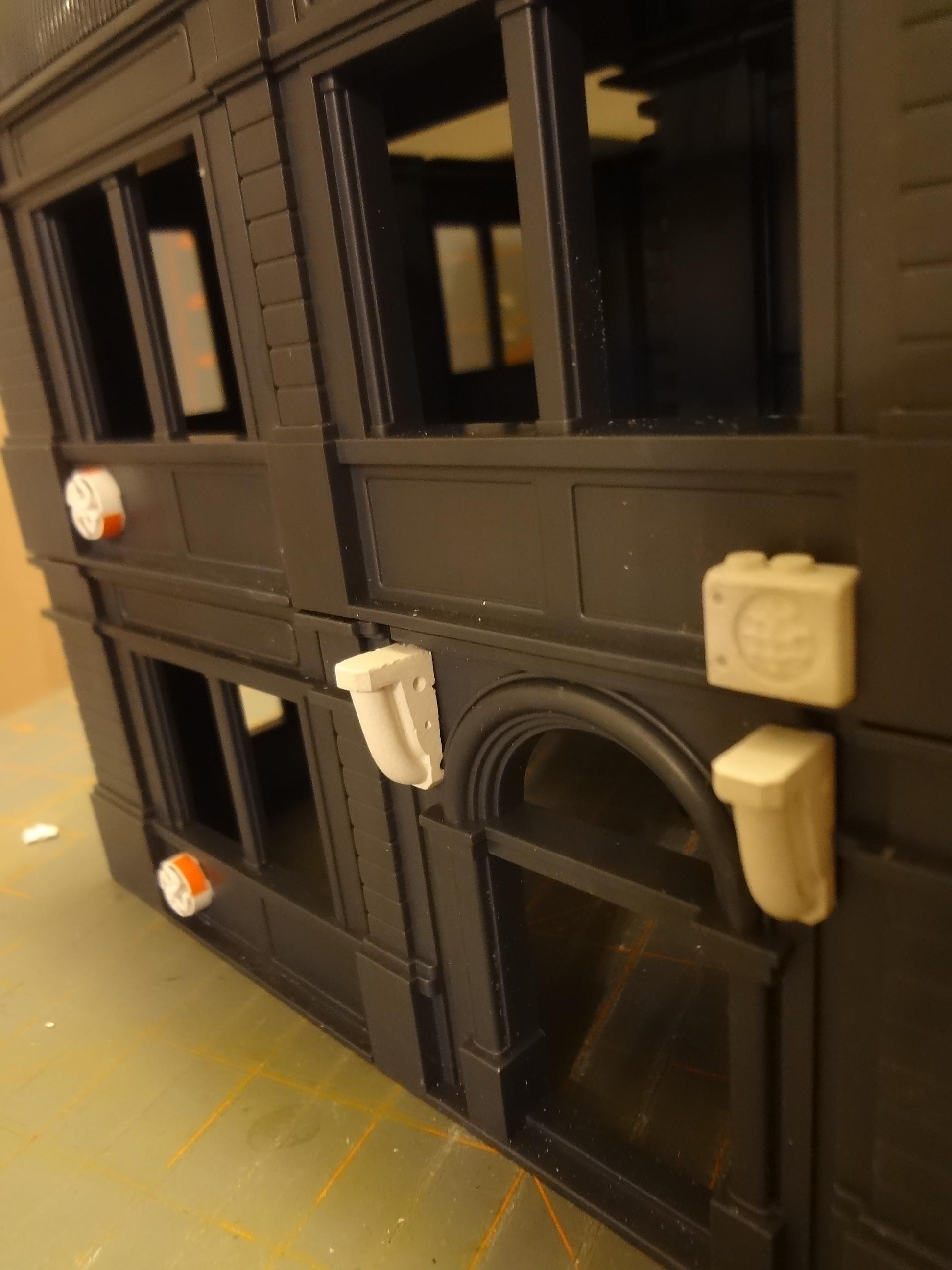
Here's a look at a few more interesting Hirst Arts bits. I've no idea what they were intended to be, but they make great vents, lights and intercoms.
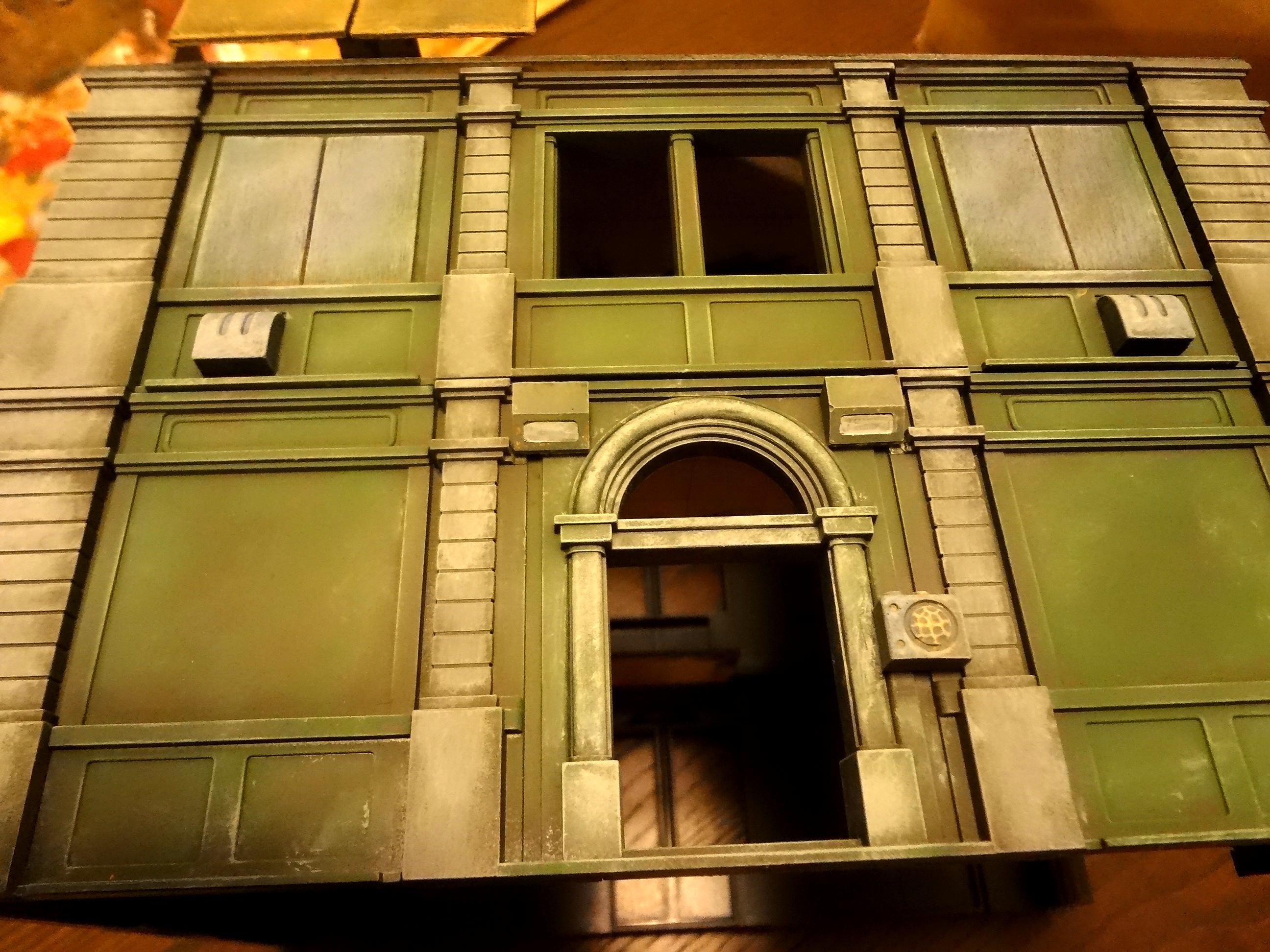
Building 5 - Large Boarded-Up Warehouse
This is the only other building made with no interior access. I've covered all windows with medical specimen cases. I think these bits look equally good as sci-fi window grates or as the metal screens used to secure vacant buildings throughout Chicago.
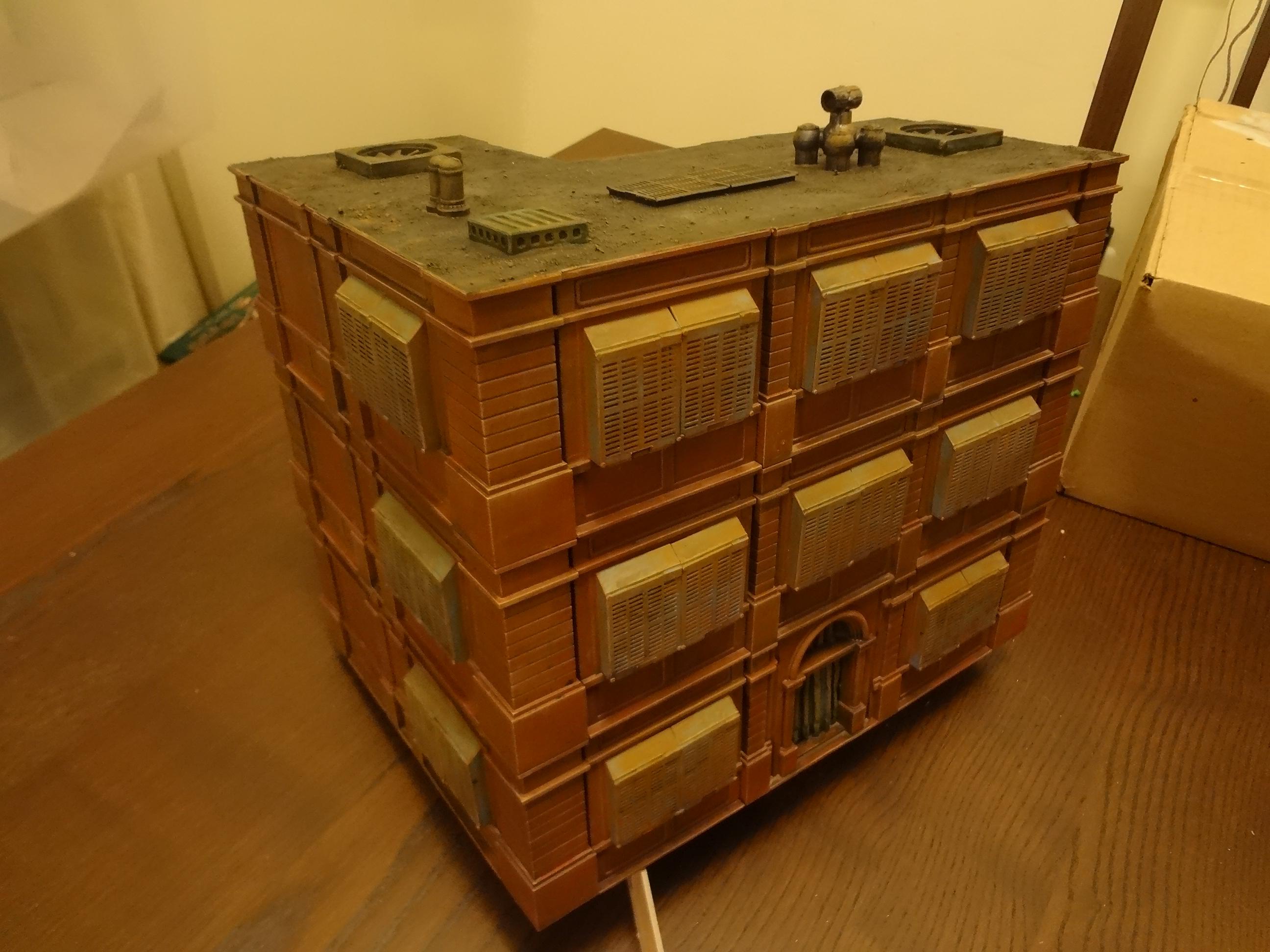
Another header over the rear garage entrance was made by cutting apart a wall section.
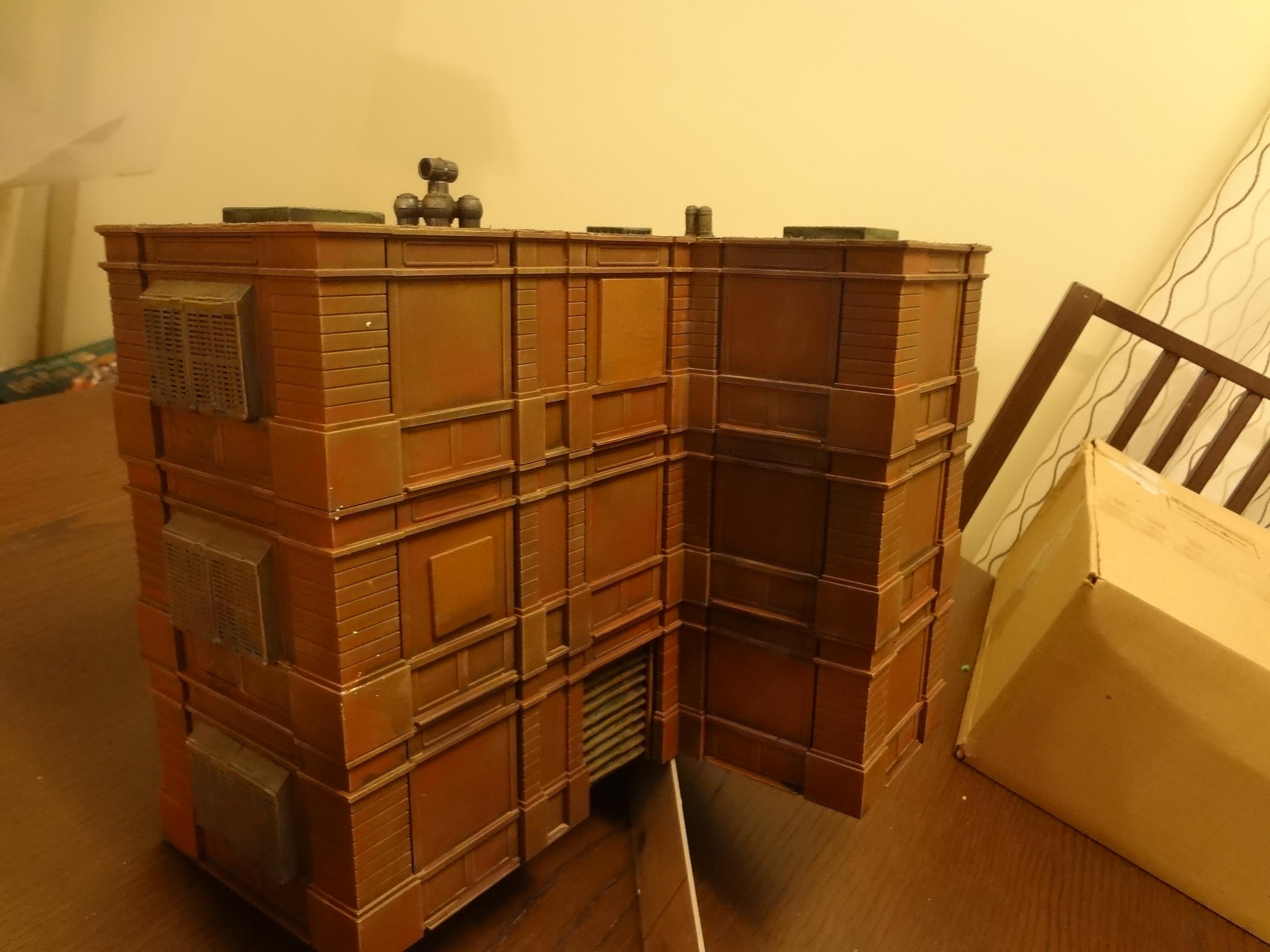
Building 6 - Large Apartment Block
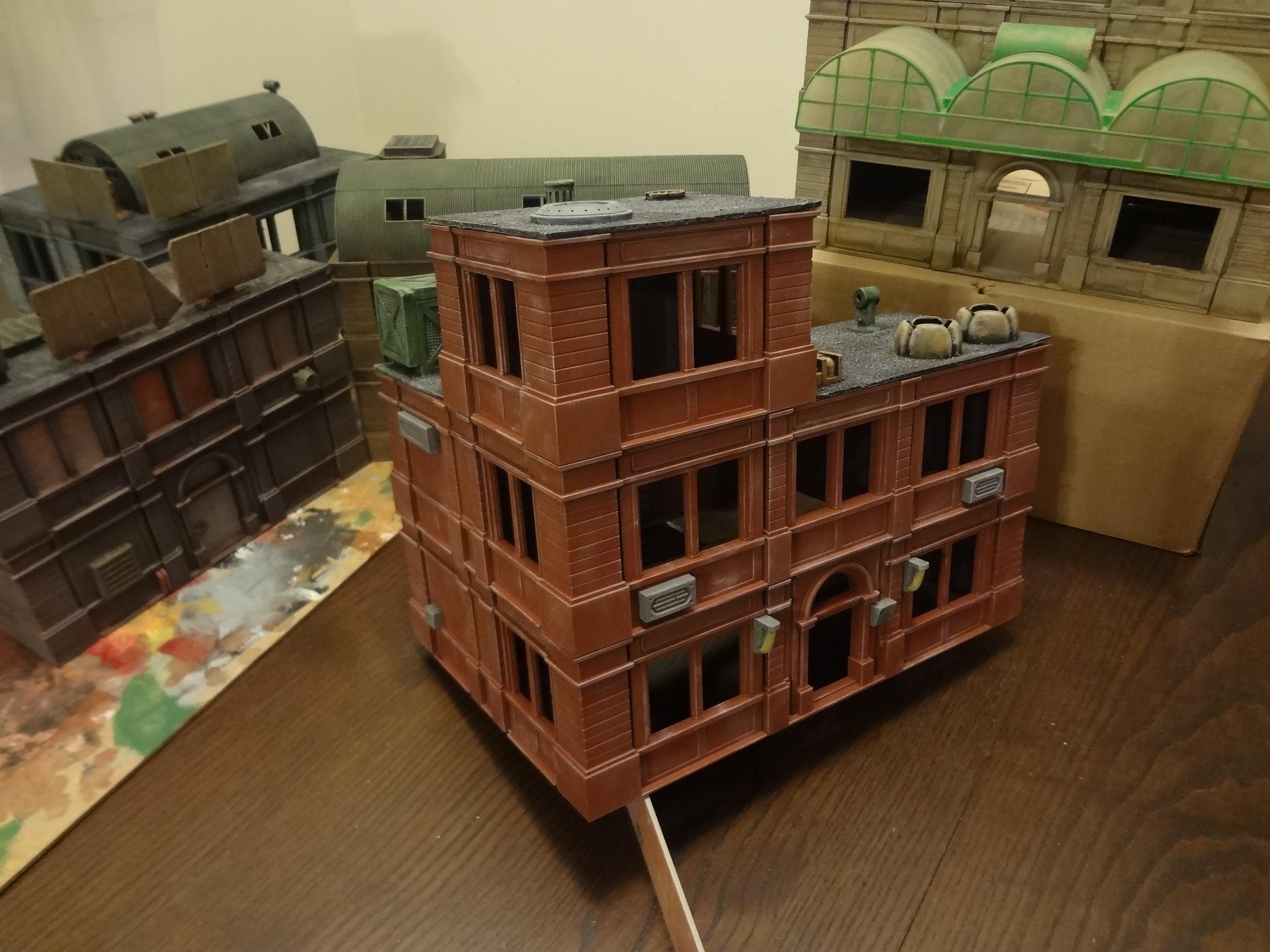
Here's another standard building, though I rather like the tower corner.
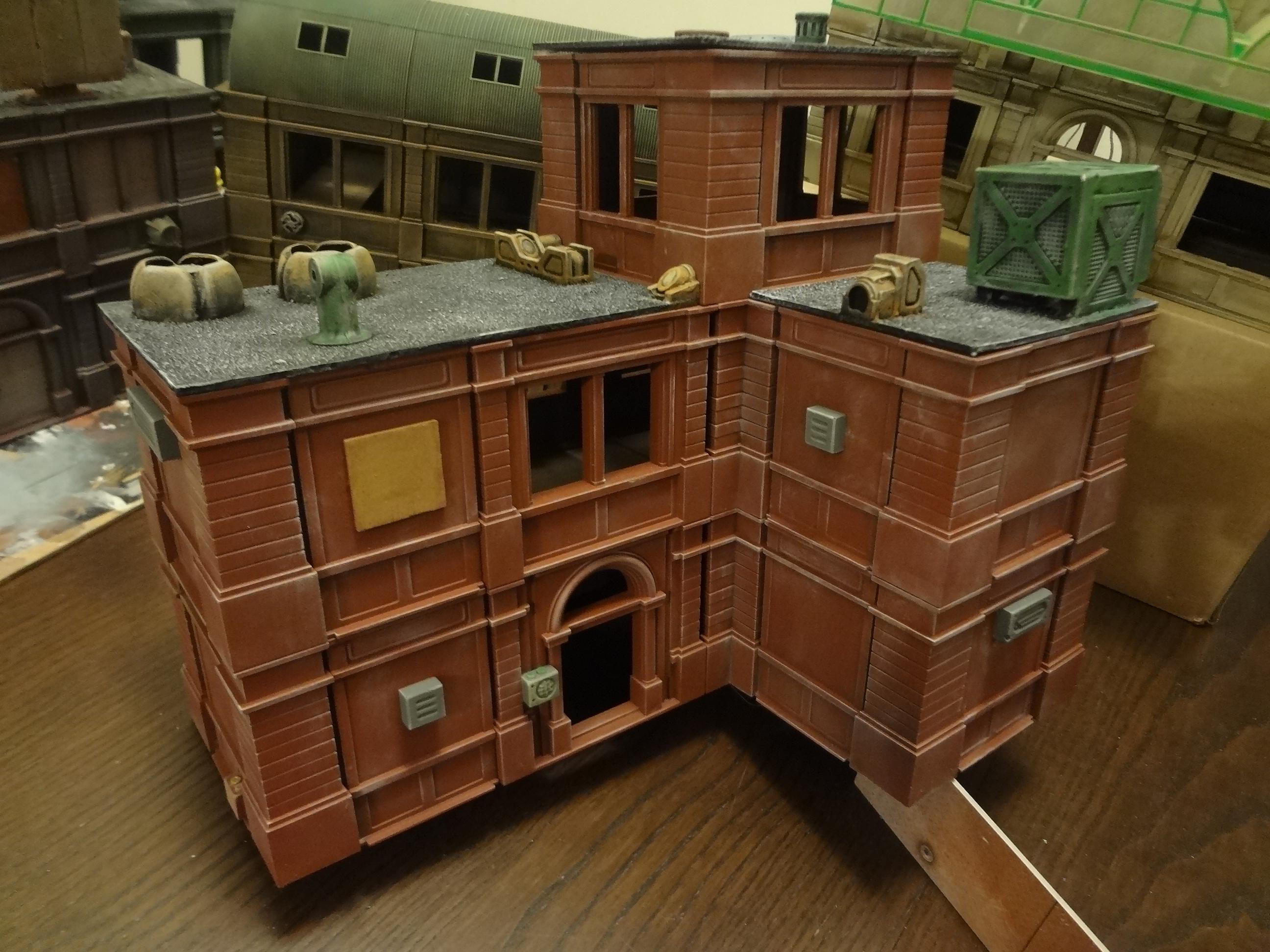
This one has the VCT roofs, and this time they are removable.
Building 7 - The Grand Hotel
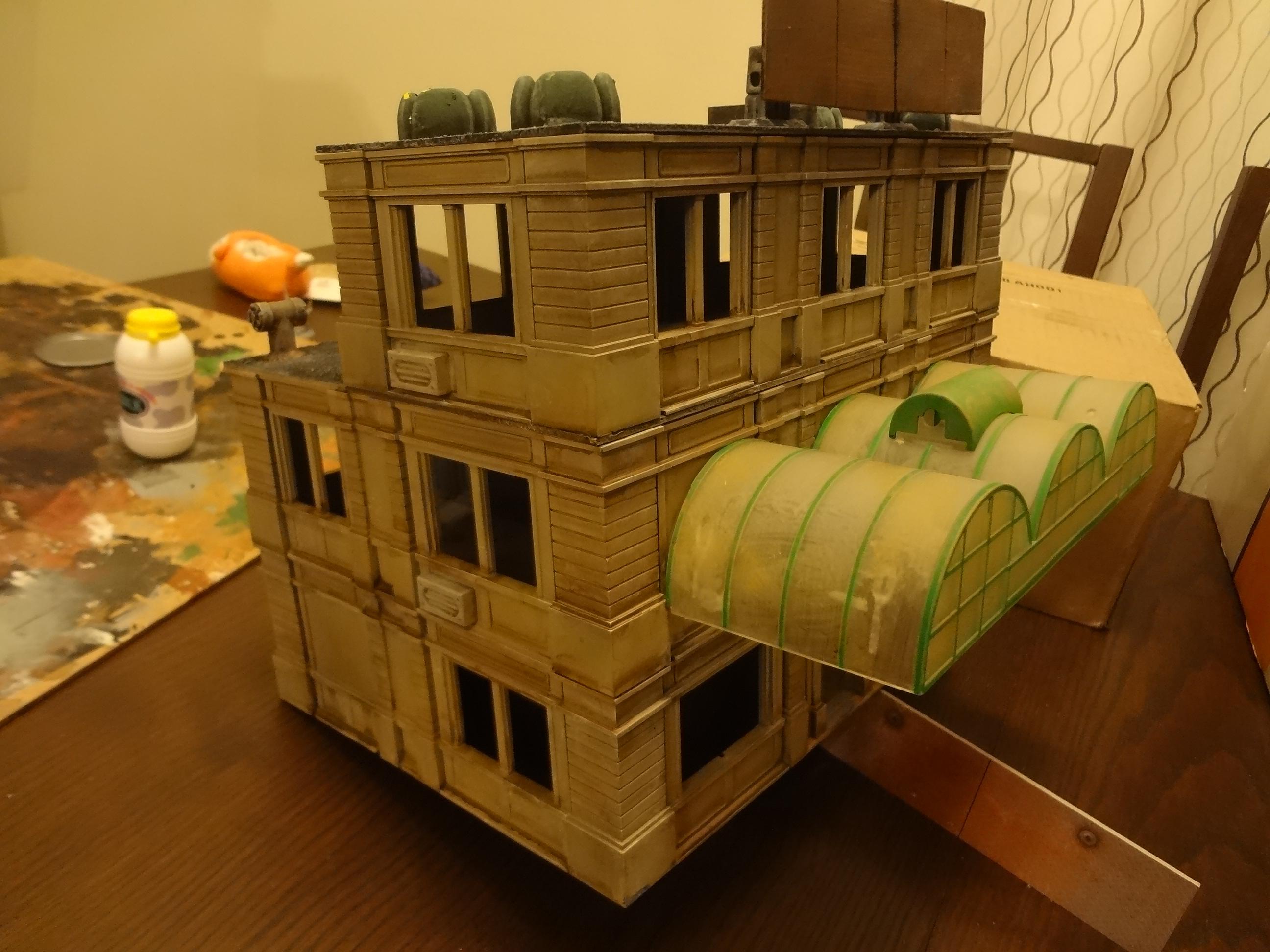
I'm particularly proud of how this one came out. The awning came from a Thomas and Friends Knapford Station toy playset I found at Goodwill, though lots of matte varnish and drybrushing was needed to muck it up. I kept the stock green framing rather than risk screwing it up with a repaint.
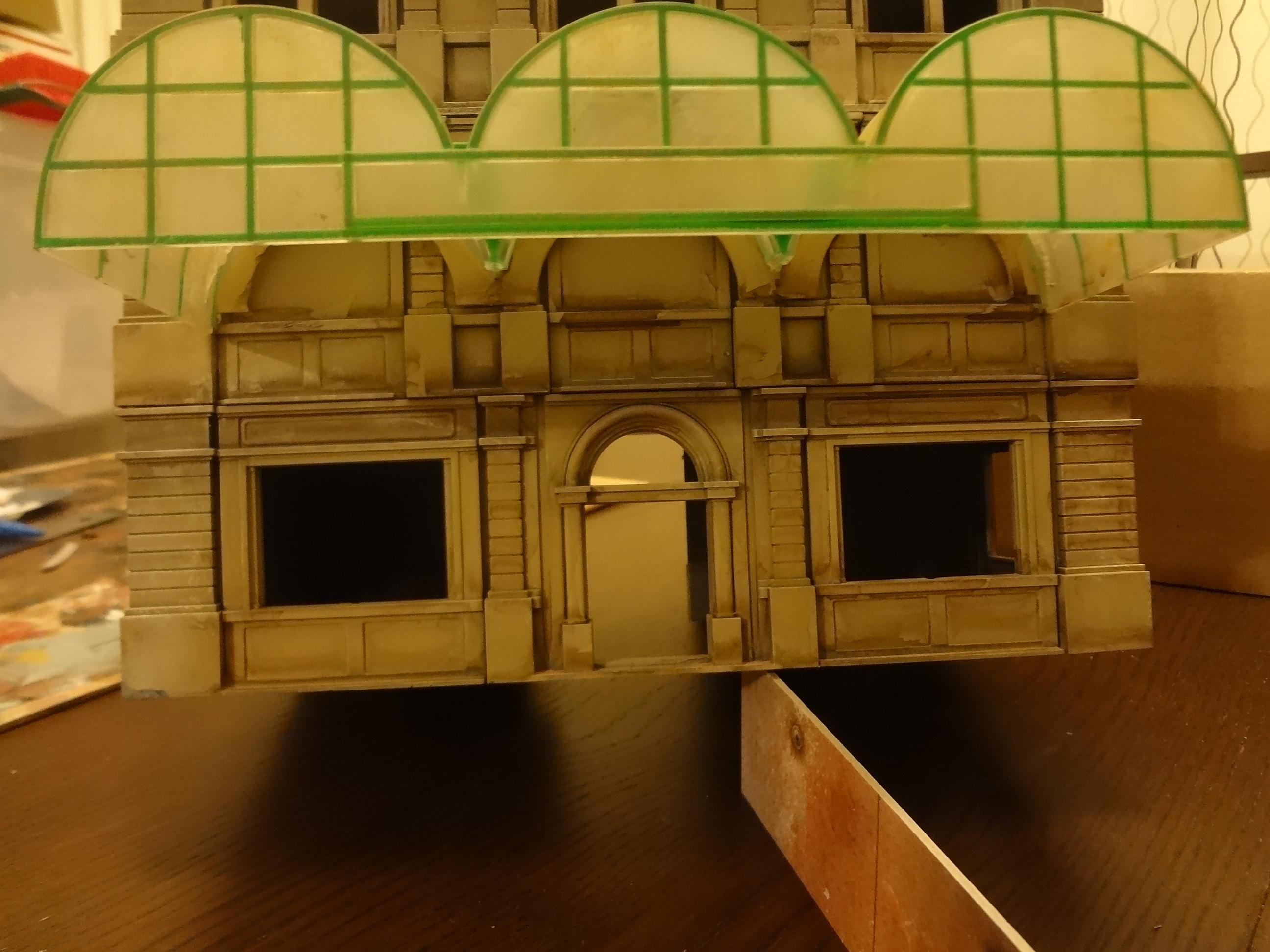
The u-shape in the back makes a great place for concealment.
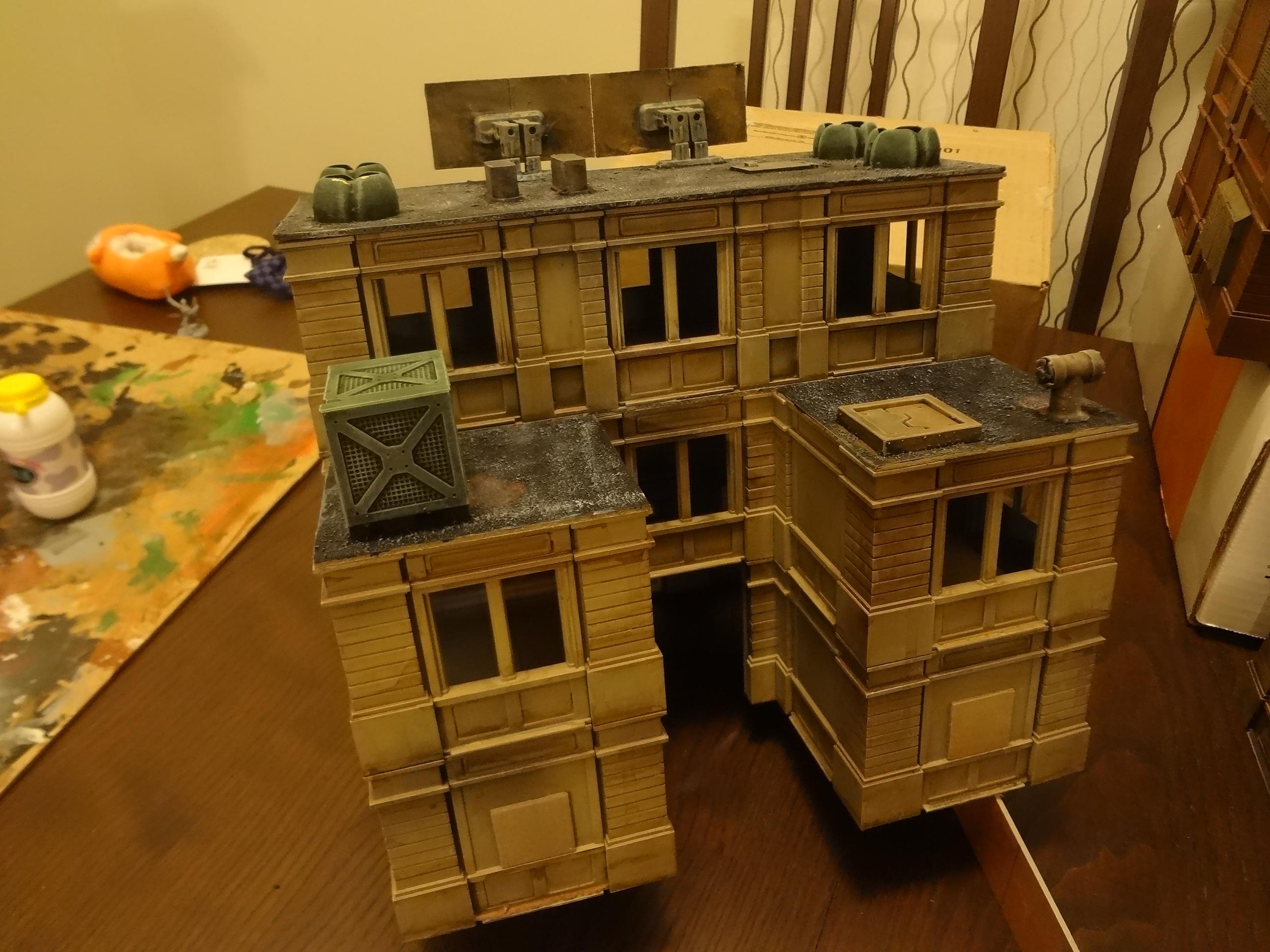
More fun with VCTs! This building has a removable top floor and roofs.
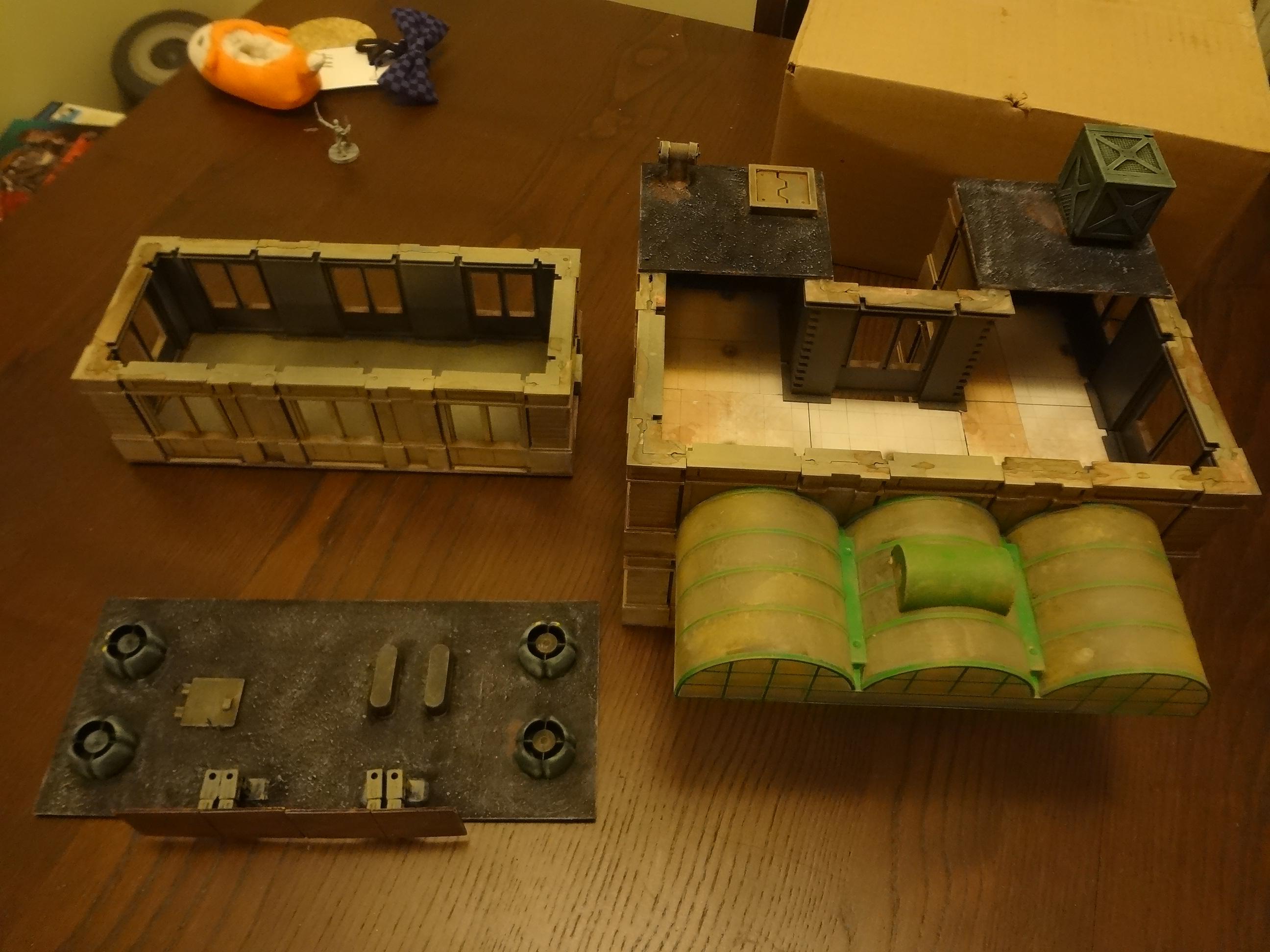
All together now!
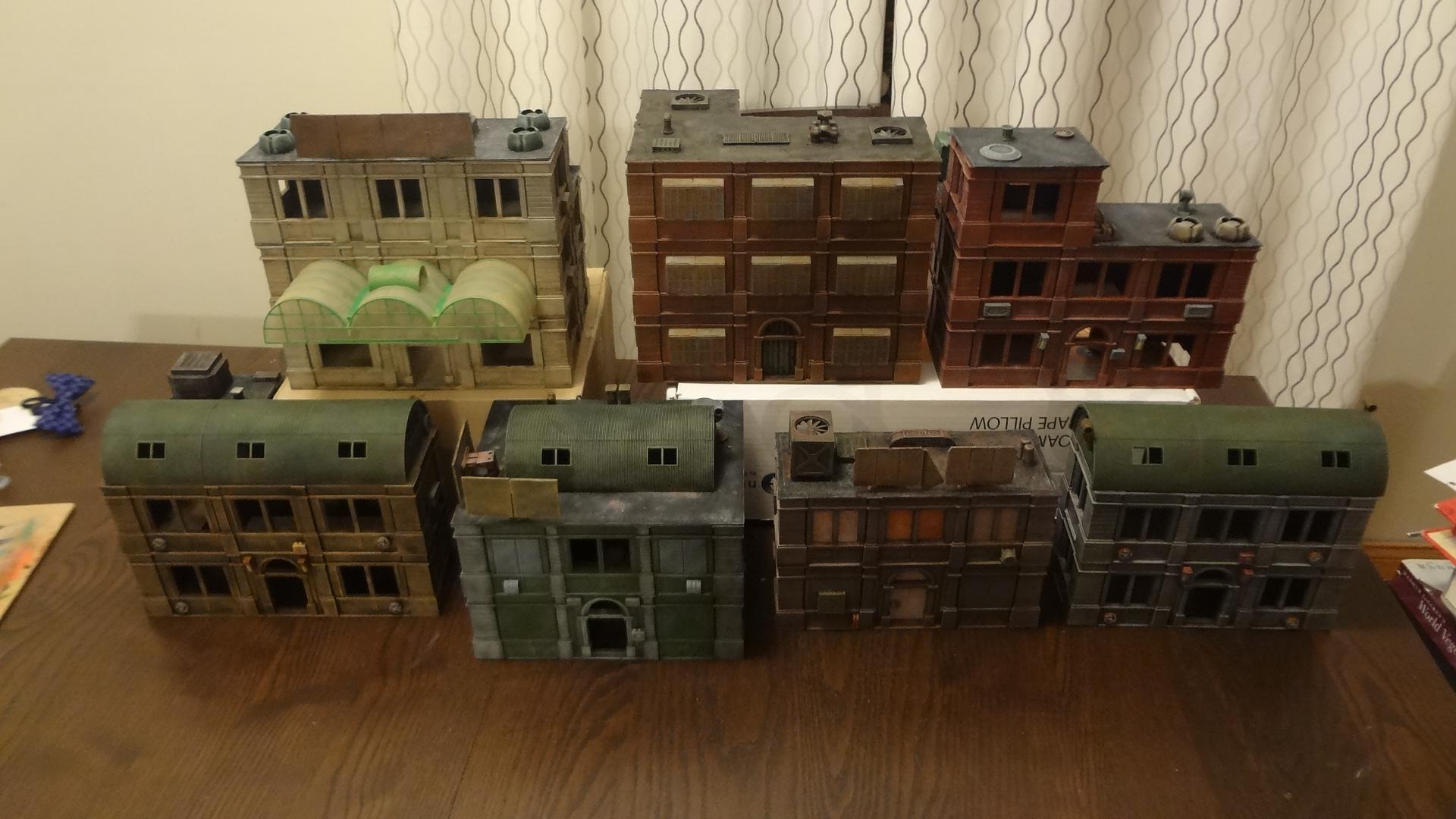
All of these were basecoated with various colored spray paints, mostly Krylon camo sprays along with gray and ruddy brown colored primers.
After that, all but one were drybrushed with a lighter shade, washed with dark brown, and most got a final dusty tan drybrush. The dark grey color of the plastic is an excellent base for this paint scheme, and it speeds up the painting process immensely.
The interior floors are mostly the cardboard floor sections included in the kits, though some have VCT pieces or plastic card floors.
I think the final buildings could have been improved with some signage and graffiti, but it was a higher priority to keep them genre and era neutral.
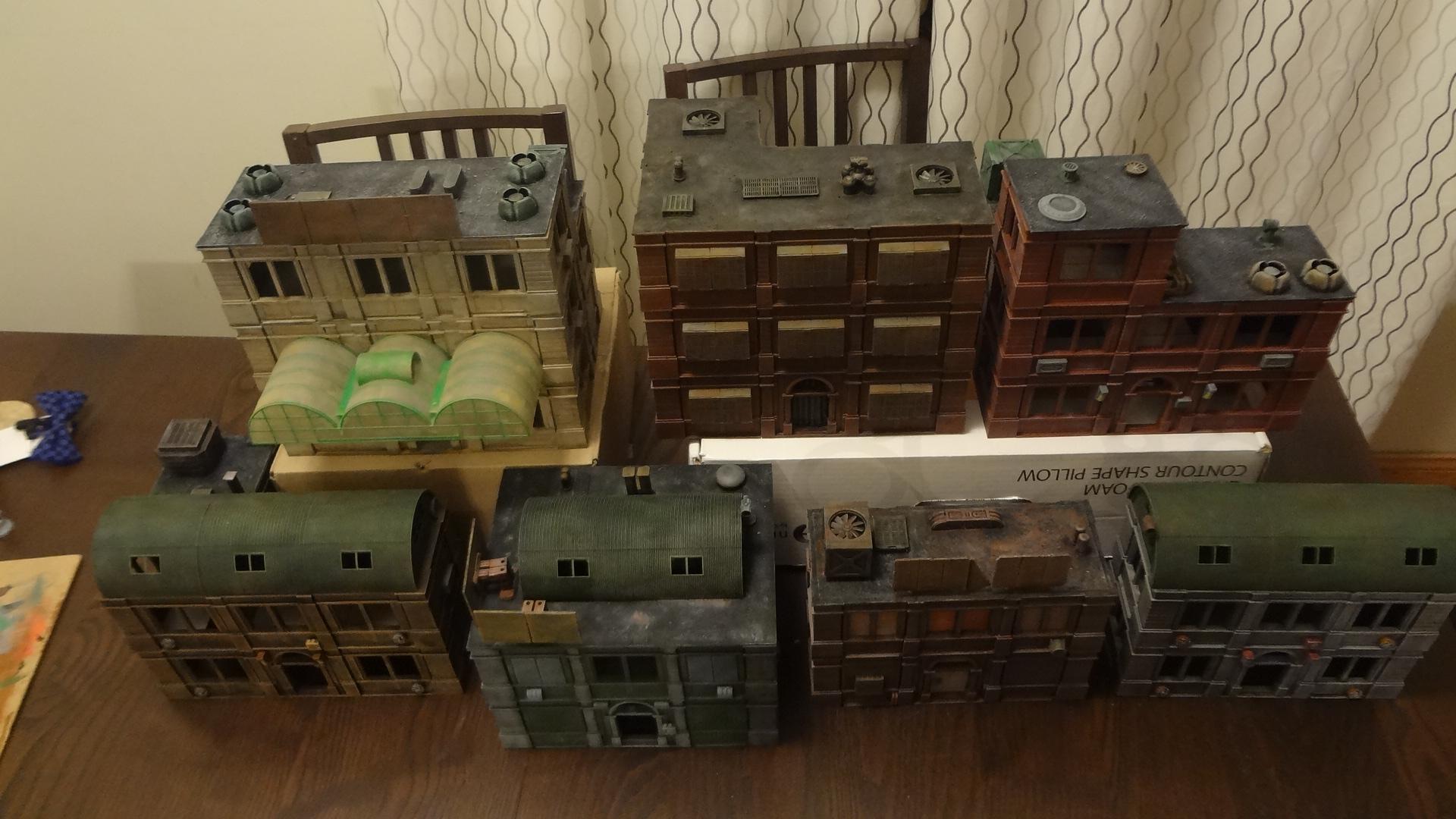
All in all, this is a very pleasing set of buildings. They should have no problem fitting into modern day, near future, cyberpunk or even sci-fi settings. I'm sure they'll see use in many games!
The main impetus for this project was that, for the first time, CSW will be hosting a game at Adepticon! We plan to run a game of Mech Attack on a glorious 28mm scale urban battlefield. It will be similar to our past games at Little Wars (which we also plan to attend) but this time the table will be expanded to 8x8 feet and will have lots of new terrain and a new gaming surface. Adepticon is known for having really good looking games and excellent terrain and I want our showing to be just as impressive.
If you're in town for Adepticon in March, look us up!
-- Karl, Chicago Skirmish Wargames club member
Tuesday, January 20, 2015
Tuesday, January 13, 2015
Getting the Most from Dust Tactics Tenement Buildings
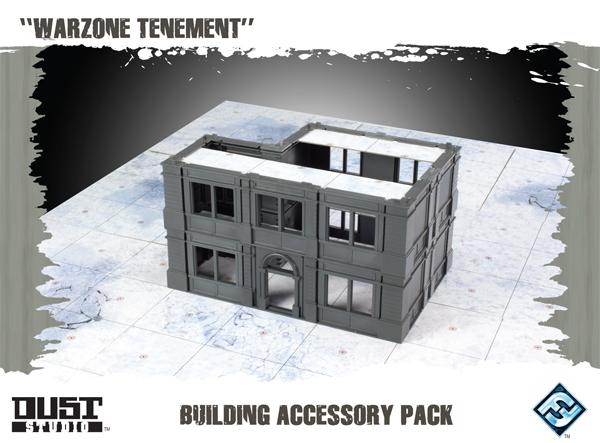
Last year I sold off a large medieval army, and I turned right around and sunk the proceeds into nine boxes of Dust Tactics Warzone Tenements from Fantasy Flight Games' year-end sale. There are already some fine reviews of the product out there, so this article will focus mainly on how to get the most out of these kits.
The kits themselves are very well made. The components arrive off the sprue and partially assembled (front and back wall sections). Cleanup isn't necessary, and you can start building immediately. It may take a bit to familiarize yourself with the metrics and proportions used for the various sizes of walls, but once you get the hang of it these buildings go together easily and somewhat intuitively.
In a future post I will display all the completed structures, but today I'll show a just a few.
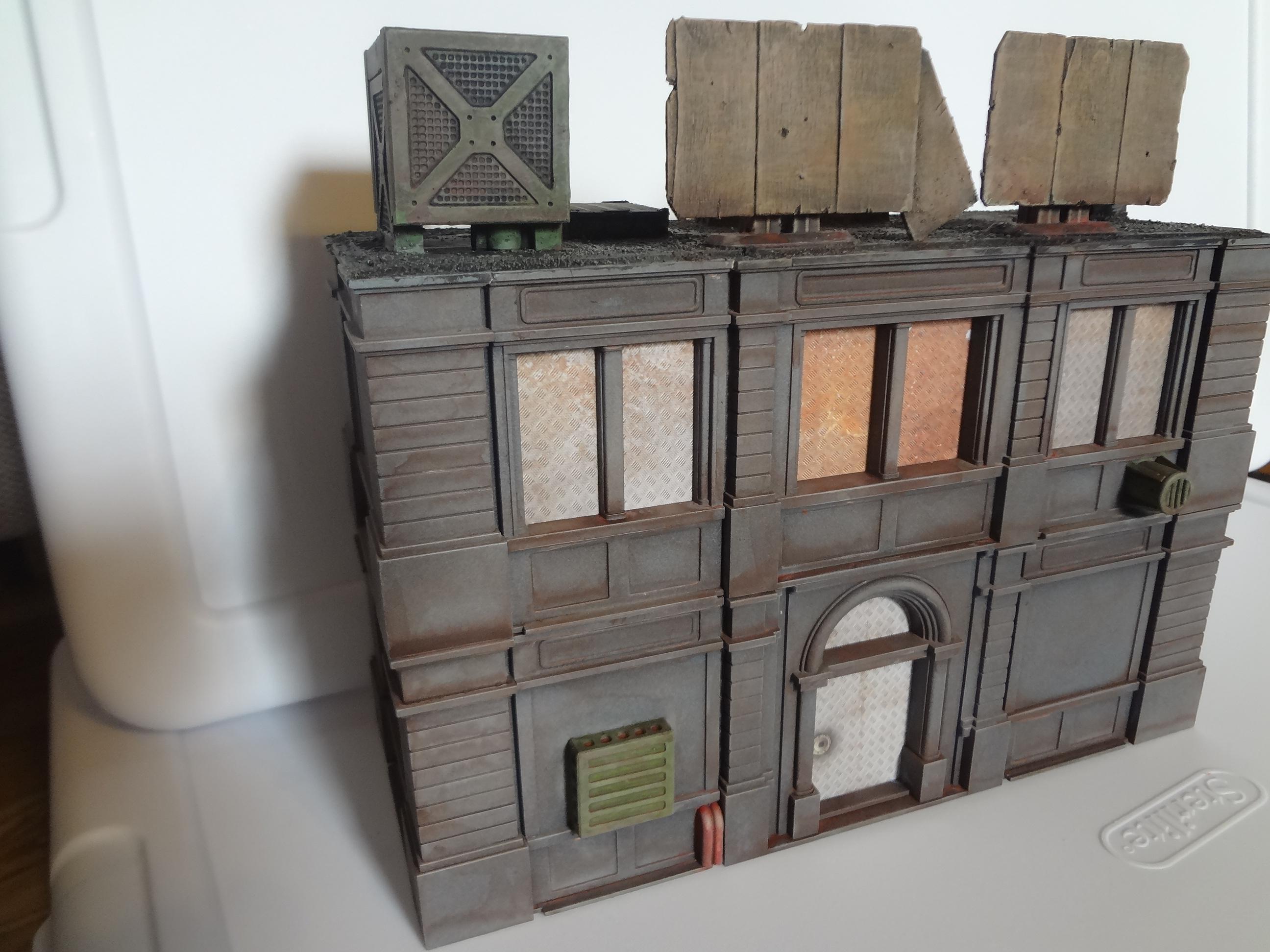
This first building is entirely closed, so there was no need to use the floor pieces or put on a removable roof.
I used cardboard floor sections to cover the windows and doors on the front. The wooden sign sections are from little bags of pre-cut wood that you can find at the craft store. I highly recommend these wood pieces for detail work on your buildings.
In this building, some Hirst Arts plaster bits provide tech details and the rooftop air conditioning unit. The Hirst pieces came from fellow blogger Lucky Joe, who sent me a bunch of extra bits a while back. They've sat in my collection unused for several years, but they were a godsend for this project.
If you know anyone who casts Hirst Arts, I highly recommend inquiring about leftovers. Most folks will have a lot of random, unused pieces after given project.
The rear side of the building has medical specimen cases as window coverings. They look a lot like metal board-up screens. The garage door is single-sided corrugated cardboard. The lights are Hirst Arts pipe ends pointed downward.
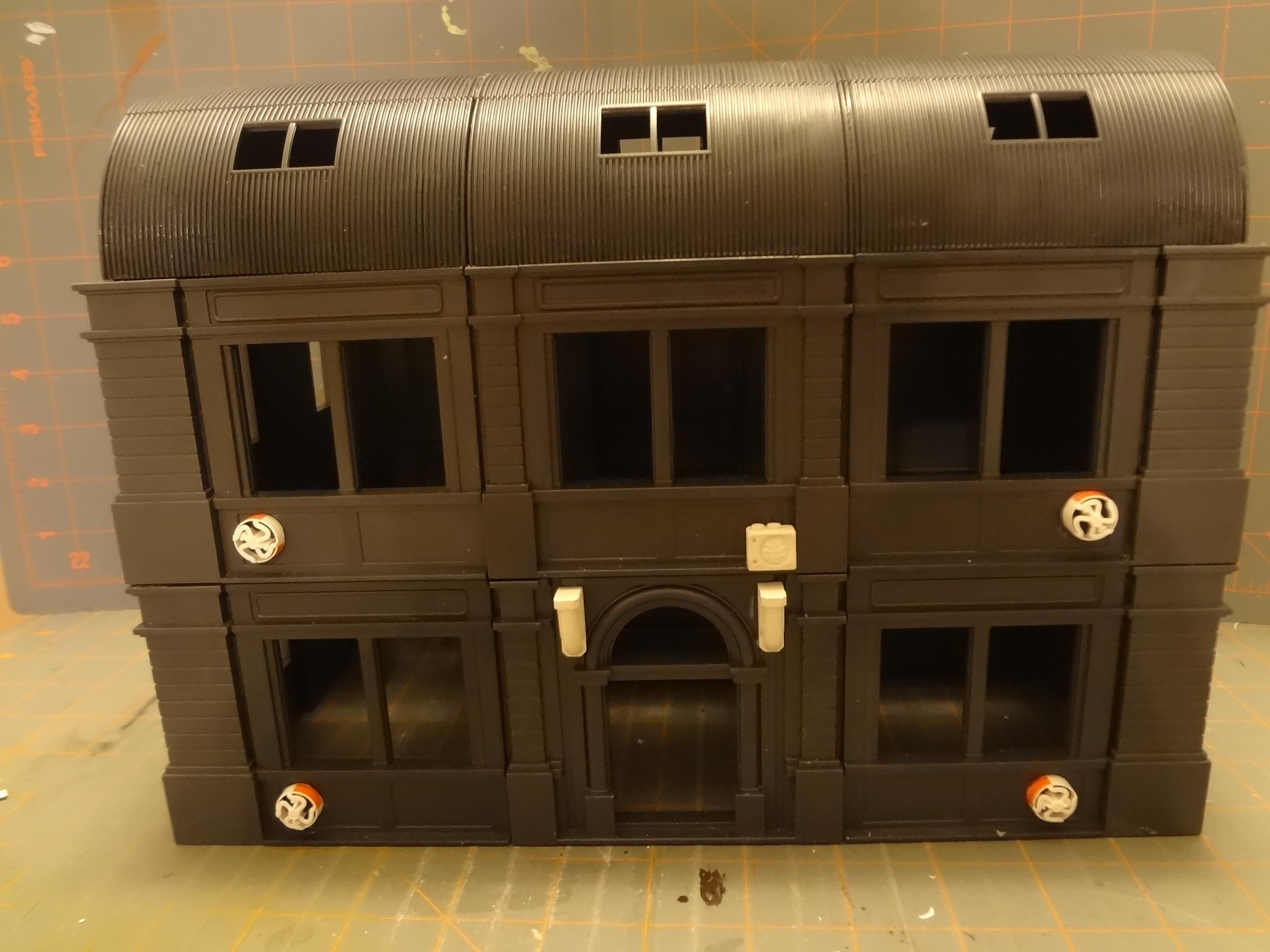
This next building uses the Dust Tactics Quonset Huts as roof sections.
The huts are almost exactly the same width as a building made with the short wall sections.
For this one, I had to cut some of the huts down, but the grooves on the roofs make for very easy cutting. More Hirst Arts bits -- sci-fi tube curves in this case -- made for great light fixtures.
The little round vents are small medical bits of unknown origin. The second story of this building lifts away, which was made possible by removing almost all of the connecting tabs and trimming the remaining tabs down.
Here's a trio of buildings.
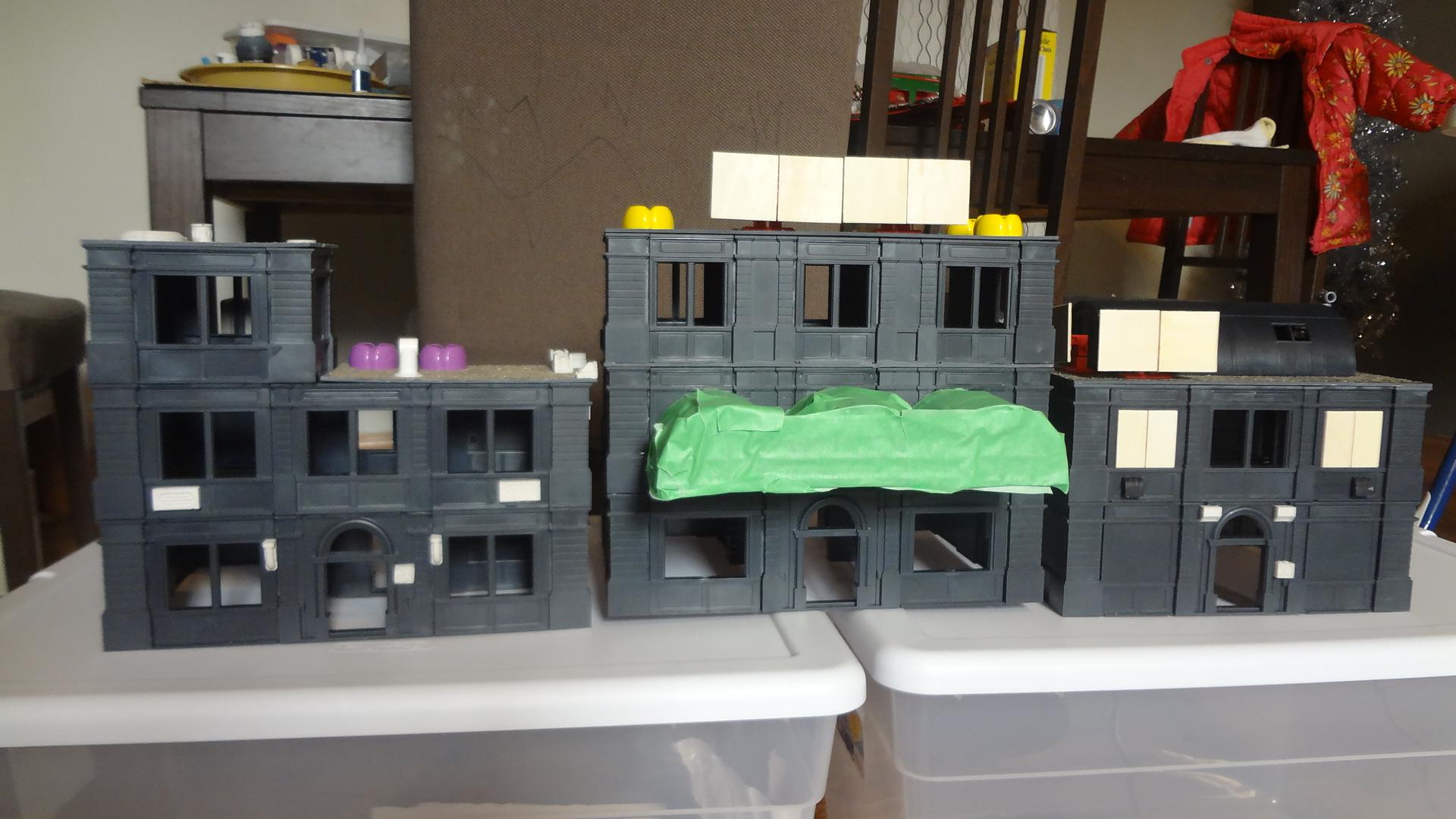
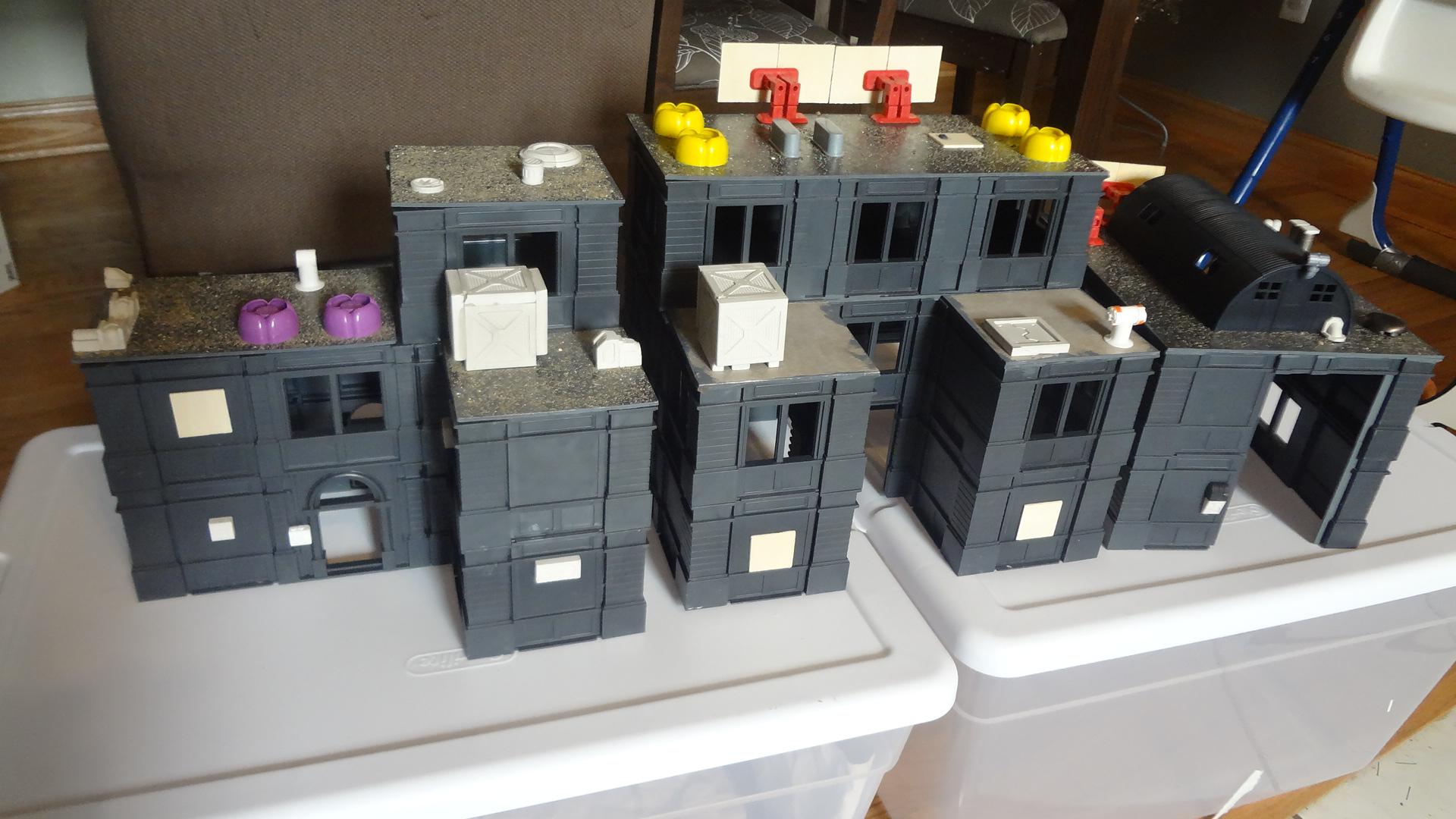
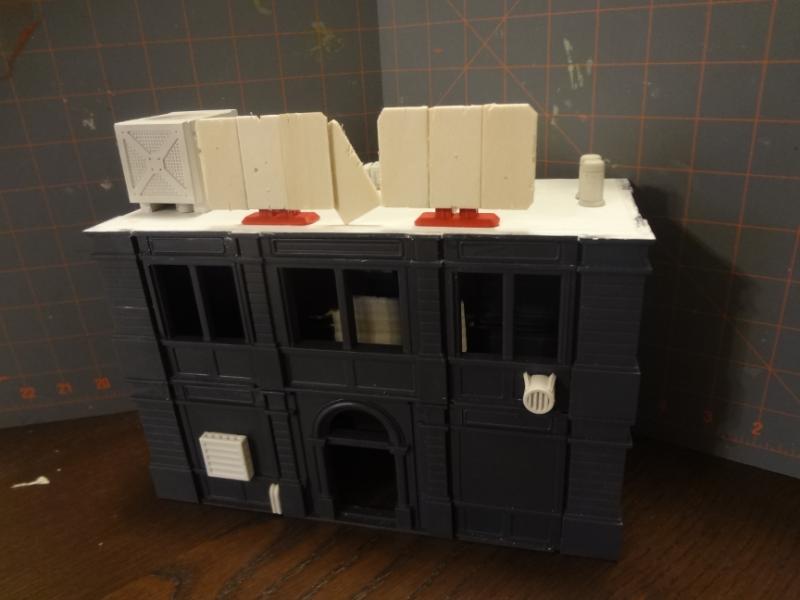
The masked-off awning is from a toy train station that I found at a resale shop. The purple and yellow vents are the caps from baby food pouches. For these roofs, I tried something different that worked really well. The roofs are self-adhesive vinyl composite tiles. At about $1 per square foot, these cheap tiles have adhesive on one side.
You can put them sticky side down as seen on the 2nd floor of the middle building, or (as with the rest) you can put them sticky side up. The glue is sticky enough that almost all the stuff on top of them required no glue. After I attached the various details, I sprinkled sand over the rest of the sticky surfaces to simulate the tar and gravel roofs that are so common in the city. Black gesso will nicely cover any remaining adhesive Almost all roofs lift off to access the interior of the buildings.
That's all for now! I'm working on two more buildings, but you'll have to wait for the next post to see them all. Here's a teaser of what's to come when I show off all seven finished buildings…
Stay tuned!
-- Karl, Chicago Skirmish Wargames club member
Monday, January 12, 2015
Would You Explore These Dark Depths?
Right on schedule, my shipment from 2014's Dwarven Forge Caverns Kickstarter arrived last fall. I participated in the Dungeon Tiles Kickstarter as well, so I was excited to use these new pieces on the table alongside my existing collection.
First, though, I needed a paint scheme. Aside from a few splatters of blood, slime and ooze, my dungeon tiles were mostly monochromatic, as you can see in this pic from a recent game.
That's fine for a dungeon, but the level of sculpting and detail on these cavern pieces begged for a more diverse palette. So I tried added in some bursts of color to the various textures and growths on the cavern walls. Depending on the scenario, these scenic bits can either represent verdant fungi, toxic mold, or even precious gems and ores to be mined and extracted by an enterprising underground expedition.
You be the judge. Would you light a torch and plumb these dark depths?
- Patrick, Chicago Skirmish Wargames club member
Thursday, January 8, 2015
Sedition Wars: A Good Deal for the Patient Modeler
I recently stumbled across one of the biggest bargains in miniatures today: Sedition Wars, Battle for Alabaster. The boxed game can regularly be found for 60% to 70% off, making it a fantastic deal for a box full of Studio McVey miniatures, and oh yeah -- the box also happens to come with a game.
However, as you'll see, I had to overcome a few hurdles to get the most out of these models.
In this review, I'll focus on the Vanguard troopers (the human faction), as I split the box with fellow club member Tim, and he got the other figures.
I have little interest in the game itself, and I plan to use the miniatures as the military forces of the Maersk-Tesla Corporation, a faction in our club's Galactic Frontier homebrew sci-fi setting.
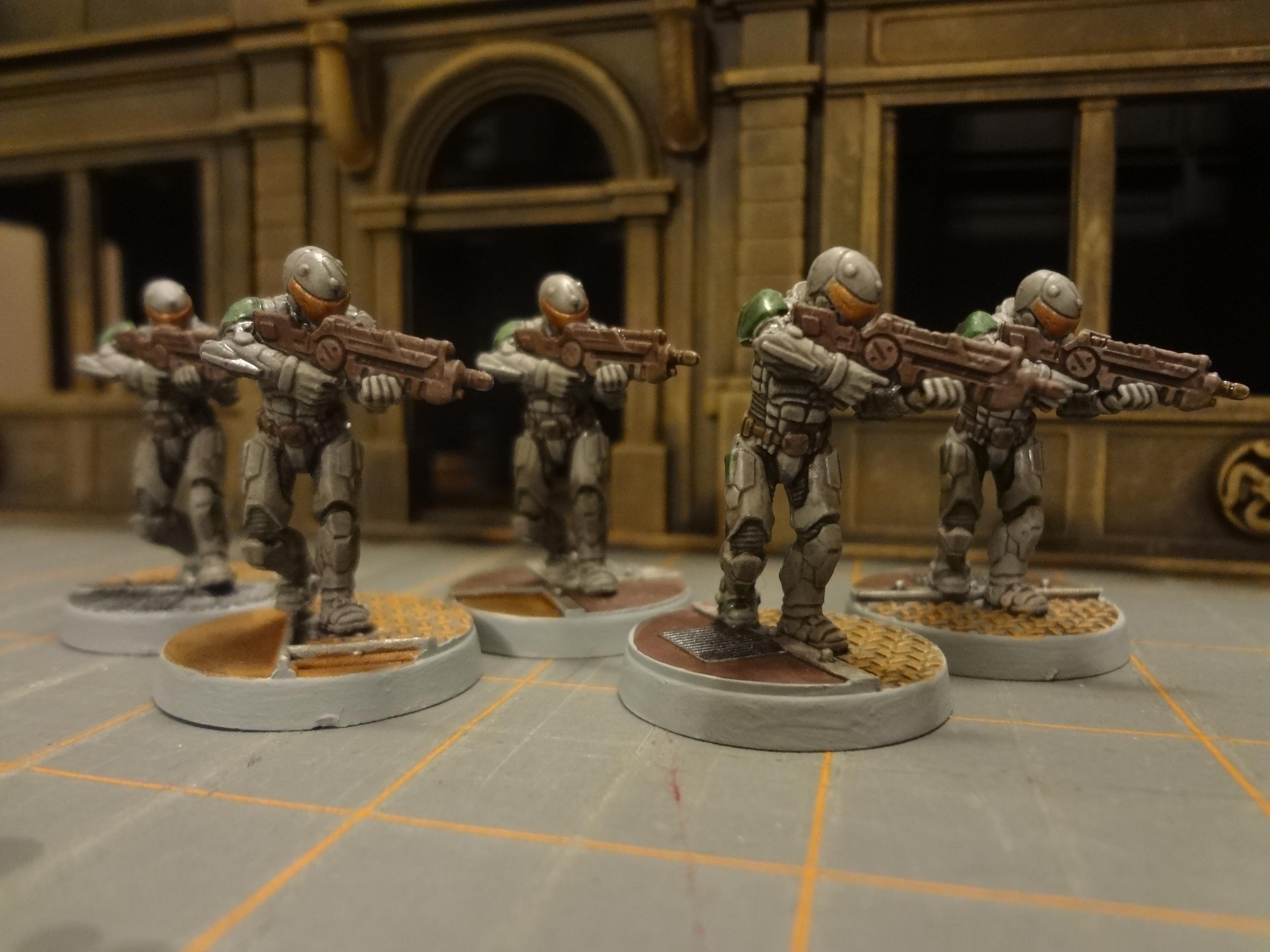
To that end, they have been painted in a scheme similar to my Necromunda Van Saar gang, which also serves double duty as a Maersk-Tesla survey team. I ended up with a number of scenic bases from the Sedition Wars box set, but I set those aside and based up the Vanguard troopers on the same Champ Industries plastic bases as the Van Saar.
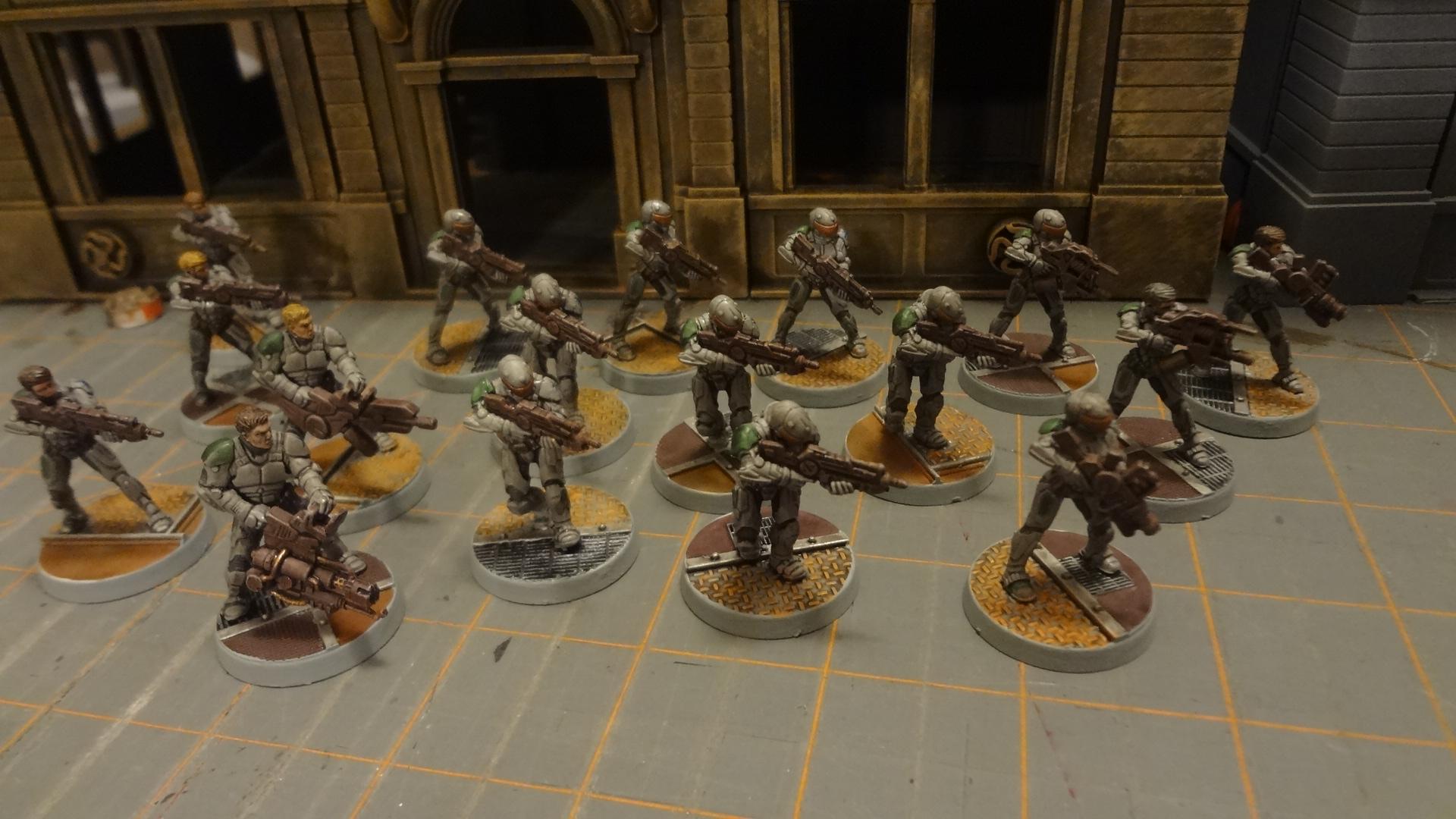
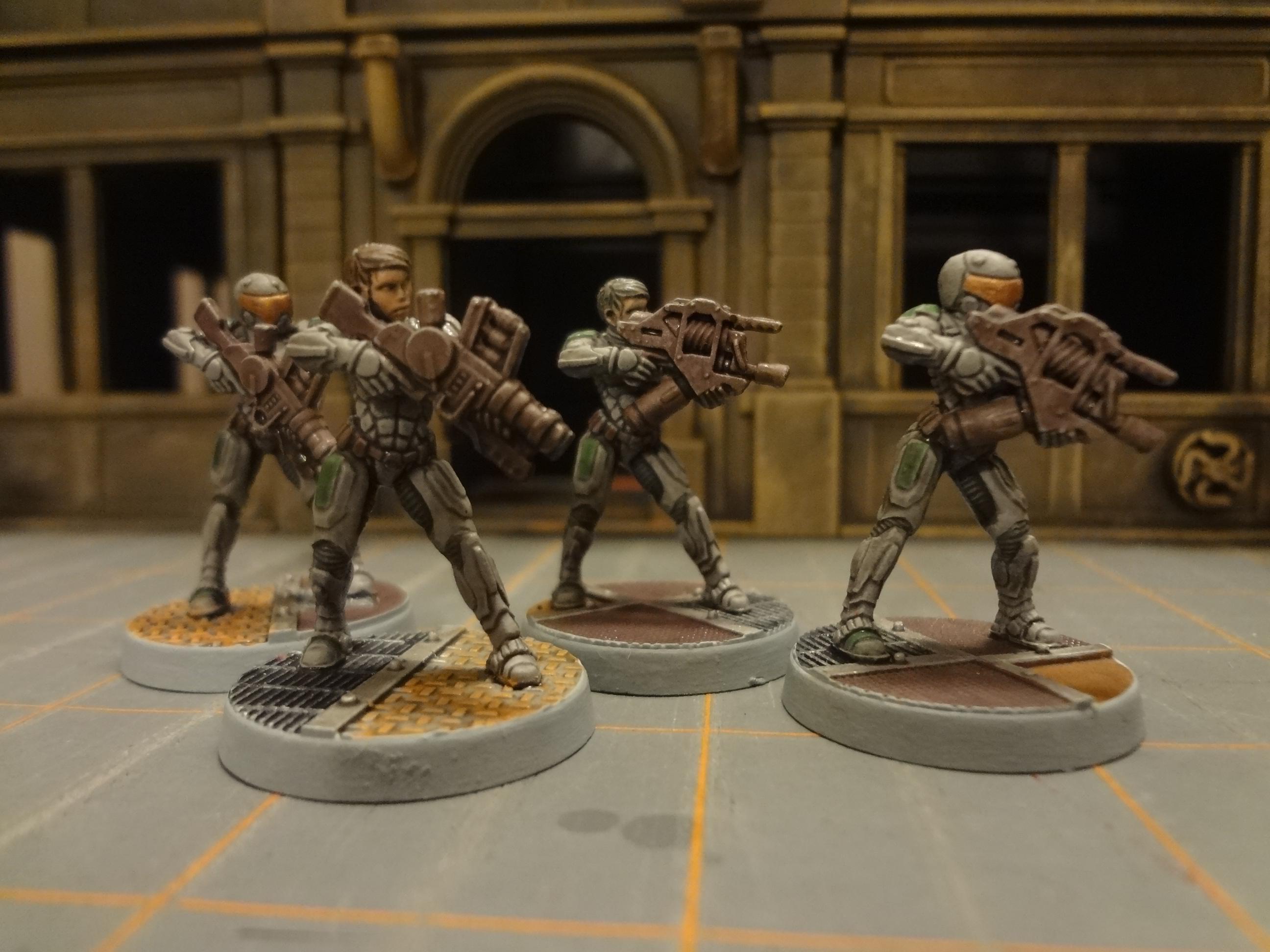
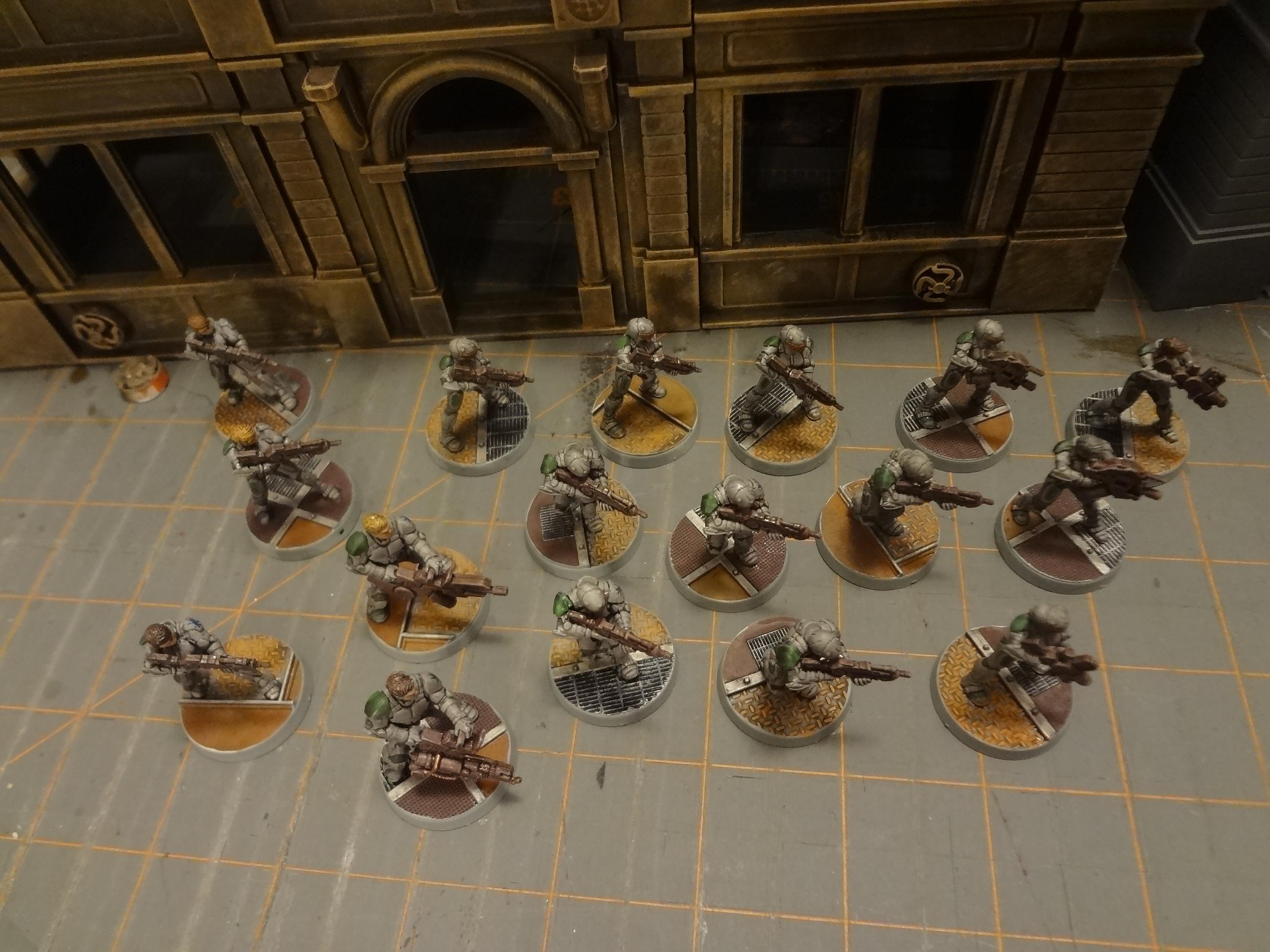
The Vangaurd Faction includes 22 models, 17 of which are variations on the basic trooper in four different sculpts.
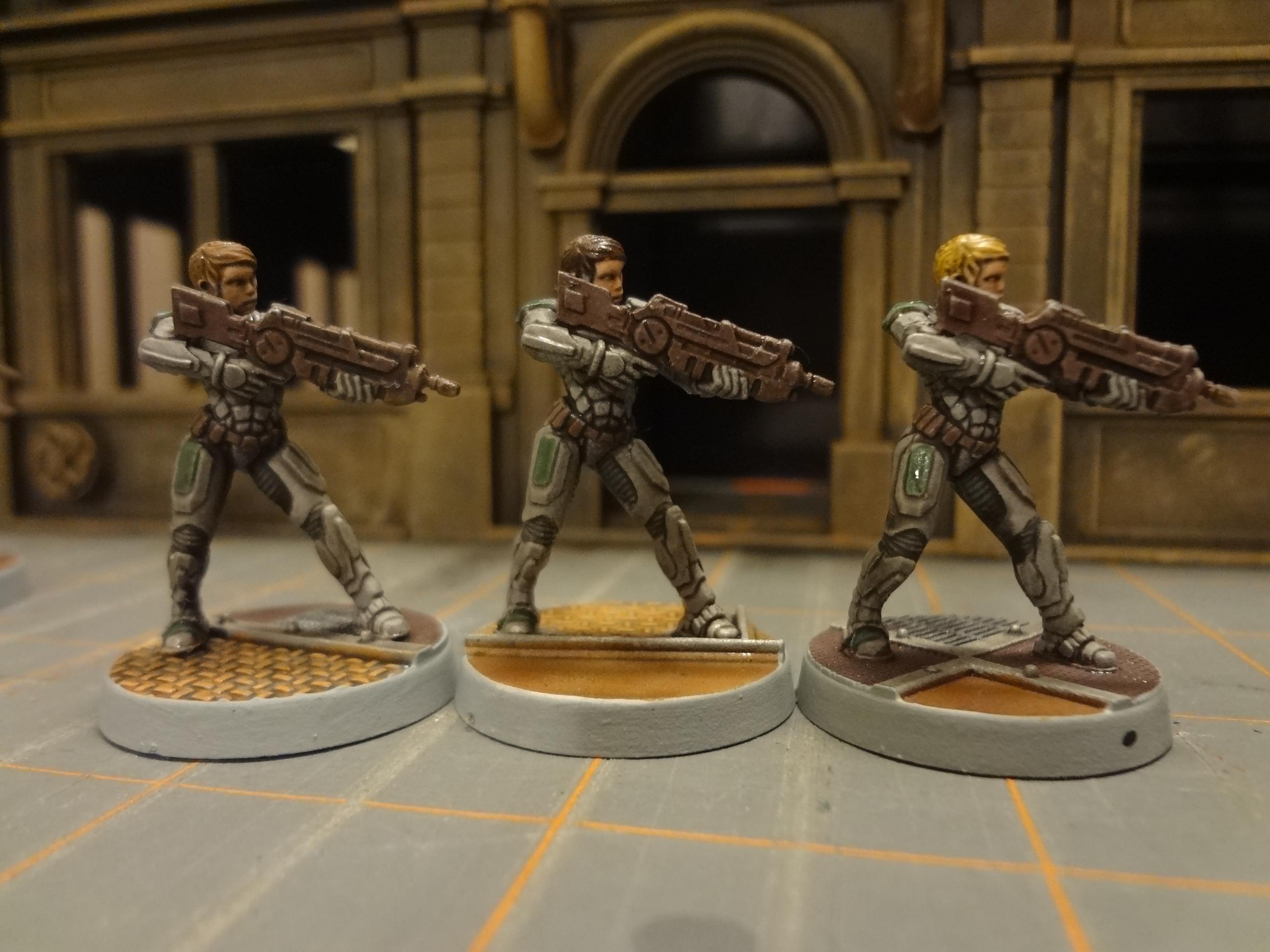
Here's the male trooper with rifle.
These guys have shoulder joints that protrude much farther back than they should when you attach the arm/gun piece. Rectifying this required shortening the back of the shoulder pad and carving away a bit of the underarm area on the body.
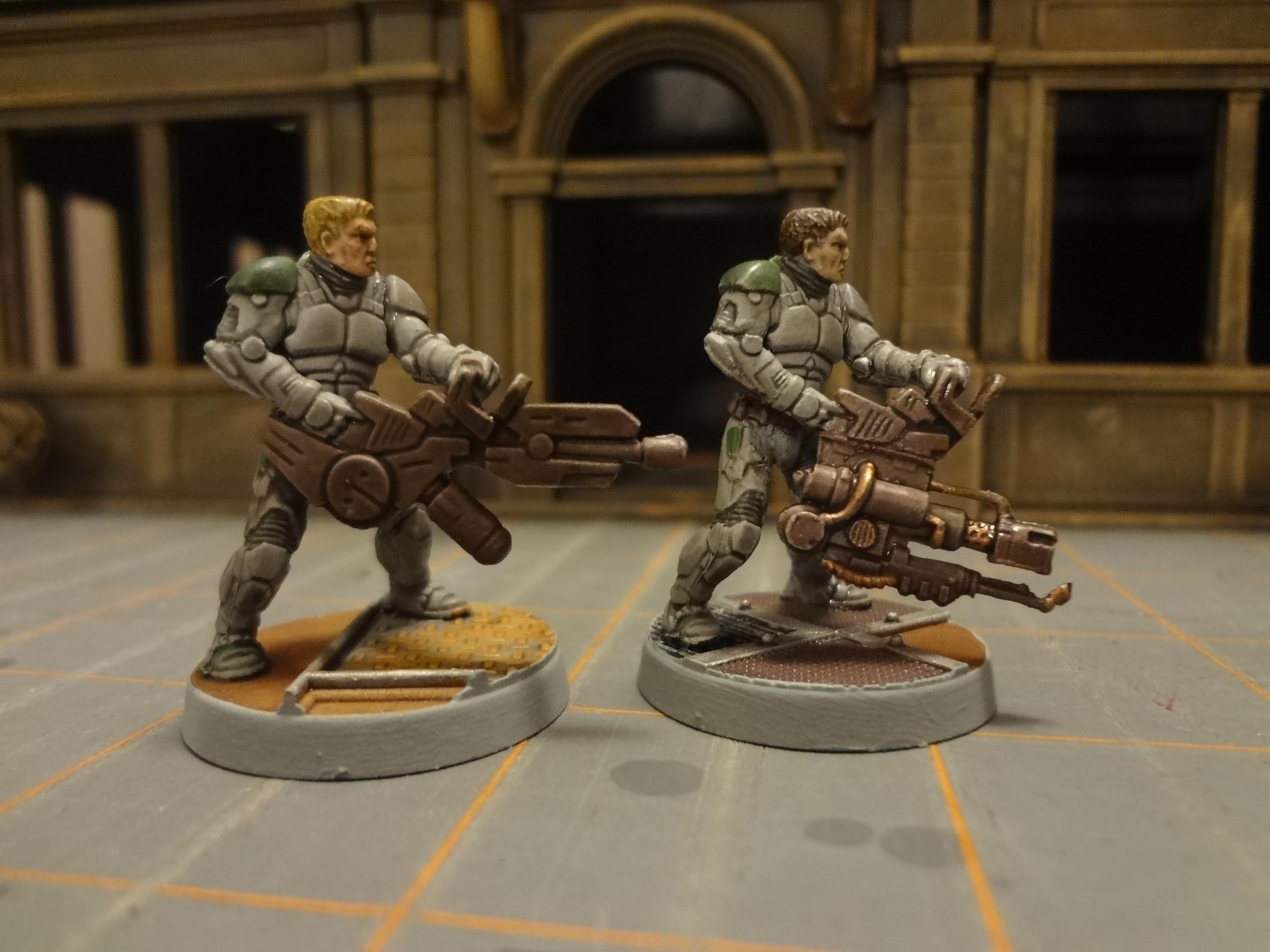
Here is the male trooper with support weapon.
This one went together pretty easily without much trimming. I got two of these figures, both with the gun on the left. The figure on the right is converted with an optional flamethrower bit from my bits box.
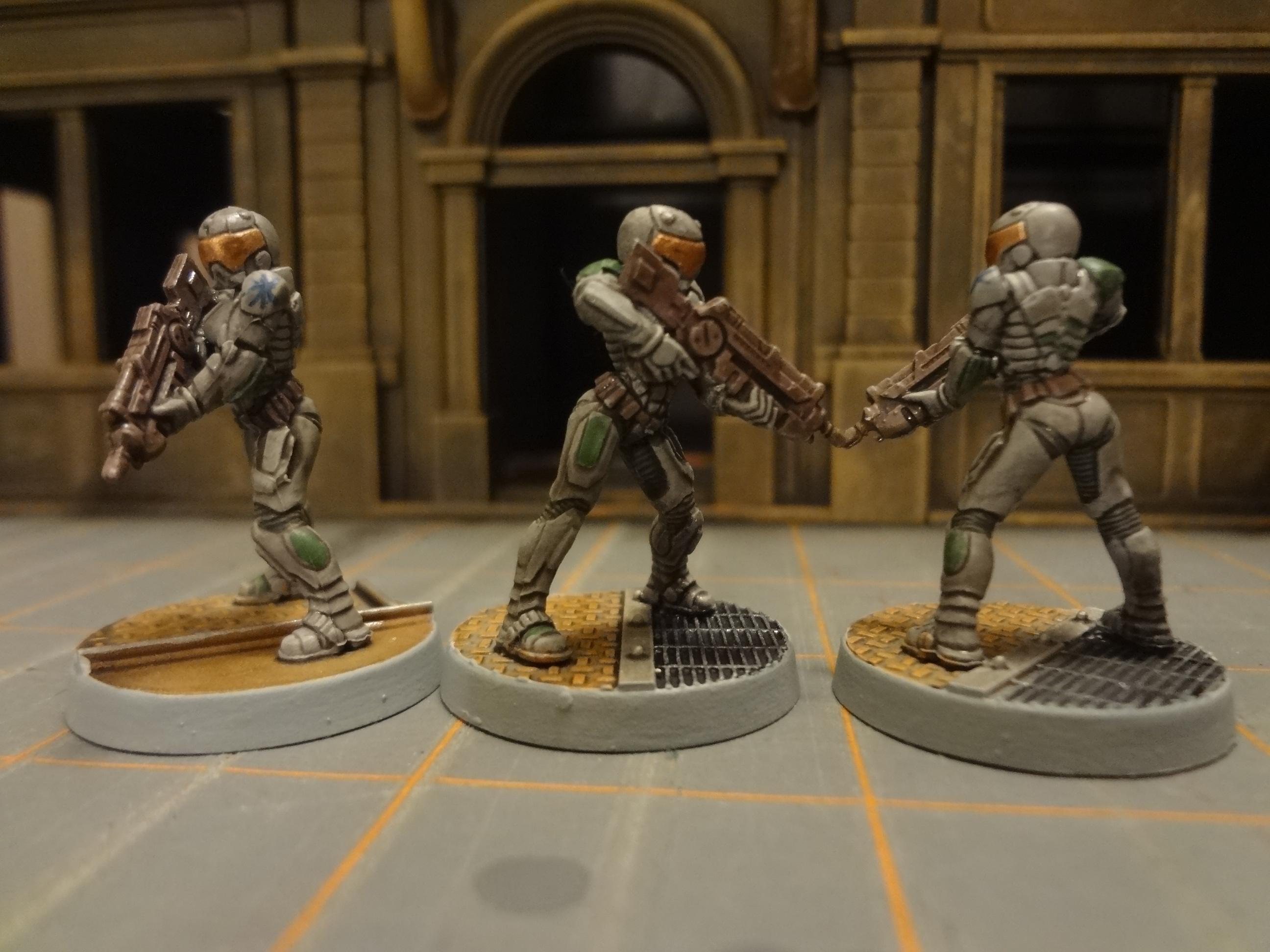
Here's the female trooper with helmet and rifle.
The female trooper comes in two poses: one helmeted and one bare-headed. Unfortunately, the connection between right elbow and upper arm is not a perfect one. A bit of sanding to the upper arm helps, but unless you want to sculpt every elbow joint, I recommend a nice thick gel superglue to fill the join. This is annoying, but it looks OK when finished.
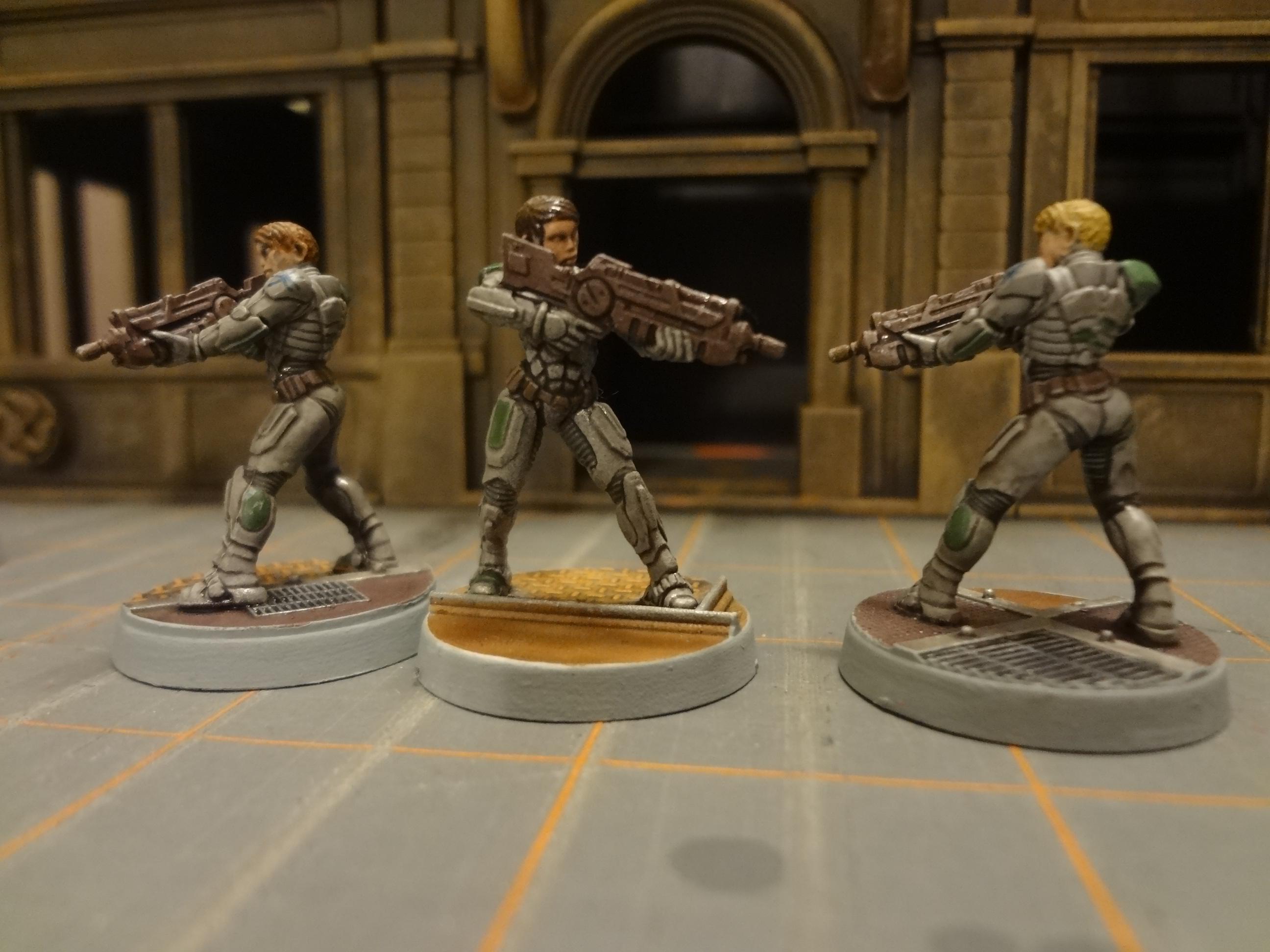
Here's the female bare-headed trooper with rifle
The bare-headed female trooper has the same assembly issue as the helmeted trooper.
Here we have a couple female troopers with special weapons.
As well as rifle arms, the female troopers include four special weapons: two plasma guns and two grenade launchers. I wish they had included at least two more rifle arms as an option, but there are no extra guns included. The special weapons arms can be used with the either the helmeted or bare-headed troopers, and both unfortunately have the same elbow issues.
So, the full roster of Vanguard troopers came out as follows.
- 5 males with rifles
- 2 males with heavy weapons
- 5 bare-headed females
- 5 helmeted females
Six of the females have a rifle, and four of the females have a special weapon of some type.
The Bad News
As noted, the joins between the bodies and arm/weapons on most miniatures don't meet exactly. This isn't the end of the world, but I can see how it would be massively frustrating to someone without much gaming experience (Sedition Wars was marketed as a board game, after all). This is a major failing when you consider that most minis consist of just two pieces.
The real kick in the teeth, though, are the mold lines. They aren't huge, but every miniature has them, and they're awkward to remove. Mold lines are an expected part of plastic miniatures, but the issue here is that these figures are made of the sprue-less plastic material (aka restic, plastic-resin, etc) that many companies are using these days to save money.
This plastic cannot be scraped or filed or assembled with plastic solvent glue. All cutting must be done using a sharp knife (use a new blade), superglue is required to attach the pieces. Consequently, the removal of mold lines is a very long and sometimes frustrating task -- far more difficult and time consuming than with resin, metal, or polystyrene.
It took me noticeably longer to clean up a two-piece Vanguard miniature than to to clean-up and assemble a multi-piece Games Workshop infantry model.
The Good News
The sculpts themselves look great. They're a step above any of the other bargain-priced lines of sci-fi troopers. Studio McVey premium sculpts (some of the identical models) will set you back $8 to $15 each when bought individually in metal or resin.
Once properly assembled, these Vanguard troopers look almost as good. The style is crisp, the details are very well done and the design work is great. The figures are an example of the shiny sci-fi aesthetic seen in games like Infinity (where these figures would work as excellent proxies).
For those willing to put in the time and frustration, the opportunity to pick up McVey sculpts for around 50 cents each is too good to pass up.
My Overall Impressions
I really did not enjoy assembling these models, but I can't deny that they look great when done. The crisp sculpting and excellent detail made my speed painting style (block colors and a dip) look pretty darn good.
At this low price, I'm even considering buying another batch just to get more rifle-toting troopers. I might try some head swaps to add a bit of variation.
To be clear, I would never pay the original $90 retail price for this set. At that price, I expect better miniatures with less issues. However, at $25-30 for 50 figs, 50 scenic bases and a playable game, my calculations are completely different.
Sedition Wars: Battle for Alabaster offers the patient and experienced modeler a chance to get great looking figures at a superb price. After I finish a large terrain project, I'll be back with the last five Vanguard minis from this set: four characters and a robot drone.
-- Karl, Chicago Skirmish Wargames club member
Tuesday, January 6, 2015
Armor Reinforcements for Warpath and 40k
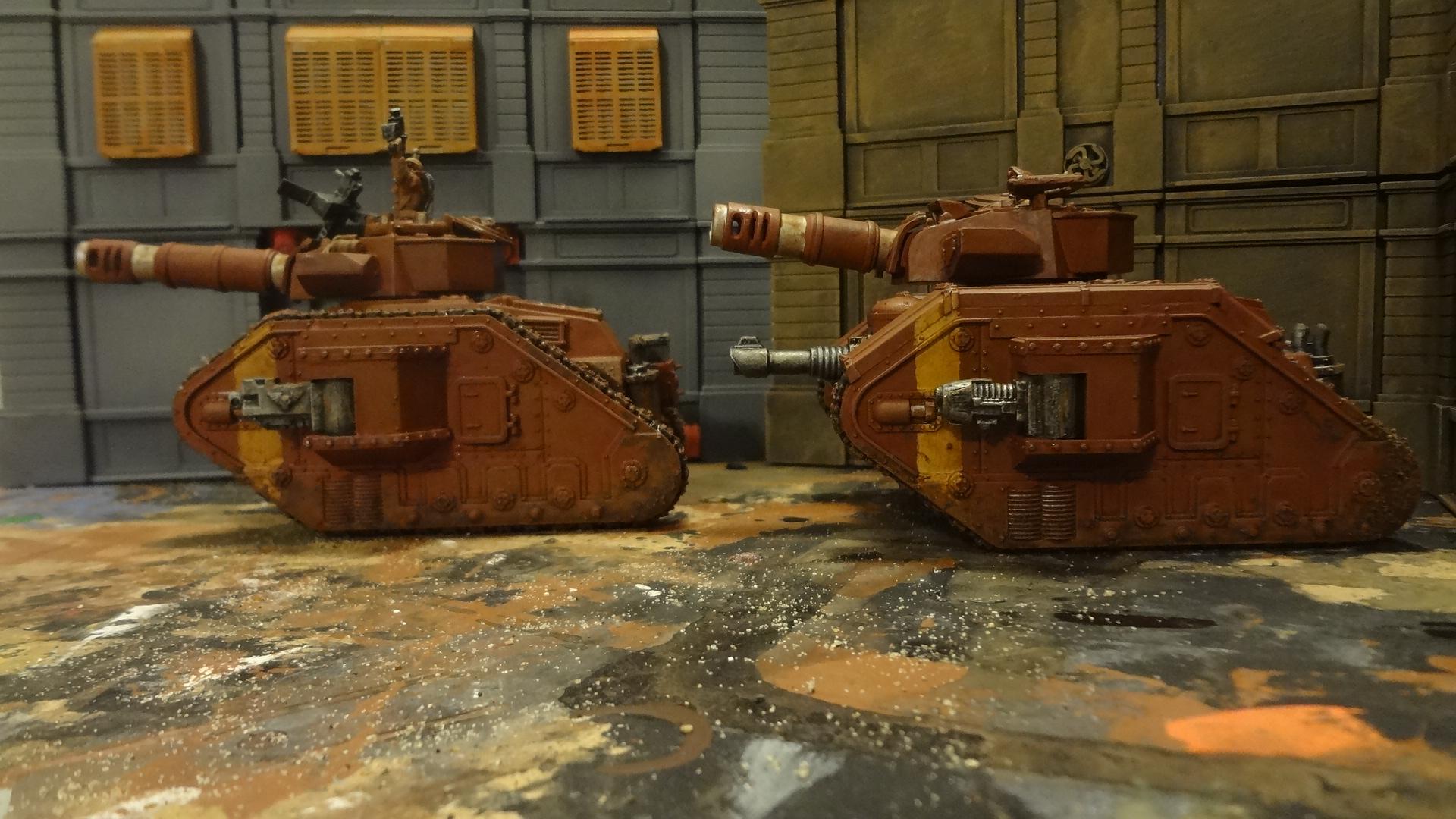
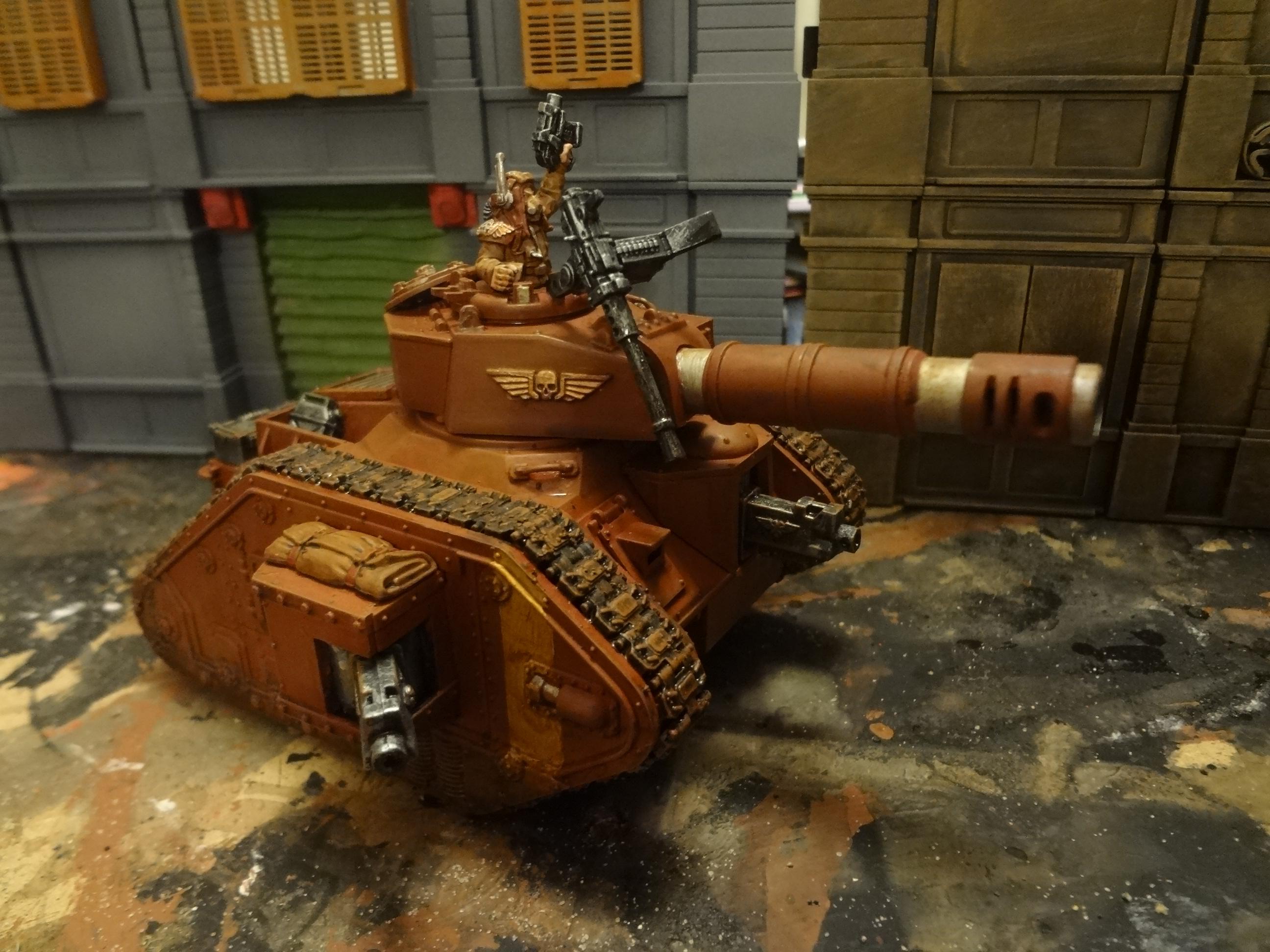
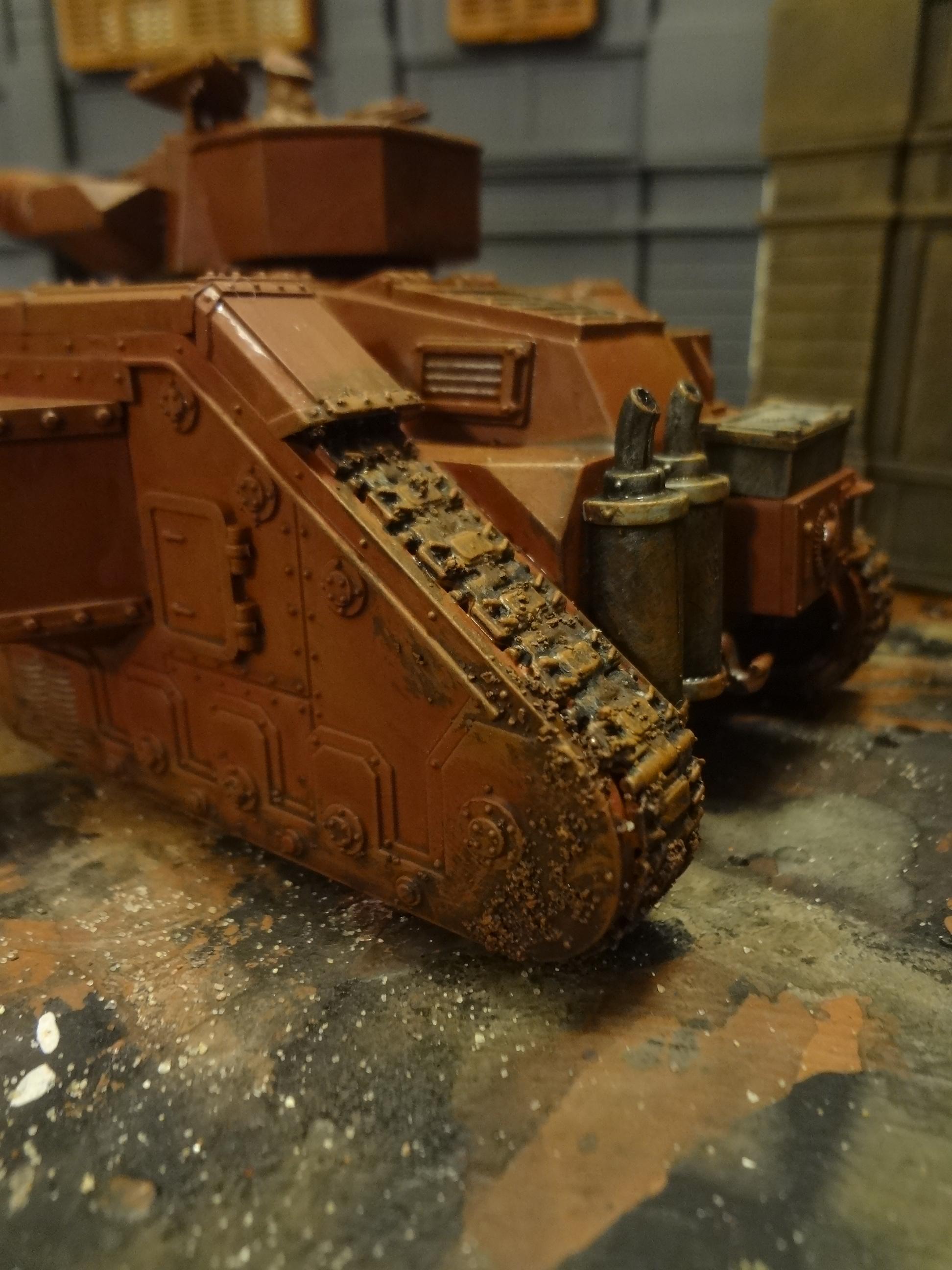
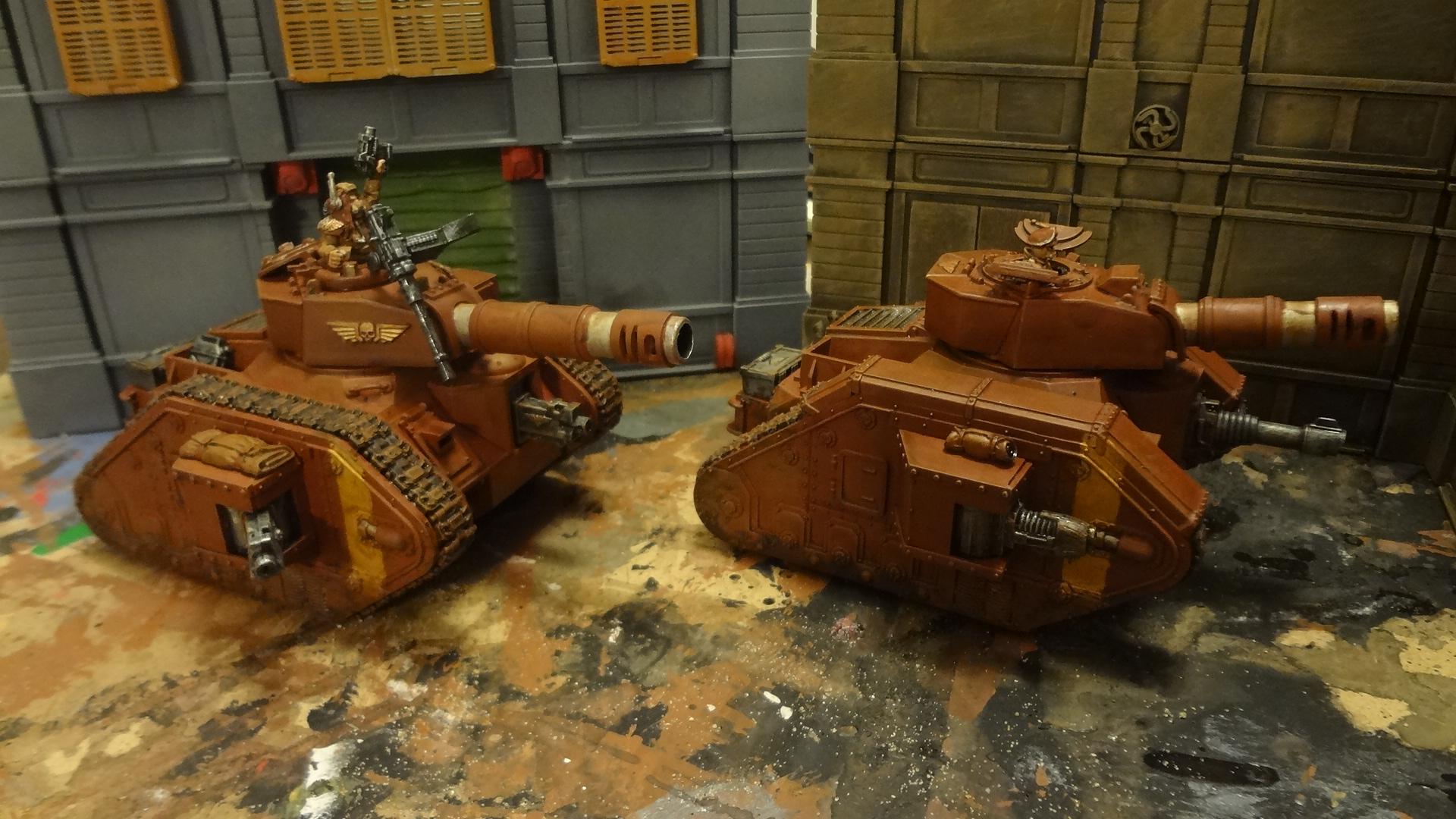
I finally brush-dipped and varnished the Leman Russ tanks I painted up for our mega-apocalypse Warpath game from last month. You can read all about it right here.
These vehicles are mostly stock with a couple of modifications, and they received a quick paint job of base colors, drybrush and brush-dip with Minwax Polyshades Tudor. One of these was a kit that I've had sitting around for about a decade and the other is a rescue of a very poorly painted (Testors gloss enamels, ugh) tank I got from Tim.
I lengthened barrel on the this cannon.
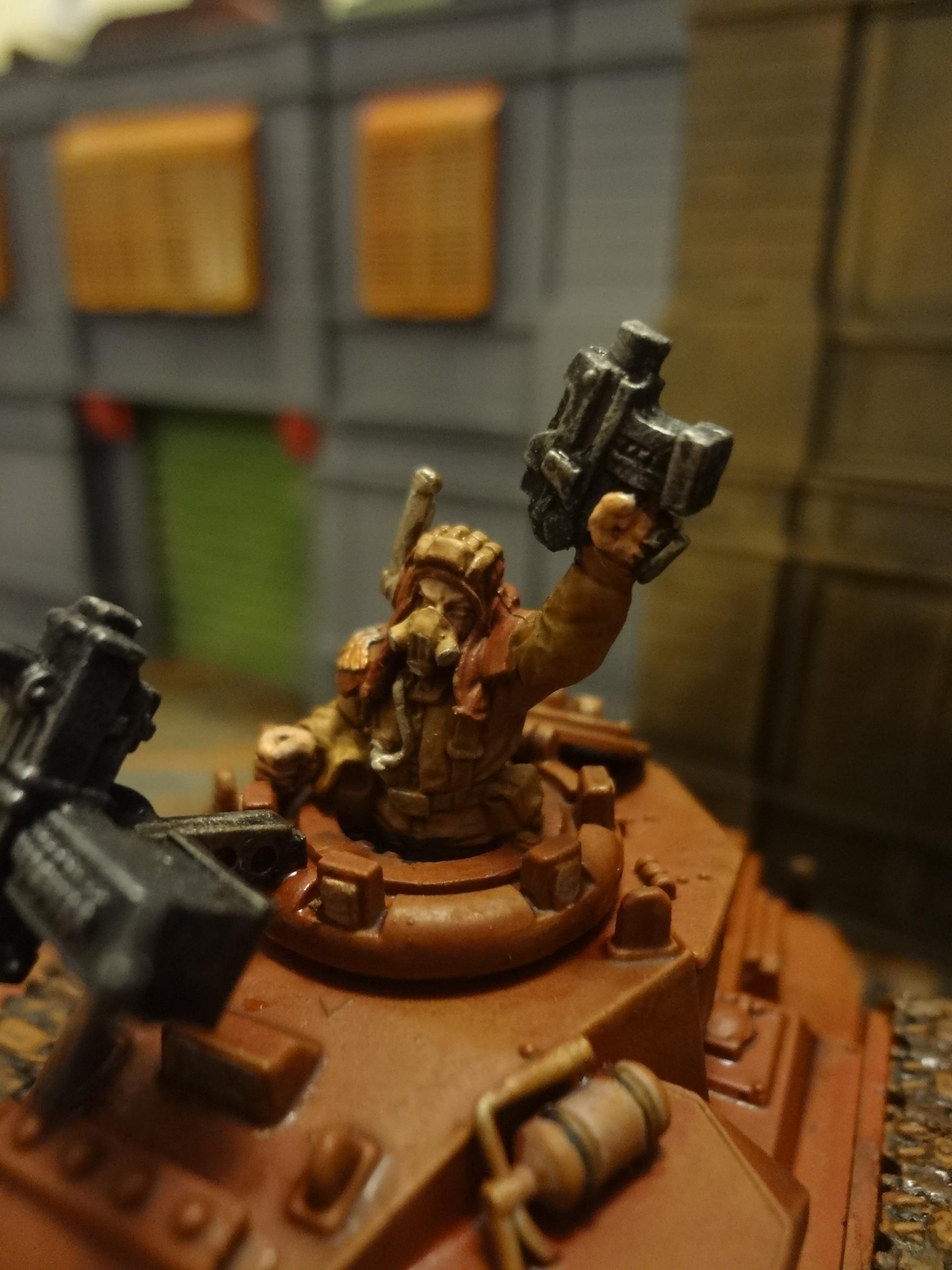
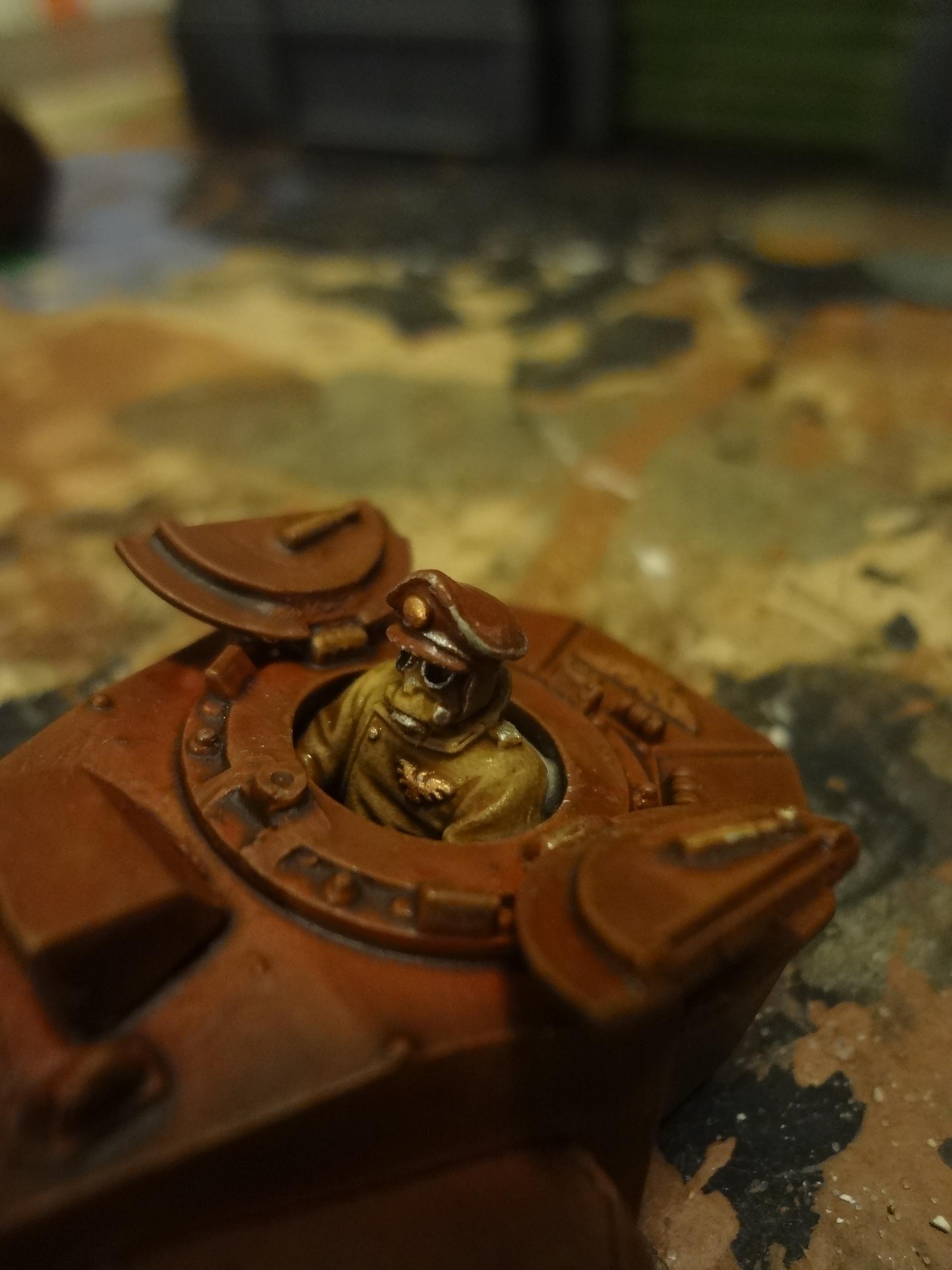
And I added a classic metal Imperial Guard tank commander figure -- something I've always wanted to paint one up. Here he is, with a small gas-mask bit from the Imperial Guard command sprue.
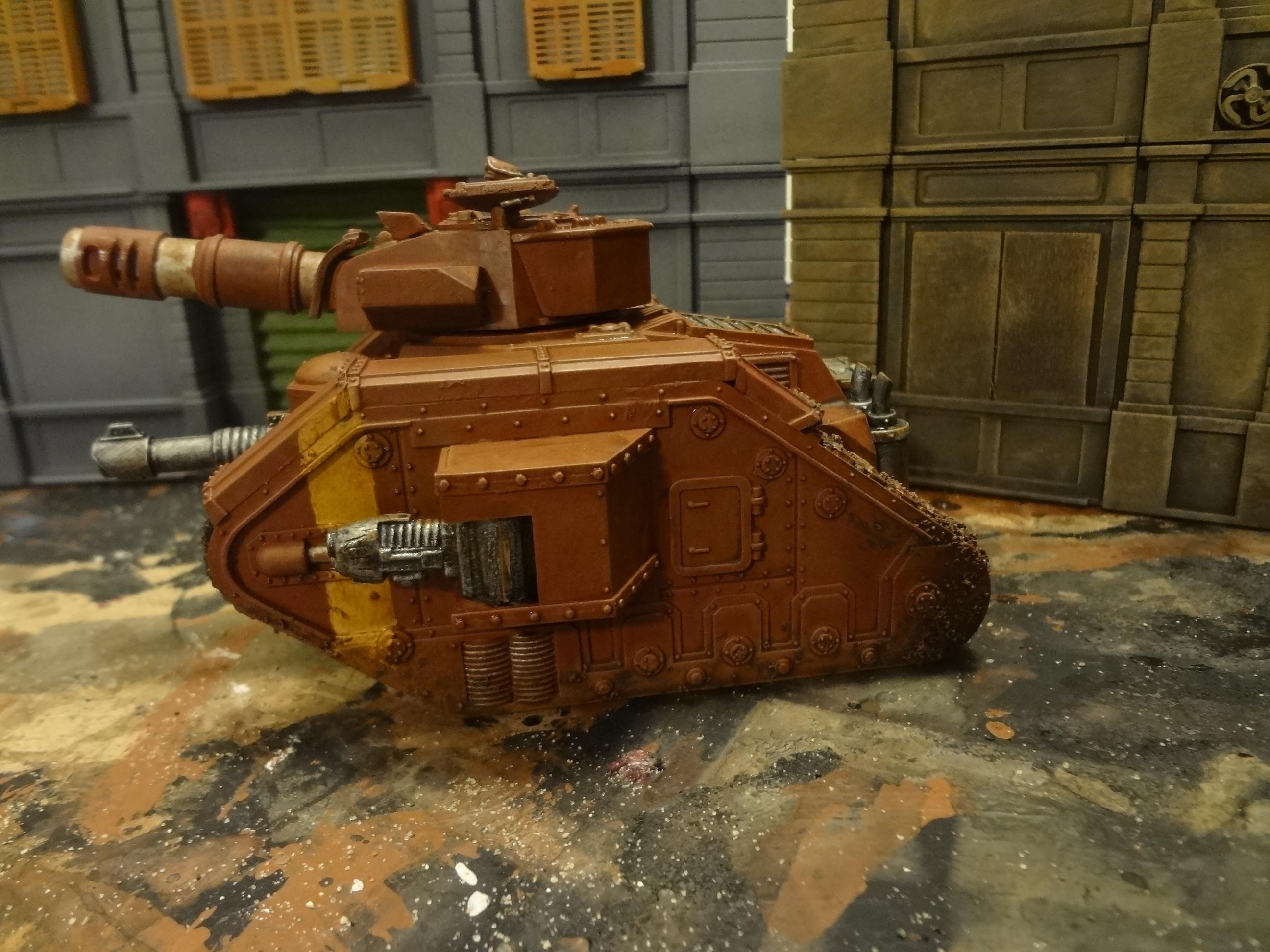
This one has a couple of metal plasma cannons from the old Demolisher kit. I'm not sure plasma cannons are an option for standard Leman Russ tanks at the moment, but I'm quite certain I don't care.
The head on the commander is from Pig Iron Productions. Every human figure in my Imperial Guard force has a gas mask.
The mud is Sheetrock brand paint texture mixed into brown paint.
All in all, these were a fun couple of tanks to build and paint.
I can't imagine anyone ponying up the $50 each that Leman Russ tanks cost nowadays, but I've got a soft spot for these ungainly sci-fi-meets-WWI behemoths and was glad to add them to my army.
I don't play 40k anymore, but Warpath is always an inspiration to paint up a unit or two. So, expect the army to continue to slowly grow...I've still got a Valkyrie VTOL, some Ogryns, a small platoon of infantry and a few Chimera transports waiting for the brush.
-- Karl, Chicago Skirmish Wargames club member
Friday, January 2, 2015
Power Legion Game Report: The Fury of Gladiator
Last month the club gathered to try out Power Legion, a skirmish game set in a comic book super world written by Andrea Sfiligoi and published by Ganesha Games. While the game doesn’t have the rights to any of the classic comic book characters, the ruleset can easily recreate those characters.
With my collection of older HeroClix figures, it was easy to pick out some fun sculpts on some older figures of the appropriate characters and rebase them with plastic bases from Proxy Models. (Full disclosure: I am a credited volunteer editor for Power Legion. I was also a serious HeroClix player, so I really like my super heroic games.)
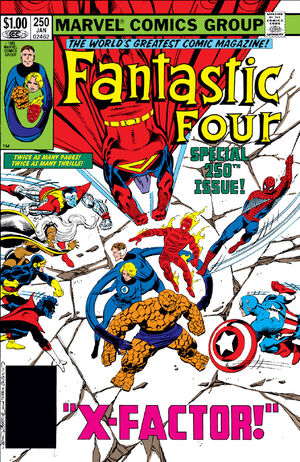
For me, the best part about a game like Power Legion is recreating the battles from classic comic books. There are few comic books more seminal to my love of comics than Fantastic Four #250. Back then when a comic hit a milestone like a 50th or 100th issue, you were in for something special.
Using the stats available online, I created teams for Tim, newcomer Brad, Karl, and me. Tim played (and supplied rebased HeroClix figures for) the Fantastic Four, consisting of Mr. Fantastic, Invisible Girl, The Human Torch, and the Ever Lovin’ Blue-Eyed Thing.
Brad ran the X-Men consisting of Cyclops, Storm, Colossus, and Nightcrawler.
Karl used Gladiator, a super man from a distant galaxy known to the Fantastic Four and the X-Men. I got to play Captain America and Spider-Man.
In Fantastic Four #249, Gladiator arrived on Earth hunting alien Skrulls. Thinking the Skrulls were impersonating the Fantastic Four, he attacked them and quickly defeated them. As the book ends, the X-Men arrived to save the day.
In #250, the X-Men attack Gladiator, drawing Spider-Man and Captain America into the battle. This is where we begin our scenario. Each player was given a secret victory goal.
To battle in downtown New York, you need an urban landscape. For ours, I printed and assembled six buildings, duplicating one, from the Capital City: Base Set PDF from Fat Dragon Games. In Power Legion, each character gets four statistics: Mind, Agility, Strength, and Knockout. (M.A.S.K., see what Andrea did there?).
Each stat is assigned a die: d4 (feeble), d6 (average), d8, d10, d12 and even an occasional d20 for the most powerful characters. In addition, there are pages of powers and abilities that will be familiar to comic book fans and allow players create any hero or villain they might want to play as in the game.
Fans of other Ganesha games will recognize the activation system. One difference is that the player rolls one die (usually a d6 to a d12) with the result giving the character one, two, or three actions to take, while losing their turn on a die result of one. And Ganesha gamers will also recognize the three movement sticks.
Early in the game we realized fliers were fast and cover a lot of terrain quickly. Walkers can take some time to get where they are going, especially if they roll low or miss their activation rolls entirely. That happened early to Tim as the Thing moved into the game slowly.
As the game began, Gladiator swooped from the street to the top of the tower to attack Spider-Man. He must have heard Spider-Man’s crack about his mohawk haircut with his super hearing. The attacker and defender roll their Agility die or some other die if they have certain abilities. Then, if the attacker rolls higher they roll Damage, pitting the attacker’s Strength against the defender’s Knockout.
Gladiator missed his attack and the X-Men went on the offensive. Colossus threw a car at Captain America while Cyclops blasted at the Star-Spangled Avenger, knocking him down to recover on his next turn.
Spider-Man spotted this assault from the heights of the skyscraper and abandoned his battle with Gladiator to help Captain America. When two characters are in melee, whoever rolls higher on the attack then rolls for damage on their opponent. So although Spider-Man was on the offensive, Colossus rolled better for the knockout. And for the trouble he took to come to the aid of Captain America, Spiderman got KOd.
Mr. Fantastic and Human Torch then flew up to face Gladiator. Mr. Fantastic was KO’d on the first shot leaving Torch to face Gladiator alone. But not for long, as Storm blew over from the other building to attack the Gladiator.
Gladiator’s next attack would knock out Storm and the Human Torch with a planned ricochet shot. Storm fell over the side of the building and was revealed to be a Skrull! The X-Men are the fiends Gladiator has been hunting!
Below, Cap and Colossus squared off in a melee that would last the rest of the game. Both were able to hit each other regularly but neither was able to land a telling blow as Colossus’ armored form and Captain America’s shield kept either from being harmed. Even with the protection of the Invisible Girl’s force shield, which eventually got her knocked out by Cyclops, Captain America could not find an advantage over Colossus.
Once Gladiator knew who the Skrulls were, he made quick work of Nightcrawler and eventually knocked out Cyclops when he swooped in for an up-close melee attack rather than trading ranged attacks with the long range marksman.
Colossus continued to square off with Captain America, and it looked grim for the silver skinned Skrull imposter as The Thing moved in. Captain America landed a minor blow that knocked down Colossus, but The Thing was unable to finish him off and the Skrull regained his feet to face off against Captain America and The Thing, then eventually Gladiator as well.
This is when the game devolved into a series of roll-offs as all the characters were landing blows, but none connected for the Knockout. We eventually decided to give the game one more round and on his last attack, Colossus finally took down Captain America.
This meant the Skrulls were able to take down three members of the Fantastic Four (even if it was Gladiator who did their work for them with Mr. Fantastic and the Human Torch) and Gladiator took down three of the Skrull impersonators, leaving Karl and Brad tied for the victory in the scenario.
In Power Legion, when a die roll is modified, it is shifted to the next die type. So a d6 can shift down to a d4 or up to a d8. So, with a second or third action on an activation, it was fairly easy for characters like Nightcrawler or Captain America with the Acrobat trait — gaining a shift from a d10 to a d12 on a melee attck — to make a Power Blow and shift from that d12 to roll a d20 on an attack and hitting successfully. But then they were only rolling a d6 or d8 to deal damage. It made me feel like I was missing some rule or ability that would help that final blow land successfully for damage.
During the game, we found it difficult to damage characters with the Armor trait. Instead of a die shift, Armor adds half the number of sides of the Armor die to a Knockout roll. Collossus with d10 for his Armor added 5 to every Knockout roll. That is an imposing number when the attackers were rolling a Strength die of d8 or d10.
The endgame came down to four characters with Armor, and the combat dragged a bit because of this. Later, Brad suggested a couple of house rules to counter the effect of Armor: 1. If your attack roll doubles your opponents defense roll, you shift your damage die up one level. 2. If your target is prone or somehow disadvantaged, shift your damage die up one level.
During our game, we also never selected any Major Damage effect other than making the opponent make a Knockout roll. A roll on a chart of damage effects, both minor and major, might give the game a little more flavor.
Overall, we enjoyed the game and we look forward to playing again. Of course, it being our first game, we made a few errors. There are also some things that need clarification in the rules. We also left out the Ace Cards and Fate Points that give characters more comic book actions. We wanted to keep thing simple the first time out.
For Karl, not being a superhero gamer before, he figured it would be a good game — it's Ganesha after all — but not one that would interest him much. After the game he really enjoyed it.
"I found the rules pretty easy to learn being in the general vein of Ganesha," he reported. "However there are some very nice changes to the dice mechanics, including the use of the whole range of polyhedrals which I really enjoyed," reported the CSW headman. “I probably won't spend much time painting superhero figs, but it's definitely a game I'd play again and I hope to dig into the rules a bit as they seem to be setup to incorporate the police figures I just finished painting."
We found that multiplayer didn't slow down quite as much as other games we've played, although 2-3 characters per player might be a better roster for beginners.
Look for more Power Legion from CSW in the future. Excelsior!
-- Terrence, Chicago Skirmish Wargames club member
With my collection of older HeroClix figures, it was easy to pick out some fun sculpts on some older figures of the appropriate characters and rebase them with plastic bases from Proxy Models. (Full disclosure: I am a credited volunteer editor for Power Legion. I was also a serious HeroClix player, so I really like my super heroic games.)
For me, the best part about a game like Power Legion is recreating the battles from classic comic books. There are few comic books more seminal to my love of comics than Fantastic Four #250. Back then when a comic hit a milestone like a 50th or 100th issue, you were in for something special.
Using the stats available online, I created teams for Tim, newcomer Brad, Karl, and me. Tim played (and supplied rebased HeroClix figures for) the Fantastic Four, consisting of Mr. Fantastic, Invisible Girl, The Human Torch, and the Ever Lovin’ Blue-Eyed Thing.
Brad ran the X-Men consisting of Cyclops, Storm, Colossus, and Nightcrawler.
Karl used Gladiator, a super man from a distant galaxy known to the Fantastic Four and the X-Men. I got to play Captain America and Spider-Man.
In Fantastic Four #249, Gladiator arrived on Earth hunting alien Skrulls. Thinking the Skrulls were impersonating the Fantastic Four, he attacked them and quickly defeated them. As the book ends, the X-Men arrived to save the day.
In #250, the X-Men attack Gladiator, drawing Spider-Man and Captain America into the battle. This is where we begin our scenario. Each player was given a secret victory goal.
To battle in downtown New York, you need an urban landscape. For ours, I printed and assembled six buildings, duplicating one, from the Capital City: Base Set PDF from Fat Dragon Games. In Power Legion, each character gets four statistics: Mind, Agility, Strength, and Knockout. (M.A.S.K., see what Andrea did there?).
Each stat is assigned a die: d4 (feeble), d6 (average), d8, d10, d12 and even an occasional d20 for the most powerful characters. In addition, there are pages of powers and abilities that will be familiar to comic book fans and allow players create any hero or villain they might want to play as in the game.
Fans of other Ganesha games will recognize the activation system. One difference is that the player rolls one die (usually a d6 to a d12) with the result giving the character one, two, or three actions to take, while losing their turn on a die result of one. And Ganesha gamers will also recognize the three movement sticks.
Early in the game we realized fliers were fast and cover a lot of terrain quickly. Walkers can take some time to get where they are going, especially if they roll low or miss their activation rolls entirely. That happened early to Tim as the Thing moved into the game slowly.
As the game began, Gladiator swooped from the street to the top of the tower to attack Spider-Man. He must have heard Spider-Man’s crack about his mohawk haircut with his super hearing. The attacker and defender roll their Agility die or some other die if they have certain abilities. Then, if the attacker rolls higher they roll Damage, pitting the attacker’s Strength against the defender’s Knockout.
Gladiator missed his attack and the X-Men went on the offensive. Colossus threw a car at Captain America while Cyclops blasted at the Star-Spangled Avenger, knocking him down to recover on his next turn.
Spider-Man spotted this assault from the heights of the skyscraper and abandoned his battle with Gladiator to help Captain America. When two characters are in melee, whoever rolls higher on the attack then rolls for damage on their opponent. So although Spider-Man was on the offensive, Colossus rolled better for the knockout. And for the trouble he took to come to the aid of Captain America, Spiderman got KOd.
Mr. Fantastic and Human Torch then flew up to face Gladiator. Mr. Fantastic was KO’d on the first shot leaving Torch to face Gladiator alone. But not for long, as Storm blew over from the other building to attack the Gladiator.
Gladiator’s next attack would knock out Storm and the Human Torch with a planned ricochet shot. Storm fell over the side of the building and was revealed to be a Skrull! The X-Men are the fiends Gladiator has been hunting!
Below, Cap and Colossus squared off in a melee that would last the rest of the game. Both were able to hit each other regularly but neither was able to land a telling blow as Colossus’ armored form and Captain America’s shield kept either from being harmed. Even with the protection of the Invisible Girl’s force shield, which eventually got her knocked out by Cyclops, Captain America could not find an advantage over Colossus.
Once Gladiator knew who the Skrulls were, he made quick work of Nightcrawler and eventually knocked out Cyclops when he swooped in for an up-close melee attack rather than trading ranged attacks with the long range marksman.
Colossus continued to square off with Captain America, and it looked grim for the silver skinned Skrull imposter as The Thing moved in. Captain America landed a minor blow that knocked down Colossus, but The Thing was unable to finish him off and the Skrull regained his feet to face off against Captain America and The Thing, then eventually Gladiator as well.
This is when the game devolved into a series of roll-offs as all the characters were landing blows, but none connected for the Knockout. We eventually decided to give the game one more round and on his last attack, Colossus finally took down Captain America.
This meant the Skrulls were able to take down three members of the Fantastic Four (even if it was Gladiator who did their work for them with Mr. Fantastic and the Human Torch) and Gladiator took down three of the Skrull impersonators, leaving Karl and Brad tied for the victory in the scenario.
In Power Legion, when a die roll is modified, it is shifted to the next die type. So a d6 can shift down to a d4 or up to a d8. So, with a second or third action on an activation, it was fairly easy for characters like Nightcrawler or Captain America with the Acrobat trait — gaining a shift from a d10 to a d12 on a melee attck — to make a Power Blow and shift from that d12 to roll a d20 on an attack and hitting successfully. But then they were only rolling a d6 or d8 to deal damage. It made me feel like I was missing some rule or ability that would help that final blow land successfully for damage.
During the game, we found it difficult to damage characters with the Armor trait. Instead of a die shift, Armor adds half the number of sides of the Armor die to a Knockout roll. Collossus with d10 for his Armor added 5 to every Knockout roll. That is an imposing number when the attackers were rolling a Strength die of d8 or d10.
The endgame came down to four characters with Armor, and the combat dragged a bit because of this. Later, Brad suggested a couple of house rules to counter the effect of Armor: 1. If your attack roll doubles your opponents defense roll, you shift your damage die up one level. 2. If your target is prone or somehow disadvantaged, shift your damage die up one level.
During our game, we also never selected any Major Damage effect other than making the opponent make a Knockout roll. A roll on a chart of damage effects, both minor and major, might give the game a little more flavor.
Overall, we enjoyed the game and we look forward to playing again. Of course, it being our first game, we made a few errors. There are also some things that need clarification in the rules. We also left out the Ace Cards and Fate Points that give characters more comic book actions. We wanted to keep thing simple the first time out.
For Karl, not being a superhero gamer before, he figured it would be a good game — it's Ganesha after all — but not one that would interest him much. After the game he really enjoyed it.
"I found the rules pretty easy to learn being in the general vein of Ganesha," he reported. "However there are some very nice changes to the dice mechanics, including the use of the whole range of polyhedrals which I really enjoyed," reported the CSW headman. “I probably won't spend much time painting superhero figs, but it's definitely a game I'd play again and I hope to dig into the rules a bit as they seem to be setup to incorporate the police figures I just finished painting."
We found that multiplayer didn't slow down quite as much as other games we've played, although 2-3 characters per player might be a better roster for beginners.
Look for more Power Legion from CSW in the future. Excelsior!
-- Terrence, Chicago Skirmish Wargames club member