Tuesday, June 10, 2014

Sci-fi Industrial Buildings from Old Plastic Toys


Last weekend I finally got around to painting a couple of industrial terrain pieces that I had built some time ago. You can see the finished product above, along with an old 25mm chaos knight for scale. The top of his axe is about the same height as a Games Workshop Space Marine on a slotta base.

Both of these pieces started life as broken and cast-off toys I found at local resale shops. Some of the parts were made of soft plastic that required epoxy, and I even used plumbers PVC cement (truly nasty stuff) to attach the space capsule (more on this later).


The tower is some sort of a dumping toy or playset. I added a barrier to the front made from a piece of plastic scavenged off a classroom mathematics toy set. There are several versions of this kind of gridded counting aid toys, and I highly recommend picking them up when you find them at resale shops. They're great for sci-fi terrain. I also added some cross-stitch mesh to make the floor, and the bucket on the side was epoxied in place.


On the back, I added some bits of wood, toy greebles and a lamp made from a piece of plastic.


The top section is stock, and it's just full of nice places to put figures for my games. It's also wide enough to hold an entire squad for larger games. I've got plans to use it as part of an elevated terrain system I'm planning out.


The chemical plant piece is based primarily around a car launcher playset and and a toy lunar spacecraft.

 
Though Krylon's Fusion and Camo spray paints has made it easy to paint, I've still run into difficulty gluing large pieces of the soft (possibly polyethylene?) plastics that toy soldiers and others are often made of. The lunar module is made of just such a plastic. First I I tried plumbers PVC solvent adhesive to attach it to the hard plastic launcher. It is probably the harshest and worst-smelling glue/solvent I've ever useed, but it worked really well. Just be sure to use it somewhere that is well ventilated.


The vents and pipes sticking out from the side are plastic medical bits, maybe part of an IV or oxygen system. In the rear we have part of a smaller scale rocket toy stuck inside, a couple of copper elbow pipes and the drain from a contact lens case.

 
Painting was my usual speed method which I've used countless times over the years. The process gives good results in no time flat.

  • Prime black 
  • Wet/drybrush on the base colors 
  • Apply two heavy brown washes 
  • Dry brush metallic in a few places 
  • Tan dry brush all over
  • Matte varnish spray

Check back soon, as I'll be blogging about several more DIY projects this month.

-- Karl, Chicago Skirmish Wargames club member

Sunday, June 8, 2014

Grind Them to Dust: An OGAM Battle Report


Last month Karl and I got together at our regular club night for another game of Of Gods and Mortals, the game of mythological battles based on our favorite fantasy skirmish rules engine. It was my second game and Karl's first, but he was very excited to try out the game after hearing about the high marks Tim and I gave the game after our initial outing.

I only ended up with a handful of photos from the game, but we had a good time. As we did with our initial game earlier this month, we eschewed the mythological flavor and instead just built some fantasy warbands using the stock army lists in the book. We found in our first game that the game plays perfectly well as a straight-up fantasy skirmish as long as you stick to the army lists provided in the book and don't bend the rules too much.

Karl brought a warband composed of chaos warriors and cavalry led by a dragon, built using the mythological Japanese army list. I brought a dwarven warband led by a big ol' frost giant, built using the Norse pantheon in the OGAM rulebook.

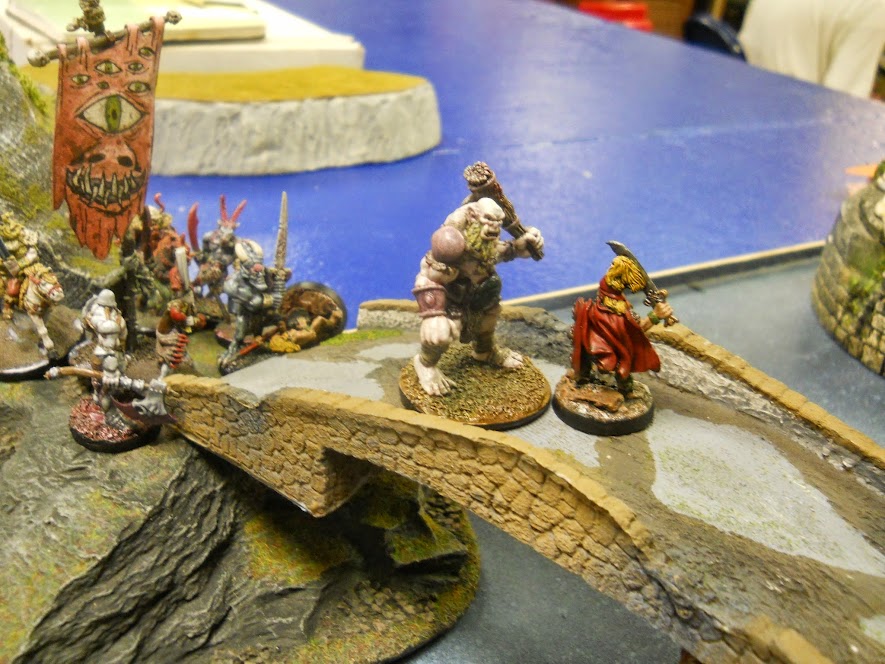
Here are a few pics of our game. In the first turn, I used my giant's frost breath (or thunderbolt, depending on how you'd like to interpret the ability) to kill Karl's dragon. Since that dragon was Karl's god, he was able to summon it back to the battlefield again on his turn, using the summoning rules in the OGAM rulebook.


That was probably my last tactical victory on the battlefield that day. Karl pressed his advantage, slaughtering my infantry and legends until I had just a handful of figures left on the field.


My frost giant gave as good as he got (his lightning strike ability was particularly useful) but ultimately my depleted dwarves were routed from the battlefield. Here is their final stand.


We discussed the game afterward and agreed that gives a very playable "big skirmish" experience that really bridges the gap between Song of Blades & Heroes (designed for 6-12 figures) and Kings of War (designed for 40+ figures). We're very keen on using OGAM to play out some larger-scale battles in our upcoming summer fantasy campaign, so stay tuned!

-- Pat, Chicago Skirmish Wargames club member

Thursday, May 15, 2014

Oxiddon Alpha: A Troubled World on the Galactic Frontier

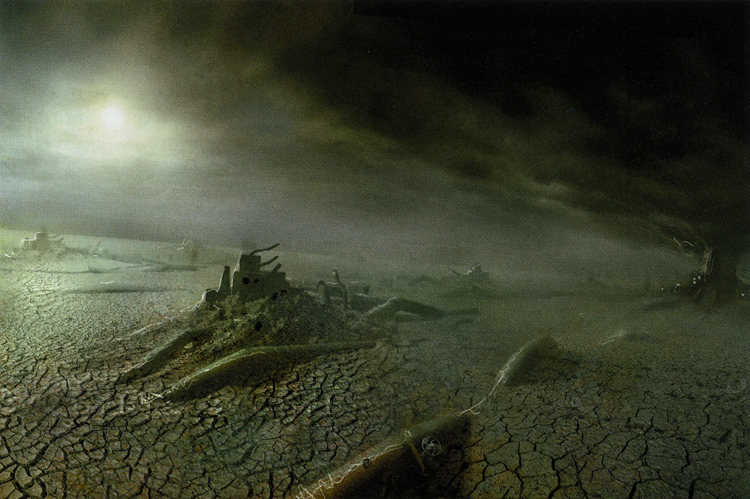
Nearly a century ago, Terran survey teams declared Oxiddon Alpha -- the lone planet in the Oxiddon system -- uninhabitable and unfit for human settlement. A marker satellite was placed in orbit, the survey details were recorded in the archives, and the teams moved on. Nonetheless, the discovery of massive mineral deposits 57 years later led to the Maersk-Tesla corporation's successful bid to be the lead agency for resource development. In exchange for a 60-year renewable contract for exclusive mineral extraction rights, the conglomerate corporation was tasked with terraforming of the planet for later human colonization.

Eager to exploit this new source of material, Maersk-Tesla hastily agreed -- though terraforming would prove to be low on the corporation's agenda. Thus, they were only too happy to let University of Noonien Professor Xian Peterson use the planet as a testbed for his own experimental techniques.


The terraforming of Oxiddon Alpha would take 45 years, and Xian would pass away before seeing the results of his labor, but in the meantime the colonization would far outpace the speed of terraforming. Mineral deposits on Oxiddon Alpha were greater than anyone had predicted, but the process of terraforming -- now watched with great interest by various politically connected educational institutions -- meant that the planet could not simply be strip-mined away or fracked into submission.

The mines themselves stretched for miles underground, with periodic above-ground facilities to extract and process the mineral wealth. Growth brought manufacturing to Oxiddon Alpha. Mining domes could not expand outward for fear of damaging the delicate terraforming process, so they expanded upward.


The Birth of the Bridge Cities 

As a result of this growth, mining domes that averaged only two miles in diameter became towering cities reaching high into the sky. Fueled by a seemingly endless flow of credits and in the spirit of friendly competition, these cities were more than functional sealed towers of living. The "city managers" -- each wishing to be more awe inspiring than their neighbor -- commissioned the galaxy's finest architects to make the cities a marvel inside and out.

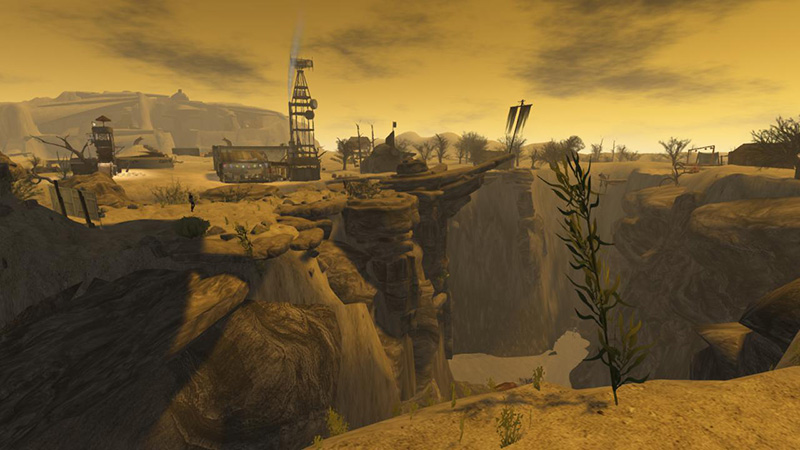
To connect these cities, great sealed bridges, often stretching dozens -- or in a few cases hundreds -- of miles long were constructed. And thus were born the Bridge Cities. Some areas of the planet, too remote to be connected by bridges, would remain small mining outposts, and other less mineral rich regions would remain undeveloped. On the resource rich continent of Sealand Major, it took human settlers built less than four decades to develop beautiful spires, towers and cityscapes across the landscape, all connected by immense carbon-fiber bridges.


The last of the Bridge Cities was completed a decade before the terraforming effort was finished. It was nearly two generations since landfall, and the Bridge Cities had developed without any real confidence that terraformation would be successful. These self-sufficient spires contained everything that a population would need and almost as much as they could want.


Before terraforming was complete, the bridge cities decided on a radical course of action. Within a decade, they knew, a massive influx of colonists would arrive on Oxiddon Alpha. To head off this potentially imbalancing threat, the Bridge Cities declared themselves the "independent and contiguous nation of Uberbrucken." Terran authorities quickly granted a charter and a new kind of nation was born on less than 800 square miles (not counting bridge supports) of actual land occupied by the Bridge Cities.

One Planet, Two Worlds
A decade after the completion of the last Bridge City, Oxiddon Alpha was reborn. Unblemished by pollution from the self-contained Bridge Cities, the planet was ripe for colonization, soon developing into a thriving breadbasket for the Galactic Frontier.

The colonists set about establishing their egalitarian settlements around the newly formed nation of Tenuta. Uberbrucken, on the other hand, kept to the more corporate and top-down methods that had served them well for decades. Though there were many opportunities for trade, Uberbrucken's governing board decided instead that a nearly complete embargo on contact with the settlers would best preserve their way of life.

And so, these two nations remained, both more geographically intertwined and yet more culturally separate than perhaps any two nations in human history.

The Bridger-Broadlander Wars 
No side has been quite willing to take responsibility for the conflict known as the Bridger-Broadlander wars, but the results are well known. Some 85 years after terraforming wrapped up on Oxiddon Alpha, Uberbrucken and Tenuta existed peacefully, but with little contact besides the most minimal levels of diplomatic communication.

In the late planting cycle of 2406, the sleeping citizens in the Tentua settlement of Brinsk awoke to the sound of the ground beneath their feet splitting open. A minute later, the entire settlement was swallowed up in a giant man-made sinkhole, created by over-mining on the part of the Bridge City megacorporations. There were no survivors.

 
Outcry was swift and loud, but tempers were restrained as representatives of Uberbruken and Tenuta quickly entered into intensive discussions. An agreement regarding reparations had almost been reached when the second sinkhole collapsed part of the city of Hondon, which sits between the Bridge Cities of Parvassa and Inverness. Affecting only a small outlying neighborhood, it was not the tragedy that Brinsk was, but it set off alarm bells as leaders in both factions realized the continent could be riddled with potential sinkholes.

Indeed, secret documents showed that fully two-thirds of the populated areas of Sealand Major lived within a mile of a potential sinkhole, and several major Tenutan cities were located directly over such danger zones. The Bridge Cities, of course, bore no such risk, located as they were far from the mining operations that sprawled across the planet.

One morning in 2406, an extremist Tenutan faction struck at the Bridge City of Uman. After gaining entry to the city, suicide bombers with tactical nuclear devices detonated themselves at key support structures throughout. Its structural integrity compromised, the miles-tall city commenced a slow-motion implosion and collapse over the course of several hours. Thousands died, and Uman's death throes dislodged the bridges tethering it to its sister cities.


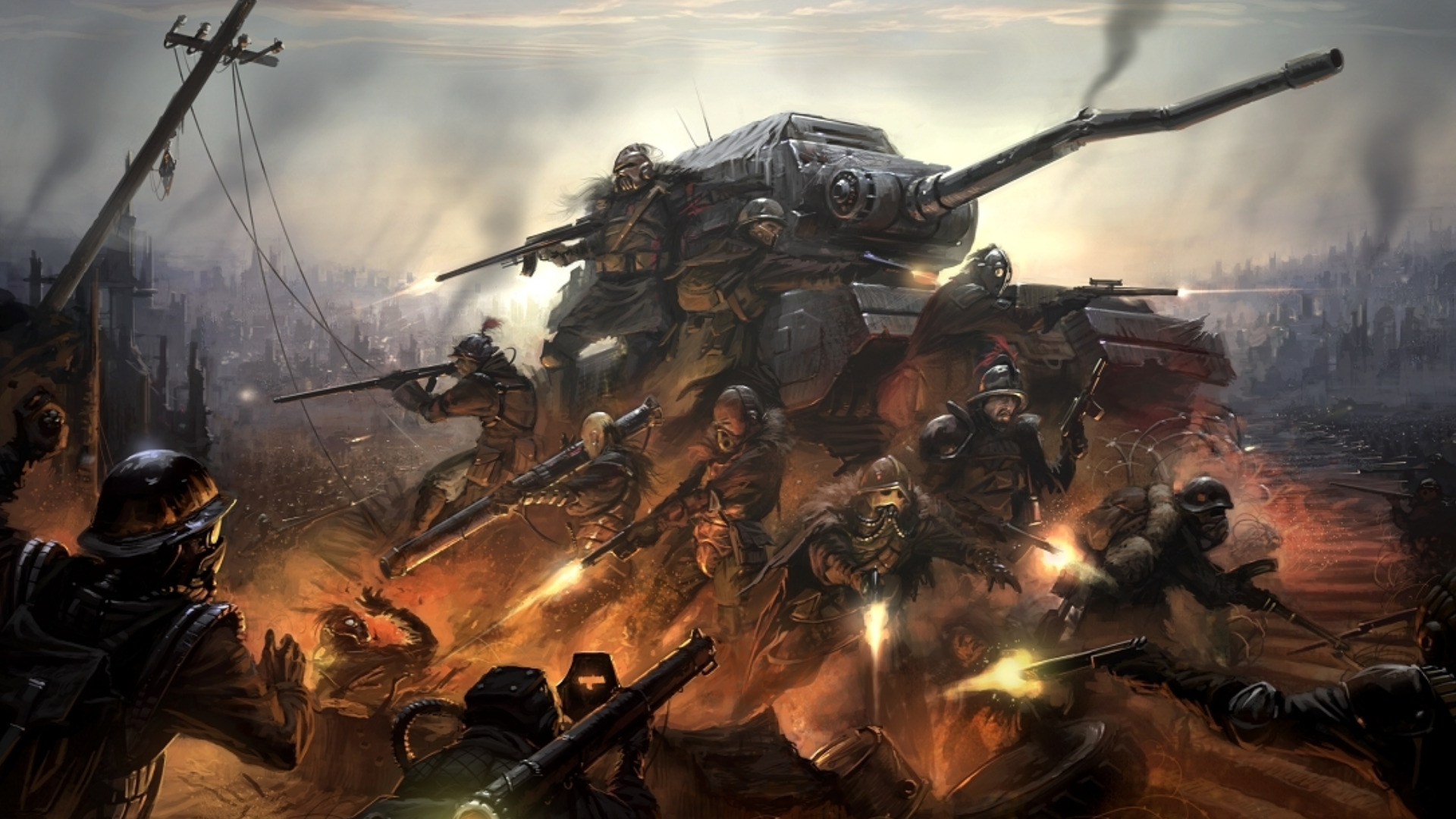
The first Bridge City to fall would not be the last. Within days, Maersk-Tesla corporate marines were fighting pitched battles with Khiff mercenary brigades hired by the Tenutans and possibly funded by other corporations. The bloodshed increased as more Bridger cities fell...one, three, then dozens.

  
Uberbruken retaliated by deliberately collapsing the underground mines beneath Tenutan military bases ... many of which were located near settlements and cities. The conflict might have torn the planet apart, but Oxiddon Alpha was too important for Terran Authorities to abandon. After eight months of fighting and the loss of hundreds of thousands of lives, it took only Terran threats of sanctions against Maersk-Tesla to bring an immediate withdrawal of nearly all fighting forces.

In a Terran sponsored deal, Uberbruken paid for the relocation and resettlement for almost the entire non-Bridger population, as well as grants and low-interest financing for additional development. Maersk-Tesla also ceded the rights to mining on the other continents, though this was not seen as a notable penalty since it is Sealand Major where the richest resources were -- and still are -- located.

Since then, the new colonies elsewhere on Oxxidon Alpha have maintained a unified identity and government known as New Tenuta.

The Remnant
Despite the destruction of their entire society, and instability of a land where underground mining is now conducted with no concern for above-ground dwellers, a few Old Tenutans refused relocation. Known to themselves as "Broadlanders" or "The Remnant," they chose to stay.

Their lives are best described as pastoral, or even primitive. Uberbruken currently maintains a complete embargo on communication and transit on Sealand Major. The Broadlanders thus scavenge leftover equipment and technology from the war-torn former Tenutan settlements or collapsed Bridge Cities.

 
The Remnant inclues hardy settlers who have banded together to stake out land claims and work out their living on vast plots of still-virgin farmland, along with bands of marauders who pillage across the continent preying on the weak. Nomads scavenge the wastes and the fallen Bridge Cities and trade their finds all over Sealand Major.

All these groups live our their lives in the sometimes anarchic and often apocalyptic Broadlands. Despite the deprivation and constant possibilities of new sinkholes, it is a vibrant place with danger and opportunity present in equal measure.


As long as they stay in the Broadlands, Uberbruken takes little notice or responsibility for these peoples. They will not aid the needy, nor will they punish evil deeds so long as they occur out of view of Uberbruken citizens. It is essential that Uberbruken people not disturbed by the Broadlanders, so atrocities (or other potentially aggressive acts) committed within sight of a Bridge City will result in swift justice from an Uberbruken Enforcement Team.

The Gates
There is an exception to the odd sort of of paternal neglect that has risen up between the Uberbruken population and the Broadlanders. Every Bridge City has a clearly marked portal at its base. These "gates" are always open to any Broadlander -- in fact, the bridge cities will respond with surprising force to any attempt to block access to the Gates. It is perhaps the only truly shared and universal agreement of New Tenutan, Bridger and Broadlander law that any Broadlander has the right to enter a Bridge City.


Upon entrance, they will immediately receive full medical attention (if necessary) as well as interviews and possible interrogation. They will then be relocated to anywhere Tenutans have been resettled, usually being reunited with existing family if possible. A select are offered a place within the Maersk-Tesla Corporation. W

Wherever they end up however, it is an inflexible rule that once a Broadlander enters the gates, they leave the Broadlands forever. It is commonplace for orphans and the very ill to make use of these portals, as they are often a literal gateway to a new life.


However criminals, and those with a price on their heads may also attempt to make use of the gates as well. If a refugee Broadlander with a criminal record enters a gate, he may be sentenced to a period of time in the Terran Penal Legions, or may be exiled forever into the windswept wastes, their gate privileges revoked forever. In this way, the Broadlands act as a sort of open-air prison for the planet's worst offenders.

-- Karl, Chicago Skirmish Wargames club member

The Beacon of Raggid Holf: A Song of Blades & Heroes Game Report


Last week the club met at our favorite friendly local game store, Games Plus. While Tim and Pat amused themselves with a game of Of Gods and Mortals, Karl, Mike, and I got to play an awesome game of Song of Blades & Heroes. We picked out the Silence the Watchtower scenario, converted from a Warhammer skirmish scenario by Hour11Gaming in their excellent supplement.

Karl, commanding his Night Herons of the Black Crown, was charged with defending the warning beacon in the ruined tower on Raggid Holf (the name of the central island, I’ve decided) against Mike’s Picked Men of the Wolves of Powys and my own demented Brigandry of Skeldkryk. After six turns the beacon would light, warning the Commandery of the secret order of the Night Herons of the incursion; if Mike and I succeeded in kicking down the door to the tower and extinguishing the beacon before it was fully lit, the Commandery would be ignorant of our invasion and the order would surely crumble!


"Light it," croaked the Sergeant-Marshal. "The Grand Master must be informed that the Holf is threatened."

"In repayment of the gods," said his hulking lieutenant, and swiftly he disappeared into the tower. The Sergeant-Marshal could hear the tramping of the self-righteous heathens on the bridges to the South and the West. The outpost was hemmed in, surrounded by those who would throw down the idols of his order. They knew nothing of his fervor, nor of the debt that every living thing owed to the dark gods. 

The Sergeant-Marshal was glad to send them back to their filthy corners of the world. At first he had scorned the lump of blasted rock, to defend which he had been summoned from his manor, and his jeweled chambers, and the maids who applied the balms to his twisted arm. But did he not owe all of those things to the favor of the dark gods? Indeed, he now knew he was fortunate to have the opportunity to repay his favor. With such thoughts, and in the light of battle, the Raggid Holf seemed almost sublime. 

Yes, he thought. This will be a good place to show his devotion to the dark gods. 

And, if necessary, this will be a good place to die for them. 


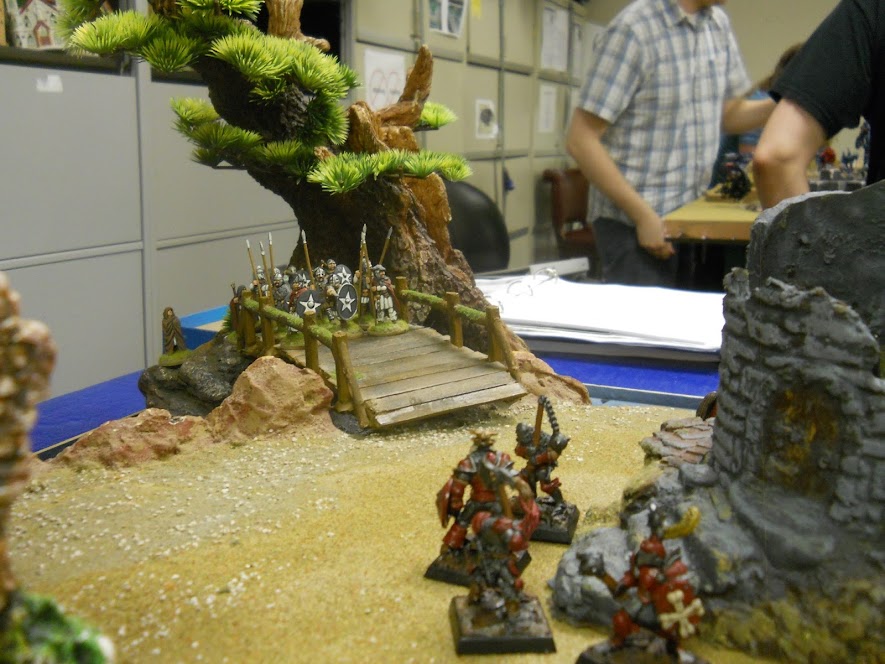
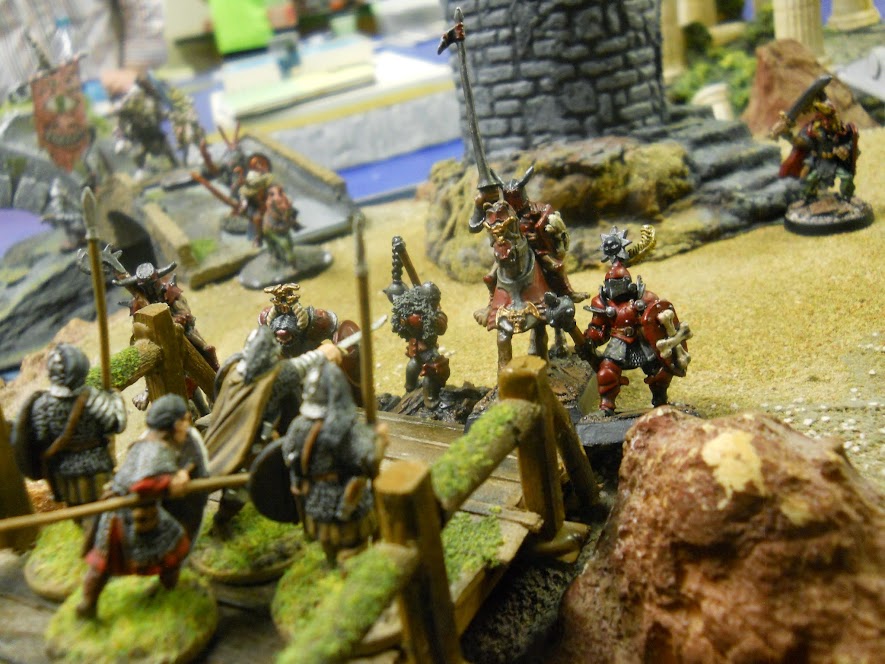
The Sergeant-Marshal could afford to waste no time. The picked men had already advanced in dense formation halfway across the mangrove bridge, with shields locked. At the head of the column came a fierce figure clad in a red robe. He chanted and struck his shield with his sword; and the picked men around him chanted in return, and rattled their spears.


The Sergeant commanded his men forward to the southern bridge to arrest the advance of the Wolves of Powys, with his Beastblood riders in the van to break the wall of shields. He sent the so-called half-elves, the stillborn tribesmen, to hold the western bridge against the collection of brigandry that remained strangely quiescent, standing in close order beneath their banner, which was bedecked in dripping eyes.


The forces met at the landing of the southern bridge in an unmoving line, with each side striving to push the other bodily back. Unable to move, soldiers were forced onto the points of spears amid the press, and their bodies pushed over the rails and into the sump below.

The red-robed Champion made sure that many knaves would pray to their dark gods no more. But in the thick of the foot of the bridge he met a fearsome warrior with crested helm. The knight’s studded maul shattered Gawain’s shield and his arm with it, and he collapsed in the crush of bodies and was overcome.


"On! Foward!" cried Derfel over the din. "Be not cowardly and run in fear, for we are the Wolves of Powys and lest we darken the name of the fair lady of that place, we shall stand!"

"But lord," said the slinger at Derfel’s shoulder. "Gawain, the lady’s champion… he has fallen. He who they said could not be slain..." The boy’s eyes were trembling. Derfel perceived that he was lost in a cloud of fear. 


"Perhaps, boy, they will sing that this was the place that bold Gawain fell. But perhaps they will also sing that this was the day he was avenged. Now load that sling and press forward!"

The boy did as he was told, and Derfel carried on shouting whatever he could think to keep his men fighting on. What they will NOT sing, Derfel thought to himself, is that the Wolves of Powys turned and ran because a foolish boy lost his stomach!


On the Western bridge, the stillborn sounded their shrill death-cries and threw themselves forward, intending to smash their way through their adversaries and break them before they could even gain the bridge. But even as their axes started to fall, the flag bearer swung the staring gonfanon in a signal and the ranks opened. Mottle-skinned, be-taloned creatures leapt upon the unfortunate warriors and tore them to pieces. Then emerged a giant of a man bearing a maul the size of a tree who strode forth and grunted his challenge to the captain of the half elves and beat him back along the bridge.


"Would that all days could be blessed with rains such as these," said Aelfnir the Deranged to the Shivering King as he brought his bearded ax to rest at last. His plumed helm was bespeckled with tiny drops of blood, like lazy insects. The senseless yammering of Brittlegast the cut-pate drifted back from further along the bridge, along with the rhythmic sound of his cleaving. 

A shallow whisper issued from behind the Shivering King’s visor: "I have dreamed..."

"Eh?"

 The strange cavalier pointed his sword to Raggid Holf, pointed at a figure near the far bridge whose arm appeared - at least to Aelfnir - to end in a large claw. But then Aelfnir had often been told that his perception was... askew. 

"I have dreamed," said the Shivering King, more loudly now, seeming to speak more to the distant figure than to Aelfnir. "I have dreamed of your face through the feculent skies." And then screaming: "I have dreamed of the chattering of ruminants and the maumetry of your faith!" And with that, the Shivering King screeched and spurred on his beast of war, and its six hooves made a hollow thunder across the bridge to Raggid Holf. 

"Huh," mused Aelfnir. "At first I thought he wasn’t listening...but it looks as though the King is as excited about the rain as I am!"


The Sergeant-Marshal could see that his hold on the Holf was failing. The western bridge had fallen and the southern hung by a fingernail.


He looked to the tower in desperation. Was it a curl of smoke he could see issuing from the top? There came a shout from the remaining picked men on the bridge. Many had fled, but Derfel had rallied the rest and they were pressing forward once more.


So, after bidding the half-elf captain to guard the tower with his life, he sprang into the combat at the foot of the bridge, battering back the tide and rending spear and shield in his claw. As in a mist, he perceived the face of the leader of his foes... and he reached for it. His claw tightened around Derfel’s neck and sword arm, which was prying bloodily at the pincer, but to no use. Derfel fell at the foot of the bridge. Twice.

So taken was the Sergeant in the euphoria of battle that he did not hear the echoing screech of the Shivering King until he was already upon him. He struck in vain at the guilded cuirass, but felt the Cavalier’s searing blade cut deep into his throat. The Sergeant-Marshal fell and the outpost guard withdrew to the base of the tower - dismayed, yet determined to continue fighting.


The Slavering Banditry pressed the attack, supported by the dogged remainder of the Wolves of Powys; but even as the entire outpost seemed doomed to butchery on Raggid Holf, the impossible happened…


The Sergeant-Marshal tried to compose his breathing while he gathered his silken tunic in his left hand to staunch the flow of blood from his neck. At length he found himself exhausted, and so instead he rolled onto his back and prepared to meet the gods. But as he did so he was met with the wonder of fire, for the beacon had taken and was ablaze. 

He heard his Lieutenant bellow from the top of the tower: “It is lit and the Grand Master shall know! Long live the Night Herons! Long live the Black Crown! 

...And with his dying eyes, the Sergeant-Marshal saw smoke billowing into the sky, as black as the hair of the maids of his manor…indeed, he thought, as black as the favor of the dark gods.


--Mattias Darrow, a Chicago Skirmish Wargames Club Member

Wednesday, May 14, 2014

The Maersk-Tesla Corporation


(For the Galactic Frontier sci-fi setting)

In 2250, two of humanity's largest megacorporations (a transportation outfit and a hyperdrive engineering firm) came together to form a shipping conglomerate designed to push the boundaries of the Galactic Frontier.

It was only partially successful. The newly formed Maersk-Tesla Corporation has used its size and influence to keep only a modest lead on its rivals for most of the past 200 years. Corporations like Ever-Honda were quick to follow suit and merge shipping and spacecraft production, while conglomerates like Nippon Yusen Mitsubishi rushed to better synergize divisions already serving those sectors.


Nonetheless Maersk-Tesla has exceeded its rivals by also taking on the more risky tasks of exploitation and production. While most transportation companies prefer to make the easy money of simply moving materials, goods and people, Maersk has extensive interests in the the entire production cycle, from the location and extraction of raw materials, to the development, manufacture and in some cases the sale of commercial goods.


Following the debacle of Oxxidon Prime, Maersk-Tesla has turned to mercenaries to enforce its holdings on the Galactic Frontier. However, it does maintain its own "Asset Protection" forces ranging, from civilian security guards, to paramilitary units such as the Seven Guard Hussar and Moller's Dragoons.

Maersk-Tesla even fields the elite covert Jægerkorpset, which are deployed for the most sensitive missions where secrecy and deniability are essential. Though relatively few in number compared to national military forces, all Maersk combat forces are known to be extremely well trained and equipped.

The Maersk-Tesla symbol is a stylized red "T" inside a white 7-pointed star, on a blue background. Maersk-Tesla still maintains its historical 550-year presence on Terra in the city of Copenhagen, Denmark. However, true active headquarters of Maersk-Tesla is on the planet Nu-Jylland in the city of Schleswig.

-- Karl, Chicago Skirmish Wargames club member

Monday, May 12, 2014

Of Gods & Mortals Game Report


Song of Blades & Heroes holds a special place in the heart of many Chicago Skirmish Wargames members. It was the game that brought us together way back in 2010, and since then we've become experienced (some might say veteran) SBH players.

So you can imagine how excited we were to read about Of Gods & Mortals, written by Andrea Sfiligoi and released last year by Osprey. The game might be best described as large-scale skirmish featuring gods, mortals and legends drawn from history and mythology clashing on the battlefield. Based on our reading of the rulebook, OGAM games are quite a bit larger than the typical SBH game, with maybe 20-25 figures per side in OGAM compared to 6-12 figures for SBH.

Both games share the same basic rules engine, which means we already knew 75% of the rules before we even opened the rulebook. We've been looking for a good framework for doing large-scale SBH games, so Tim and I carved out some table space at last week's club night to try out OGAM.

We built two 900-point armies: Norse/Celt-inspired undead guys for Tim, and Egyptian-themed undead guys for me. Undead vs. undead -- what could go wrong?!

Here are my guys, led by Hesperax, the undead dragon.


And here are Tim's guys, led by his undead giant along with a werewolf and Celtic chariot.


We decided to play the "Sacred Grove" scenario, in which both sides fight to control an enchanted copse of trees in the center of the table. Here's the battlefield at the start of our game.


We deployed our guys in a rough arc around the sacred grove. In the base rules for OGAM, units can deploy anywhere on the battlefield as long as they're a minimum distance away from any other enemy unit. That's fairly cool! No more lining up on the table edge and spending the first three turns moving forward!

Tim took the first turn and advanced his undead giant, chariot and a squad of skeleton warriors toward the sacred grove.


I did the same on my side of the table, taking care to keep Hesperax (my leader) near her troops for support.


OGAM has three different unit types: gods, legends and mortals. Mortals move around the battlefield in formations, and the game has just enough crunch in this respect to satisfy gamers who might be familiar with ranked unit movement from games like Warhammer Fantasy or Kings of War. But units are capped at 8 figures, so you won't find yourself struggling with ungainly blocks of individual troops.

Legends are basically heroes or champions with better stats and a few special rules. They can roam around the battlefield, and they stand a decent chance of threatening a small unit of mortals.

Here, Tim's werewolf encounters my lich lord on a flanking maneuver. Both are legends and both will shortly be joined by their comrades as the battle develops.


Closer to the sacred grove, my unit of skeleton archers had invested a ruined building and were taking potshots on Tim's advancing guys. As in SBH, shooting is not all that effective unless you really dedicate some points to it. My archers didn't do a whole lot in this game.


Here's another look at the scene above. You can see I've got an 8-man unit of skeletons moving into contact with Tim's undead guys. In the second pic below, he's bringing another smaller unit up around the rear of my skeletons.


We ran into an interesting rules situation at this point. In OGAM, a unit that loses a combat always recoils away from the opposing unit -- but it doesn't always suffer casualties. In the photo above, my skeleton unit in the center got pinched between Tim's two mortal units and basically bounced back and forth for several turns like a pinball, constantly recoiling into another enemy unit, losing 1 figure at a time but never quite falling apart.

Eventually Tim destroyed the unit but he had to commit two units of mortals and his undead giant. It was a real grindfest and we were wondering if we were playing the combat correctly. We kept flipping through the rulebook looking for a rule about how units that recoil into larger enemy units are automatically destroyed, but such a rule didn't exist, so we just kept playing out the combat in little spurts each turn.

On the other flank, the battle between the werewolf and lich lord was heating up. Tim committed another unit of mortals and I brought up my undead abomination to support the lich.


We smashed on each other for a few turns, but ultimately the lich lord prevailed, slaughtering the mortals and prompting the werewolf to fall back toward the sacred grove.

Oh yeah! About that sacred grove. I didn't take very many photos of it, but the grove saw some fierce fighting. Tim seized it early in the game with his chariot, but then I moved up a unit of 8 skeletons, destroyed the chariot, and promptly seized the sacred grove for myself. Here they are, taking up defensive positions as Tim pivots his troops to focus on the objective.


In the end, Tim couldn't quite seize the objective before the end of the game (it was capped at six turns). So although I definitely lost on the battlefield, I was able to hold onto the scenario objective and score a victory.


We hashed out some thoughts on OGAM after the game. Short version: Tim and I both enjoyed it and feel it could be a great "next step" for our club. We've been looking at slightly larger games for a while now, and OGAM offers that while still maintaining a lot of the skirmish aspect that we like about SBH.

The combat rules have been cleaned up a lot compared to SBH. Almost all of the combat modifiers are bonuses, rather than penalties, which makes them a bit easier to track. Units still have only two stats, just like in SBH, plus a few special rules which will look familiar to any SBH player.

One minor quibble has to do with some of the combat math. Outnumbering counts every factor of 4 when determining bonuses, but casualties count every factor of 3. It seems like it wouldn't have been too hard to bring these two areas into harmony so that you could say something like "This game uses the rule of 4s...." which is quite elegant. But again, Tim and I had no real problems handling the separate rule elements.

The flavor of OGAM (gods and mortals clashing on a battlefield) doesn't resonate particularly well with me, so I don't see myself playing out the games described in the rulebook (Heracles + Greeks vs. Anubis + Egyptians). But it's perfectly serviceable for more typical fantasy games, which is how I expect we'll end up using it. Really, I see OGAM as more of a "stopgap" solution until the official large-scale SBH game (Song of Armies & Hordes I think?) is released, hopefully in the next 18 months or so.

The verdict: OGAM is a great game for our club! We've got quite a nice collection of fantasy miniatures now, and this game gives us a chance to get them all on the table using our favorite rules engine. I look forward to introducing everyone to OGAM in the future. Stay tuned!

-- Patrick, Chicago Skirmish Wargames club member