In recent weeks this humble blog has been honored by not one, but two Liebster Awards, meant to call attention to blogs that haven't yet built a critical mass of readers but nonetheless produce compelling, original content all the damn time. At least, that's how I understand the award, given CSW's prolific gaming/blogging schedule and our general enthusiasm for tabletop hobby games.
A key stipulation for new award recipients, though, is to pass along the Liebster Award to a few additional blogs that really ought to be read by more people. After polling the CSW player base, we assembled this list of worthy, yet criminally under-read, blogs.
Warhammer For Adults -- Beginning with the tag line "Remember when Warhammer was a game and not a marketing tool?," WFA is focused on retro gaming and a bittersweet appreciation for the simpler era of the hobby. That fits really well with CSW's overall game philosophy, so we're happy to bestow a Liebster on WFA.
Super Galactic Dreadnought -- With a name like that, it's got to be over the top. And it is! Desert Scribe shares his love for epic spaceship gaming on Super Galactic Dreadnought. Great painted miniatures, fantastic photos. If you've ever thought about spaceship gaming, just take a stroll through his site. Your imagination will catch fire!
Mattblackgod's World -- Gonzo hobby gamer Mattblackgod is (mostly) focused on just one genre: post-apocalyptic sci-fi. He's an absolutely prolific modeler and painter, and most of his stuff appears in photo galleries on his site (and his old site). He also moderates the Post-Apoc Wargames forum, which is a real treasure trove of inspiration and discussion about all things post-apoc.
Old School Miniatures Bulletin -- Here at CSW, we love old, vintage miniatures from the early days of fantasy gaming. Those old sculpts may be a bit lumpy, but they've got loads of character. Our friends at Old School Miniatures Bulletin agree with us, and it's always a treat to see what treasures they've dredged up from back when our hobby was young.
Modern Appendix N -- Using Gygax's fabled Appendix N from the AD&D Dungeon Master's Guide (which sets out various books, movies and art to help inspire DMs), the author has applied that mentality to the modern era. He offers up regular posts about contemporary fiction, miniatures, comics, etc.
At the Games Plus miniatures game auction in October, I nabbed a pair work-in-progress terrain pieces. They were on their way toward becoming a pair of urban ruins, but their owner decided to get rid of them before completion. When I picked them up -- for bargain prices -- they were basically two chopped-up resin building wall corners sitting on a piece of hardboard. No extra bits, no rubble, no gubbins, no embellishment -- and no paint. Just barebones resin walls hot-glued to the hardboard.
After some hemming and hawing about exactly how I might finish off these pieces, I just bit the bullet, pulled out my foam rubble bin, and started slinging glue around. These pictures show the finished product, which hit the battlefield in last week's In The Emperor's Name session. I've included a couple of figures for scale: a wasteland raider and a sniper lying in the rubble.
I mostly used expanded polystyrene chunks (bead foam, the kind that is made up of little balls) as well as blue foam insulation. The chunks were glued on haphazardly to create a rubble zone in the center of the terrain piece, with the walls still standing on either side. I glued everything in place, then threw in a bunch of spare bits: drinking straws for pipes, coffee stirrers for metal beams, wooden craft sticks for broken floorboards, etc. I added little bits of wire poking out of the foam chunks as concrete rebar.
After affixing all the decorative bits, I slathered the whole thing in a thick coat of blue-gray house paint. My goal was to seal the foam chunks so spray paint wouldn't melt them. The house paint created a nice unified surface, but alas I must not have done enough coats, because some of the foam chunks still melted a little bit during the spray paint stage. I was initially dismayed, but the foam didn't melt away into a puddle of goo...they just shrank a bit, and the effect was pretty cool. Crisis averted!
On to the
painting! I sprinkled on some gravel and ballast to break up the smooth
areas of the ground floor, then sprayed the whole thing black. After
that I sprayed a few targeted blasts of brown, followed by a rough
textured gray spray that unified the whole thing.
Once
this was dry, I used a big brush to splatter on a rough coat of brown
wash, then drybrushed with a light tan to pick up the highlights. The
final step was to add some patches of dead grass flock to the ruin. I guess I could have gone crazy with detailing, but I was more interested in making this piece quick and simple.
Here are a few more pics of this piece in last week's game. When these photos were taken, I hadn't yet completed all the steps described above, but the terrain still looks pretty cool. Pictured are Karl's Squats and Tom's Necrons.
Remember, the auction lot included two buildings. The second is currently a work in progress. It's about half the size of this piece, though, so I anticipate having it done in a week or so. Check back for more pics of the second piece!
The club's upcoming post-apocalyptic campaign gave me a little push to finally make some simple foamcore ruins I've been thinking about for quite some time.
To start out, I made a rough sketch showing a plan and elevation of the structure.
I drew out the pieces on the foam core and cut them using a metal ruler and a hobby knife.
The most difficult parts to cut are the windows. I had quite a bit of trouble with ripping up the foam part of the board cutting them. Next, I glued them together with hot glue. Each set of walls and a
ceiling is a separate piece, to make the structure more modular and
easier to store. I also made several sections of wall without a
ceiling,
Looking at the unpainted pieces stacked together, I noticed that they have a strong brutalist look. I could have painted them in a tan cement to emphasize this, but I wanted them to look more generally modernist. So, I painted the walls in a dull gray with rusty streaks. The floors/ceilings are a mottled light green.
Leave a comment if you have any questions or thoughts about these terrain items!
This week we met up to play In The Emperor's Name, the quick-play ruleset inspired by early edition Warhammer 40,000 skirmishes. We've dabbled in ITEN before, but this time we gave it a dedicated run-through (6 games on 3 different tabletop layouts) to see if we could use it for our upcoming post-apocalyptic campaign.
Since this was a 40k-inspired game, the players brought a nice array of 40k-inspired warbands, including Space Marines, Necrons, Squats, Tau, Imperial Guard and Daemonhunters. Plenty of these warbands were composed of non-Games Workshop figures, though, since we always try to put lots of different miniatures on the table as often as possible.
Here's the table, looking across all 3 tabletop layouts. We played 3 side-by-side games, then shuffled up the players and got in a second round of games, for a total of 6 games played.
The foreground is a ruined battlefield, the middle layout is a bunker complex hidden away in some rugged hills, and the final layout is an industrial warehouse sector.
The games went pretty well. ITEN is a quick and easy game to pick up, and it helped that we were familiar with the capabilities of 40k dudes (as in, a Necron warrior should be harder to kill than a Guardsman).
Here are a few shots from the games. In the pics below, Josh's newly painted Dark Angels faced off against Tom's Necrons in a fight to claim a piece of xenotech from a bombed-out battlefield.
Ultimately Josh's Dark Angels prevailed, spiriting away the alien device before the Necrons could seize it for their own nefarious purposes.
Across the board, my Necrons were flushing a platoon of terrified Guardsmen from their bunker complex. Here we learned a perennial lesson about skirmish games -- heavy armor (or metal bodies, in the case of the Necrons) -- is a serious force multiplier. Mike's Guardsmen didn't have enough heavy weapons to effectively fight off my robots, so they inexorably squeezed the Guardsmen as the game unfolded. I only had 5 robots but they proved quite potent, especially when taking advantage of cover!
Oh! But this was a 3-person game. Another Mike, playing his Daemonhunter warband, was advancing across the board as well. He exchanged fire with my Necrons, found the match-up to be a rather bloody affair (for him), and turned his attention to the poor Guardsmen.
His warband figures are mostly Dark Elves that have been converted to hold a variety of sci-fi weapons. This young lady is a Dark Elf Beastmaster, heavily converted of course.
Across the table, Tim was running a Tau warband composed of Skinnies from the Starship Troopers game line. He also had some 28mm scale Daleks in his warband, which were quite awesome. Check out his warband below.
We also didn't end up with many pics from the warehouse sector battlefield. Here's one, showing Josh's Dark Angels defending a refinery from a two pronged assault by both of the Mikes. Yes, that's my washing machine in the background -- 'tis the blessing and the curse of playing in the basement.
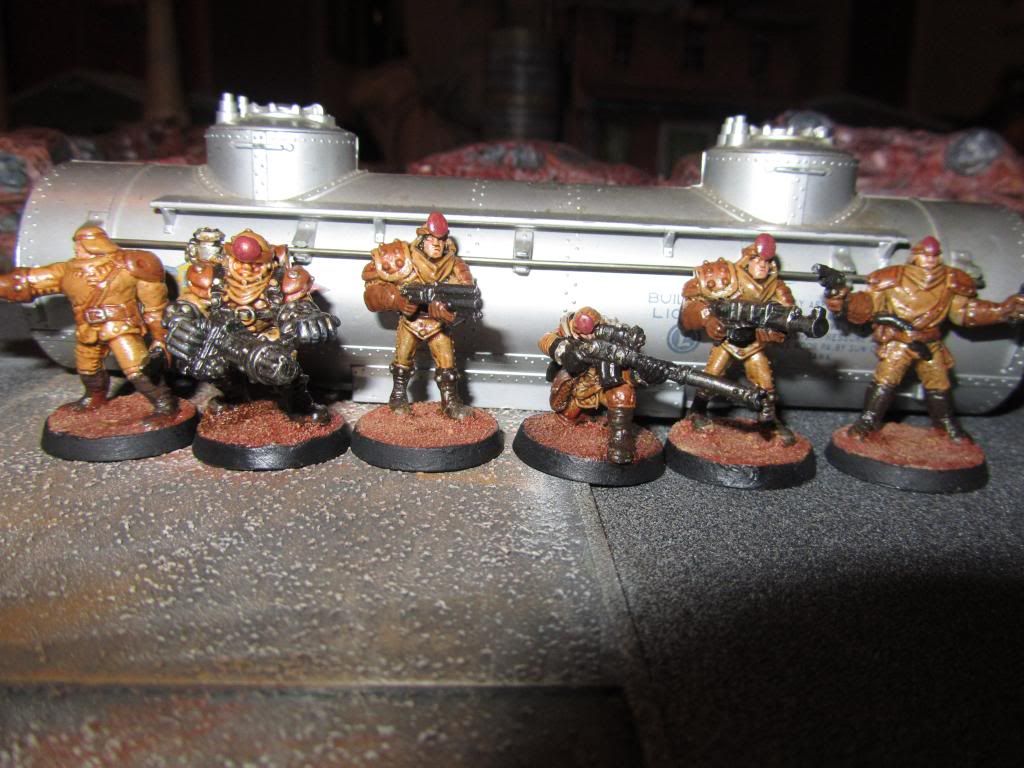
One of the last games of the night was a scenario from the ITEN rulebook called "Fort Apache," where Karl's Squats attempted to defend a ruined building from my advancing Necron warband. We went a little crazy with the pictures because his Squats (a new warband that's he's been painting up) looked so good lurking in the ruins. This is an almost-finished piece of terrain that I've been working on recently.
He managed to slaughter most of my robots before we called the game for the night. Karl had figured out how to use the "torrent of fire" rules in ITEN to his advantage, which helped make my heavily armored robots not quite so dangerous. I still ended the game with my fair share of Squat carcasses on the battlefield, though.
What followed was a lengthy discussion on ITEN as it pertained to our upcoming post-apocalyptic campaign. We spent a lot of time talking about whether or not we should limit heavy armor (like power armor for Space Marines, or metal bodies for Necrons) since it proved to be such a force on the battlefield. We also discussed the idea of creating a custom equipment list to limit the number of zany plasma guns and refractor fields in our post-apocalyptic campaign. We agreed that ITEN was a serviceable ruleset that we could build a campaign around. Hurray for that! Now let's get the campaign going!
-- Patrick, Chicago Skirmish Wargames club member, with extra photos by Josh and Karl
This week the club got together to playtest Neutron York 3000 as a potential ruleset for our post-apocalyptic campaign.
NY3K is a fast paced warband-size skirmish game set in a pulpy post-apocalyptic future. It has it's own fluff, factions and even a small miniatures line, but also has a unit creation mechanic that allows you to use any miniatures you wish. You can find out more about the game, rules and figures here.
A total of six games were played among the six of us. We met at my house, so I prepared three different battlefields.
The first was an industrial corridor that's become a border between two gang territories. This was a great chance to use the urban terrain table that I made last month.
The second setup allowed gangs to battle for an oasis.
The third battlefield was a showdown in a border town.
Look for upcoming articles on the distillery building as see in the border town, as well as the car stacks from the urban layout.
I had prepared four gangs for players to use.
Eastern Tribe
Rob's Raiders
Hat Scavs
Dead Skulls biker gang
Unfortunately I wasn't able to get pics of the other gangs, or much in-game action, as my camera was running out of juice.
Tom brought a robot army made of Legions of Steel figures, and Jon brought a Japanese cyber-samurai robot army from various manufacturers (as usual, painted to top standard) and a group of elite soldiers made from Warzone Bauhaus troops.
Here's a couple other pics of the battles.
As for the rules themselves, we were torn.
We liked the fast play and easy to understand nature of the basic game mechanics. There also is a very nicely designed advancement chart for each character, so it's ideal for campaign play. The differences between factions are subtle, but effective.
The ruleset also has plenty of scenarios and deployment methods, so it's unlikely that a campaign would get stale. Though we would be using our own setting, the NY3K setting is entertaining and written in a good tongue-in-cheek style with flavorful art throughout the book.
Some mechanics continually frustrated us. When folks began reserving actions (a necessity for survival), we found that we had to spend a lot of effort tracking reserved actions, as well as how many bonuses each figure had left. Also, we found that it was pretty common for certain weapons to hit automatically. Combine that with some weaker figures that had no defense roll, and we found that the game had more auto kills than we would have liked.
Oddly, the games felt almost too short. It's the author's intention for several games to be played in a row, but this game was considerably shorter even than Song of Blades and Heroes.
Lastly, there were a few other ambiguous areas of the rules where we would have to house rule for.
In the end the club wasn't sure they wanted to invest the time in house-ruling and tweaking the rules. We may still end up using them, but next week we'll be trying out another ruleset that we've played before: In The Emperor's Name.
I would still give NY3K a cautious nod as a ruleset that wasn't to our taste, but is still worth looking at when considering post-apocalyptic gaming. It will probably require a bit of houseruling, but at $7 it's not an expensive experiment.
After seven campaign sessions and many, many individual games, we had reached the end. Our Song of Blades & Heroes fantasy campaign wrapped up Nov. 7 after an impressive run at our game table. As this was our first time running a narrative, map-based campaign, we were looking for an opportunity to go out in style. Luckily Karl had an idea brewing in his head for an epic, no-holds-barred final game using some of our most exciting terrain pieces. Here's his concept:
The Dark Elves, one of many factions competing for territory on The Iron Isle, began a powerful occult ritual on a lonely mountain peak. Unfortunately they misjudged the grim powers they were attempting to harness, causing the dormant volcano at the center of The Iron Isle to tremble and erupt! The Dark Elves were consumed in a fiery pyroclasm. As earthquakes and lava flows wrack the small island, two warbands found themselves trapped on the coast near a desolate village. On the other side of the village is the Dark Elf galley -- and the promise of rescue. But the town is not as deserted as it first appeared. Which group will be the first to fight its way to the ship and sail to freedom?
With the background established, we set about building our battlefield. The key component was going to be Jon's scratchbuilt Dark Elf War Galley. It's a fantastic model and we're grateful for Jon for letting us borrow it for the evening (he couldn't make it to the game).
Maybe a video would be a better way to show you the battlefield. Check out the 45-second clip below for a real-time tour of our battlefield. You'll see lots of players' legs, as well as my dog Rupert (glimpsed briefly).
We used a spare green mat to hang behind the battlefield for these photos -- that's explains the split pea soup-colored sky. Beyond the rocky coastline, we put together two medieval villages, each with its own collection of buildings and trees. Each warband would start in the village, fight their way through the horrors that no doubt lurked within, and then the two surviving warbands would fight for the chance to escape in the boat.
Here's a closer look at the staging area near the Dark Elf galley. There are bridges and a broad, flat area on the shore. We used a translucent blue mat to create the water, then placed Karl's foam rocks around the perimeter to make a craggy coastline. Several bridges created multiple routes to reach the galley.
We all agreed that this is by far the most impressive battlefield we've ever assembled for any game. We almost felt sheepish by putting only about 25 miniatures on the table (divided into 4 warbands). It seems like this table should have been crawling with figures! There are so many places to go and things to explore!
Anyway, with our battlefield established (and photographed ad nauseum) we began the game. Tim and Mike played their two campaign-battered warbands (actually, they had pretty potent stats and equipment at this point), while Karl and I played two undead warbands that were stationed in the eerie abandoned villages.
Here's Jack the Pumpkin King galloping through the back alleys to assail Mike's stalwart warriors.
Here's a skirmish line of archers, backed up by Harcuul Lagosh the Death Knight, attempting to stymie the advance of Tim's werewolves and mutants.
Tim managed to outflank Harcuul Lagosh's forces, though. In this pic, you can see his terror bird cavalry riding around behind the death knight to assault his rear. In the foreground, more undead skeletons muster to assault Tim's warband.
Alas, the undead were dispatched in due course. We had designed these guys to be a bit of a "speed bump" as Tim and Mike sent their warbands rushing toward the docked boat, and they did their job with aplomb. With no minis left, Karl and I sat back to watch while Tim and Mike's warbands surged over the bridges and onto the deck of the Dark Elf galley.
Fighting spilled from the dock onto the deck. It was a vicious brawl, but Mike's young dragon used its assassin special ability to turn the tide and capture the galley. Tim's last few figures surrendered peacefully.
As lava cascaded down the mountains and swept through the deserted
village, Mike's warband guided the galley out of the harbor and onto the
open ocean, thus bidding farewell to The Iron Isle. Its secrets would remain a mystery ... for now ...
And thus ended our Song of Blades & Heroes campaign! We met for seven sessions, with multiple games played at each session. Though we didn't make an official tally, I'd say that we played at least 20 individual games over the course of this campaign.
This campaign served as a FANTASTIC inspiration for everyone involved. We painted, modeled and crafted terrain as the campaign unfolded. Personally, I doubled the number of painted undead models in my collection over the course of the last five months.
We doff our collective cap here at Chicago Skirmish Wargames to everyone everyone who came out and participated in one way or another. Here they are:
Karl
Tim
Patrick
Mike
Jon
Devin
We're taking a brief break, but you can expect more campaign battle reports as our post-apocalyptic game gets off the ground later this winter. We're hoping to have the first game scheduled by late December or early January.