Showing posts with label playtest. Show all posts

Thursday, July 9, 2015

The Dogs & The Dust: Dead Man Walking


Last week we gathered at Games Plus for our regular game night. Due to the availability of tables, our merry band was a bit scattered, and tucked away in the back corner were Josh and I, setting up for a game of The Dogs & The Dust, the sci-fi ruleset from the paint-addled mind of fellow club member Mattias.

We've played it a few times now, each time exploring a bit more of the game's design space. With this game, though, we decided to try a scenario. It occurred to me that the default mode of play for TD&TD (scavengers looting a battlefield) is a perfect way to game STALKER (that peculiar, post-apocalyptic video game that is just ripe with tabletop possibilities). Here's the setup for our scenario:

Dead Man Walking
Derzhensko Exclusion Zone
Area: Akulinin Industrial Sector

Once again, the lure of loot and artifacts in the Derzhensko Exclusion Zone has proven too strong. Two teams, outfitted and equipped to scavenge and survive in the harsh conditions of the area, crept into the ruins of the Akulinin industrial plant. A fortune in decrepit loot was scattered around the facility -- if the two crews could survive long enough to turn a profit.


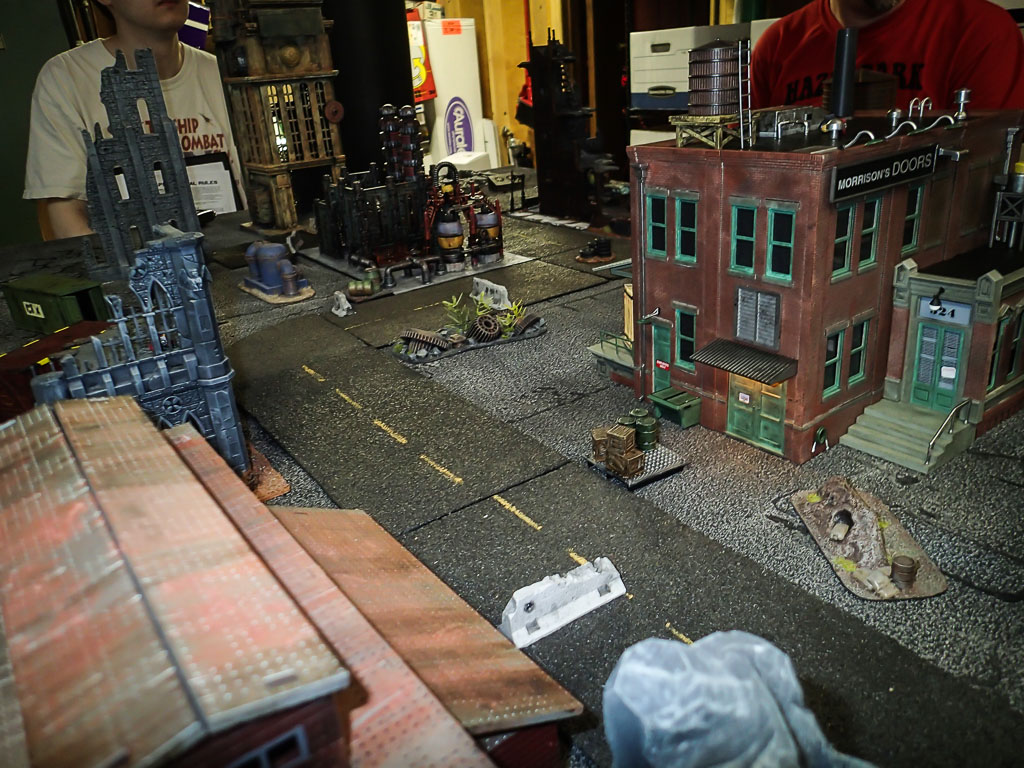
I schlepped a plastic tub full of terrain (plus my gorgeous Zuzzy mat) up to Games Plus and set up a compact little 3x3 foot tabletop battlefield. In the center was a sprawling industrial complex (terrain created by fellow club member Karl) around which were strewn six objective markers. Our task was to explore and secure these objective markers -- but a random encounter table meant that each objective could hold both plunder and terror in (un)equal parts. Here are a couple:


Josh and I deployed on opposite table edges. He fielded his Wreck-Age Reclaimers, and I was trying out my newly painted Russian scavengers from Lead Adventure Miniatures.

Each figure in my crew has his own name -- written in Russian, of course. Here are Igor and Pavel gearing up to explore the zone.


As the game began, Josh advanced his Reclaimers and seized the first objective. One lousy encounter roll later, he found himself surrounding by fleshy, wet, glistening mutants, the result of some experiment gone terribly awry.


Not to be outdone, Volodya the Russian scavenger poked around a heap of abandoned equipment and drew the ire of a pack of mutants as well, eager to devour his flesh.


At this point, we realized that the scenario could really benefit from a gamemaster. Combat in TD&TD consists of a series of opposed rolls, so it was really a lot of extra work to basically insert a third faction (the  mutants) into the gameplay without a third player to roll the dice and move the mans. I would finish my turn, then play the zombies while they attacked Josh, then he would play the other zombies while they attacked me, etc. Just a lot of dice rolling. Not a shortcoming of the game, more like an oversight in the scenario.

Anyway, back to the action. Seeing that Volodya was in trouble, Zhenya unlimbered his double-barreled shotgun and waded into the fray, peppering the mutants with buckshot.


While I occupied myself fighting off the mutant incursion, Josh was busy securing objectives. We rolled randomly to see how loot and mutants each objective would contain, and the dice were definitely in his favor. Here is an objective that spat out one measly mutant while accounting for a huge chunk of victory points.


Meanwhile, my guys were having trouble securing even one objective.


Eventually we got close enough to begin exchanging fire with each other (in spite of the mutants). The end came when the Reclaimers caught Igor, the leader of my crew, all alone out in the open. He was trying to jimmy the lock on these computer cores and didn't even see the Reclaimers coming. Oh well!


But it was all in good fun, since Josh and I had a fun game of The Dogs & The Dust. This was something of a milestone for me, as it was my first regular game night since becoming a father three months ago. It was great to get back in the saddle! You'll see more of me on the blog, too.

-- Patrick, Chicago Skirmish Wargames club member

Monday, June 29, 2015

The Dogs & The Dust Sci-Fi Playtest

Last Month, the club gathered for another playtest of "The Dogs and the Dust," a new sci-fi ruleset under development by fellow club member Mattias. Unfortunately, I forgot to take enough pictures, but this report should give you an idea of what went down.

Game 1
On this field, Mike C. and I fought a battle between his space marines and my ragtag mercenaries (figures provided by Mattias). Three objectives were scattered across the center of the table. The mercs managed to get some of their forces to close in quickly on the objectives.


However, the space marines' slow and steady advance proved to be a wise decision.


Despite concentrated fire, the mercs failed to take down a single marine.


The mercs had some fearsome and powerful creatures on their side, but when it came to blows, the power-armored marines wiped the floors with the undisciplined upstarts.


The mercs were quickly routed and fled without being in serious contention for even one objective. Last time we played TD&TD, ranged combat was very deadly. This time Mattias had tweaked the rules in favor of armor and close combat. The result seemed to move a bit too far in that direction, but the core mechanics of activation and combat was still very solid.

Though the summer campaign might delay it, I think I can speak for most of us in saying that we're looking forward to seeing where Mattias takes the rules next.

Game 2 
On the second table, Michael S.' Rebel 69th Liberators fought a battle with Kevin's Inquisitorial warband. Kevin may have been the new guy at the table, but he showed up with an understanding of the rules that put us all to shame!

Michael opted to write up their battle report in a narrative style. As with my game I unfortunately fell down on the picture taking, but it was a dramatic game. Read on!

Svetlana's 69th Liberators
Colonel ‘Iron Bra’ Svetlana, leader of her unit Svetlana's 69th Liberators, sensed someone or something approaching her command post. She sent members of her traitor legion out to investigate. Her bodyguard Zork Dead Dog went along with other members of her Company Command Squad and one of her veteran troop squads to investigate.

Zork and some warriors went to the right, and Svetlana led the others to the left, holding back just a little as reinforcements. The squad with Zork was also given the objective of going to the top of a tall building a block down to see that was coming and have a good spot to shoot from. 

After going a short distance, they ran into what appeared to be an inquisitorial warband, and they engaged in an exchange of gun fire. 


Zork went into the street in front of the objective and fired some shots. He was than charged by one of the enemy who fought him hand to hand. Even though Zork’s opponent was smaller than him, he seemed to easily match Zork’s strength. Maybe he was a mutant? A couple of more warriors charged in to help, but couldn’t stop the enemy. 


A couple of Svetlana’s warriors gained the objective of the roof. As one kept an eye on the alley behind the building, another went to the front of the building and stated to shoot into the advancing enemy. One opponent was hit about four times, but another enemy went to his aid and seemed to cure the wounds. Possibly psychic powers were at work. 


Some of Svetlana’s veteran troop squad went to the left and engaged in a firefight. During this engagement, three of her warriors fell, including the beastman. After a while both forces disengaged, leaving Svetlana to review the condition of her warriors.

Hope you enjoyed these two battle reports. We're enjoying The Dogs & The Dust and are looking forward to our next opportunity to play it.

-- Karl, Chicago Skirmish Wargames club member

Wednesday, May 6, 2015

"This Is Not A Test" Now Available!


Back in 2013 our club had the opportunity to playtest a new post-apocalyptic ruleset under development. We had a lot of fun offering feedback on "This Is Not A Test" from World's End Publishing, and now we're pleased to see that the game is available for purchase.


The PDF is available right now, and plans are afoot to produce a printed version. There's plenty of discussion about TNT (great acryonym!) over on the official Facebook group.


Perhaps most exciting are the miniatures that World's End Publishing has produced for this game. Some, like the Peacekeepers, represent official units in the game, but so far the line is generic enough that they'll work well on a variety of sci-fi, post-apoc, modern and pulp battlegrounds.

Doubtless we'll build some warbands this summer and try our luck in the irradiated Tri-State Wasteland!

-- Patrick, Chicago Skirmish Wargames club member

Tuesday, April 7, 2015

Mech Attack Playtest: Flyers, Jump Jets and Fisticuffs!

Recently we gathered at Karl’s house to for our regular gaming session. While Karl and Tim spent the evening learning Saga, Mattias, Michael, and I chose Mech Attack. Unlike the 28mm monster game we typically run at conventions, this game was set at 10mm and took up considerably less space. We also tried out a playtest version of the latest ruleset which includes aircraft, melee combat, and jump-jet mechs.

Michael picked a force of just three big, powerful mechs. I took two mechs and three tanks, while Mattias grabbed a bit of everything, including a plane and a jump-jet mech with fists for punching.


The first turn was mostly spent getting into position as we dodged through a modern city. We had no real objectives beyond the destruction of our foes. The long-range firing proved relatively ineffective as we jockeyed for position.

While Mattias and Michael exchanged long-range fire with their two heavies, I ran most of my mechs and tanks straight at Mattias. One of my tanks held off Michael on my flank, but proved completely
outmatched against his small mech.


What happens when a plane fights a mech at close range? We found out a few turns in, when both the airplane and the close combat mech with jump jets got to prove themselves.

The plane dropped down to attack one of Michael’s heavy mechs in the rear, but did not accomplish much more than scratching the paint. All the mech had to do was turn around and blast away for two turns before the plane was gone. The close combat mech also proved relatively useless, spending the entire game punching one of my tanks. We all agreed that if that mech had been a medium or a heavy it would have done far more damage.


As the game continued, Mattias’s force crumbled between Michael and me. He was forced into a fighting withdrawal and probably would have made it off the board if the game hadn’t ended when it did.

My medium mech survived an incredible amount of punishment and by the end had only three boxes of armor left out of the 50 or 60 it started with. My heavy mech was battered by Michael's two big mechs and ended up a burning wreck. My tanks proved fairly useless and I don’t think I’ll use them very often in the future. We all had fun trying out the new, revised playtest rules for Mech Attack and I will certainly purchase them when they become available.

-- Mike C., Chicago Skirmish Wargames club member

Tuesday, December 9, 2014

The Dogs & the Dust Homebrew Sci-Fi


Last week Mattias and I huddled up in his apartment to try out The Dogs & the Dust, the homebrew sci-fi game that he is writing. Though it's still a work-in-progress, Mattias (pictured above) plans to publish the completed game one day in the not-too-distant future. The "alpha" version that we playtested gave a good overview of the main rules engine, combat and crew creation.


The game itself is inspired by any number of sci-fi and post-apocalyptic milieus where desperate fighters clash over priceless relics, ancient technology, territory, bragging rights, much-needed supplies or whatever else you could imagine. Here is Mattias's introduction from the rulebook:

The Dogs and the Dust is a fast-playing science fiction/science fantasy miniatures skirmish game. It is easy to learn, but satisfyingly crunchy (or it’s intended to be, at least). It is a narrative game, and the narrative can take place in pretty much any setting. The model count is low (but flexible). And -- this should go without saying, but whatever -- you can use any models you like.

In TD&TD you play as the leader of a ruthless Crew of scavengers, scrappers, enforcers, marines, assassins, aliens, robots, soldiers of fortune, vigilantes, space pirates, regular pirates, or anything else you can imagine - so long as what you imagine involves a small group of heavily armed and desperate men, women, creatures, and/or things fighting for survival in the distant or the not so distant future (or the recent or not so recent retro-future).

Before the game, he told me to bring over an assortment of sci-fi figures, which is exactly what I did ... a bunch of assorted Pig Iron, Shockforce and Necromunda dudes led by a Reaper Chronoscope commando. Mattias fielded his sci-fi punks, and we faced off on a dusty, windswept battlefield dominated by a big ol' shanty compound surrounded by wreckage, rubble and weird trees.


In TD&TD, you roll 1d6 for each figure in your warband at the start of the turn. You'll keep these dice together to form your activation pool, which is used to activate your figures throughout your turn. Each time you nominate a figure to activate, you must use one or more activation dice from your pool ... the higher the number, the more activations you get.

Since your activation pool is public information available to both you and your opponent at the start of each turn, there's a complex interplay between these two mechanics. Do you spend that six to get extra actions for your henchman? Or do you save the six and spend a lower dice so you can have a chance to react with your leader later in the turn?


The game has a reaction system not unlike those featured in Tomorrow's War or Chain Reaction (though not nearly as complex). The reaction system in TD&TD is robust enough to keep the inactive player on his toes when it's not his turn, lest he miss an important chance to react and swing the tide of the battle.


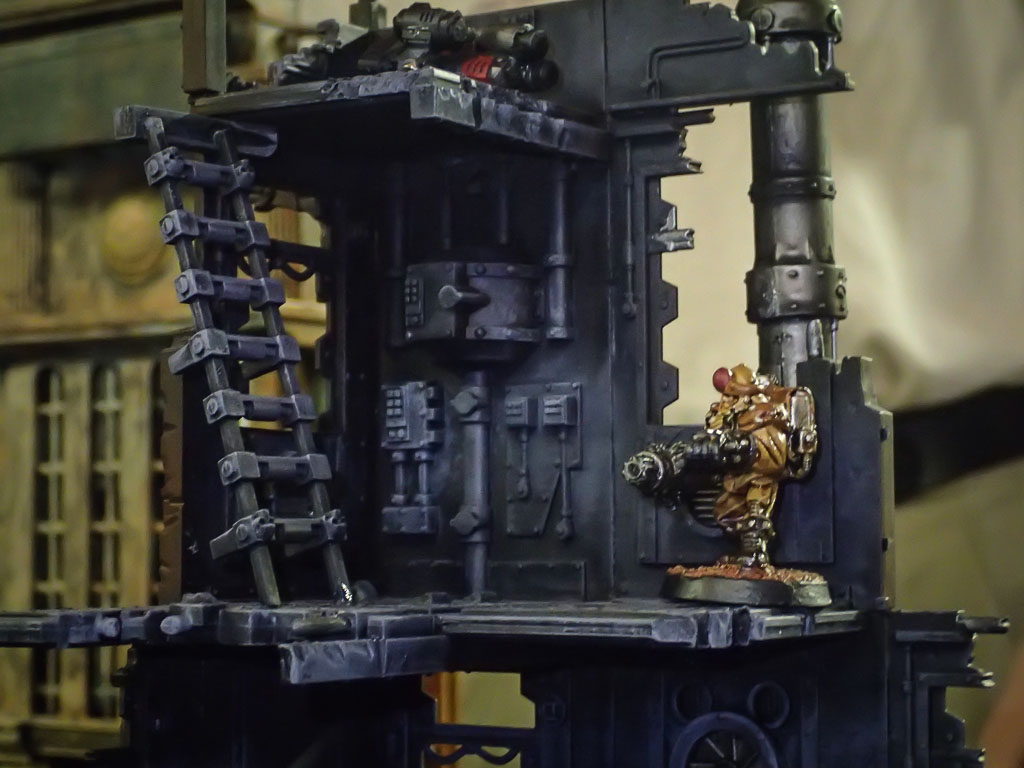
We played a typical "seize the table quarters" scenario, which turned out to be a great way to experience the game. Weapons in TD&TD have infinite range, but each different type of ranged weapon gets a bonus if it is within its "effective range," which encouraged players to get in close for maximum damage. In the pic below, my sniper was perched atop the shanty compound trying to pick off Mattias's armadillo-man.


He succeeded, but in doing so he neglected the flank, where Mattias was able to move up a pair of goons, one of whom killed this nice chap who was just sitting in the back of this wrecked truck, minding his own business with an assault rifle in his hands.


We improved and clarified various rules on the fly as we went along. One bit that we enjoyed was the rule for evades. These are special short moves that are imposed upon figures based on the outcomes of various dice rolls, mainly ties in ranged and close combat. Basically, the evading figure dives for cover, which can really impact your strategy if it happens at the wrong time. But it's a fun, realistic mechanic in a game that doesn't have a true morale system.

When a figure dies, the player is faced with a choice: he can "burn" an activation dice by permanently removing it from the pool he rolls at the start of each turn to revive a dead character. But of course this reduces the effectiveness of his crew for the rest of the game, and it begins to offer diminishing returns ... do you burn dice to keep your guys around, or do you soldier on with the remaining few and attempt to complete the mission? Both are viable strategies, as we found in our game.


By the end of the game, we agreed that I had squeaked out a victory by claiming one table quarter, while Mattias and I contested the other three.

The rules themselves seemed ripe for expansion. We imagined all sorts of special rules and abilities that could expand on the core of TD&TD, including rule for psychics or magic users! Mattias was taking notes as fast as he could for the inevitable update to the alpha rules.

We expect to play more games of The Dogs & the Dust in the future. It's a solid game that definitely fills a niche for quick-play sci-fi skirmish gaming. We hope to share more about these work-in-progress rules in the future.

-- Patrick, Chicago Skirmish Wargames club member

Monday, August 4, 2014

Nuclear Renaissance Game Report and Review


Last week the post-apocalyptic wargaming bug bit the club pretty hard, so we cleared our schedules to play a game we've been interested in for quite some time: Nuclear Renaissance.

This title from Ramshackle Games is a gang-based skirmish game that's particularly well-suited to multiplayer games. That's great for us, as our club nights tend to have an irregular number of players from week to week. For last week's game, we had 5 players, so we decided to bite the bullet and run a post-apoc free-for-all game using Nuclear Renaissance.

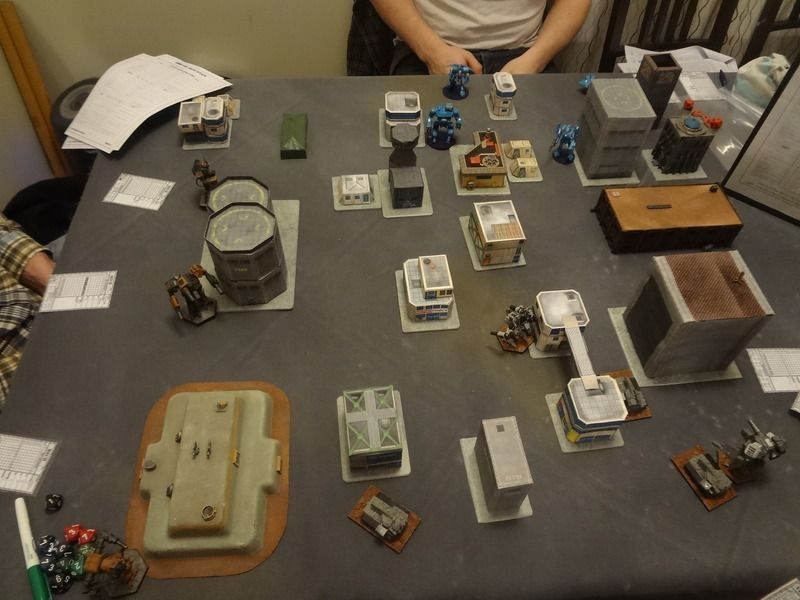
We met at Josh's house and put together a fairly epic 4x8 foot tabletop featuring a tumbledown industrial area alongside a wooded settlement. Here's a pic of the setup:


This game marked the first outing for several bits of new terrain, including Karl's tenement high-rise and Josh's atom bomb. Here's a closer look at both halves of the battlefield.


Looks like a great place to battle, right? We played a variation of the classic "Scavenger Hunt" scenario, with 10 little pieces of lost tech hidden all over the battlefield (most inside buildings or atop balconies, to encourage some mobility.

Nuke Ren is a single-figure activation game, where the players roll initiative and then take turns activating individual figures. Typical actions are move, shoot, drive, etc. Unlike games like Warhammer 40,000, vehicles don't come with a crew or pilot ... if you want your truck to move, you have to have a guy behind the wheel! Same with that sweet machinegun on top ... it won't fire unless a member of your warband is in the turret!

What this meant is that my warband (5 guys plus a buggy) was actually three guys once I got the buggy fully staffed with a driver and a gunner. Here's my team -- keep in mind that two of these guys basically weren't on the table for most of the game, since they were aboard the buggy and thus didn't need to be represented on the tabletop.


So anyway, that's something to keep in mind about Nuke Ren.

As the game progressed, each player's gang advanced toward a few of the scavenger tokens on the battlefield. Figures walk 10cm or run 20cm, and with such a large battlefield we found that our guys weren't mobilizing very quickly.


In contrast to the fairly short movement rates of infantry, vehicles proved much more mobile. This seems to be by design, probably to encourage vehicles to race around the battlefield on taxi runs.


As the vehicles moved into the center of the battlefield, we discovered the true potency of ranged firearms in the game. Such weapons are quite expensive in Nuclear Renaissance, accounting for half (or more!) of a typical figure's point value. But they're also quite powerful, and most have extremely long ranges. My assault rifle had a range of 80cm, longer than our fastest vehicle could move in a typical turn!

What this meant is that the few gangs that had assault rifles and sniper rifles were able to really rule the battlefield, despite what we thought was a pretty cluttered tabletop. Mike's troopers climbed a ruined building and took potshots from the upper-story windows...


....while my sniper scaled a warehouse and used his rifle's incredible 200cm range (why not just make it infinite?!) to rain fire down on Josh's squad.


As the game progressed, little mini-battles developed around various buildings as players fought for control of the scavenger tokens. In these two pics, Karl's wastelands raiders skirmished with Mike's troopers around the base of the high-rise. Later you can see Karl's chaingunner atop a ruined building, ready to seize another piece of lost tech.


Toward the end of the game, Josh wanted to try out the vehicle ramming rules, and he picked the only other vehicle nearby as his victim -- alas, it was my buggy! The ramming rules were fairly straightforward, and Josh reduced my buggy to a heavily damaged (but still driveable) wreck.


Conclusion
We agreed that Nuke Ren was a lot of fun. Trying to play a 5-player multiplayer game while also learning a new ruleset was probably a bad idea, as we only got through 5 turns before we had to wrap up for the night.
The size of the battlefield meant that we never even got close enough to try the close combat rules, which is a bummer considering that the game seems heavily slanted in favor of close combat.

The best part of the game is probably the well-developed vehicle section. We have lots of post-apoc vehicles in our collection, so we've been really excited to try Nuke Ren and get them all on the battlefield.


The suggested point size in the rulebook is 650 points, but in practice that gets you maybe 4-6 figures plus a vehicle, so we'll almost certainly bump the gang point total up to 1000 for future games. We'll also shrink the table size down to either 4x6 feet or 4x4 feet for most games. All in all, the game is totally playable and we'll doubtless give it another run-through in the near future. Stay tuned!

-- Patrick, Chicago Skirmish Wargames club member

Friday, July 11, 2014

Playtesting Song of Hammer & Forge


Last week Tim and I got together to try out the work-in-progress dwarf supplement for Song of Blades & Heroes. Entitled Song of Hammer & Forge, the forthcoming supplement introduces a whole bunch of new rules for the ol' stunty guys, including sections devoted to black powder firearms and artillery. The new additions add a bit of crunch to the game, but longtime SBH fans will be pleased to hear that everything is presented with the same rules-lite flavor of the core game.

We played the Treasure Hunt scenario since we wanted a simple, no-frills scenario to try out the new rules. I made a dwarven warband featuring fighters, halberdiers, a drunk berserker and some boar-mounted cavalry with hand cannons. Here's my warband.


And here are Tim's Tharks, the same warband he's running in our ongoing campaign.


I started out by dispatching my dwarves across the battlefield toward the three treasure markers. We were using a couple new pieces of terrain that I had just completed building over the weekend (the moss-covered ruins).


I kept these guys together for much of the game because I wanted to try out the long reach special rule, which allows the halberdiers to attack over the shoulder of their comrades if they are stacked behind them in close combat. Within a couple of turns, I had my chance! Tim charged his beast into contact with my dwarves, and the halberdier in the second rank was able to dispatch it by stabbing over his buddy's shoulder.


Meanwhile Tim's Tharks were moving ever closer to the three treasure markers on the table. The barrel in the photo below is one of those markers, but only one of the three is the actual treasure (determined randomly before the game started).


The black powder rules are pretty nifty. Basically you fire your gun and it produces a puff of smoke, which drifts across the battlefield according to a the wind's direction (determined at the start of the game, it never changes and is predictable, which is nice). All shooting that passes through a smoke puff suffers a penalty. Here's the outcome after my first shot.


I just so happened to have smoke puffs on hand from way back when I did WWII wargaming, and they looked perfect on the tabletop with my dwarves.

Discharging a black powder weapon for the first time causes all mounts (cavalry, pack horses, etc) on the table to test morale. We forgot to implement this rule, and it might have mattered since Tim's most potent figure was a cavalry model.

Here's another explosive hand cannon shot from the other side of the table.


Black powder weapons and crossbows feature improved stats compared to the SBH shooter rules, but they also require reloading. Depending on the weapon, this typically costs 2 actions and most figures can't move while reloading. I had two dwarves with crossbows and two with hand cannons in our battle, and we found that the reloading rules didn't slow the game down very much.

Song of Hammer & Forge also includes an extensive array of rules about drunk dwarves. Yes, you read that correctly. There are four separate rules to simulate drunken fighters, so I made sure to take one (sloshed) for one of my warriors. The rule proved to just as zany as you might expect; the melee bonuses I received were outweighed by the few times he tottered off in a random direction as a result of a quality check.

Personally I don't see myself using the drunk dwarf rules very much. My dwarves are stoic Norse-inspired heroes, not drunkards teetering from battlefield to brewery and back again. But the drunk dwarf rules do a good job of simulating some of the Warhammer-inspired silliness we've come to expect. 

Even though I found the treasure first, Tim ended up winning the scenario, and this photo is a good example of why. No halberdier in his right mind would go toe-to-claw with a Thoat, but my guy decided this was a prudent course of action for some reason.


I've been eagerly anticipating this ruleset for many months, and this playtest showed it was well worth the wait. I'm looking forward to shelling out some hard-earned cash for this supplement as soon as it's available!

-- Patrick, Chicago Skirmish Wargames club member