Monday, May 12, 2014
Of Gods & Mortals Game Report
Song of Blades & Heroes holds a special place in the heart of many Chicago Skirmish Wargames members. It was the game that brought us together way back in 2010, and since then we've become experienced (some might say veteran) SBH players.
So you can imagine how excited we were to read about Of Gods & Mortals, written by Andrea Sfiligoi and released last year by Osprey. The game might be best described as large-scale skirmish featuring gods, mortals and legends drawn from history and mythology clashing on the battlefield. Based on our reading of the rulebook, OGAM games are quite a bit larger than the typical SBH game, with maybe 20-25 figures per side in OGAM compared to 6-12 figures for SBH.
Both games share the same basic rules engine, which means we already knew 75% of the rules before we even opened the rulebook. We've been looking for a good framework for doing large-scale SBH games, so Tim and I carved out some table space at last week's club night to try out OGAM.
We built two 900-point armies: Norse/Celt-inspired undead guys for Tim, and Egyptian-themed undead guys for me. Undead vs. undead -- what could go wrong?!
Here are my guys, led by Hesperax, the undead dragon.
And here are Tim's guys, led by his undead giant along with a werewolf and Celtic chariot.
We decided to play the "Sacred Grove" scenario, in which both sides fight to control an enchanted copse of trees in the center of the table. Here's the battlefield at the start of our game.
We deployed our guys in a rough arc around the sacred grove. In the base rules for OGAM, units can deploy anywhere on the battlefield as long as they're a minimum distance away from any other enemy unit. That's fairly cool! No more lining up on the table edge and spending the first three turns moving forward!
Tim took the first turn and advanced his undead giant, chariot and a squad of skeleton warriors toward the sacred grove.
I did the same on my side of the table, taking care to keep Hesperax (my leader) near her troops for support.
OGAM has three different unit types: gods, legends and mortals. Mortals move around the battlefield in formations, and the game has just enough crunch in this respect to satisfy gamers who might be familiar with ranked unit movement from games like Warhammer Fantasy or Kings of War. But units are capped at 8 figures, so you won't find yourself struggling with ungainly blocks of individual troops.
Legends are basically heroes or champions with better stats and a few special rules. They can roam around the battlefield, and they stand a decent chance of threatening a small unit of mortals.
Here, Tim's werewolf encounters my lich lord on a flanking maneuver. Both are legends and both will shortly be joined by their comrades as the battle develops.
Closer to the sacred grove, my unit of skeleton archers had invested a ruined building and were taking potshots on Tim's advancing guys. As in SBH, shooting is not all that effective unless you really dedicate some points to it. My archers didn't do a whole lot in this game.
Here's another look at the scene above. You can see I've got an 8-man unit of skeletons moving into contact with Tim's undead guys. In the second pic below, he's bringing another smaller unit up around the rear of my skeletons.
We ran into an interesting rules situation at this point. In OGAM, a unit that loses a combat always recoils away from the opposing unit -- but it doesn't always suffer casualties. In the photo above, my skeleton unit in the center got pinched between Tim's two mortal units and basically bounced back and forth for several turns like a pinball, constantly recoiling into another enemy unit, losing 1 figure at a time but never quite falling apart.
Eventually Tim destroyed the unit but he had to commit two units of mortals and his undead giant. It was a real grindfest and we were wondering if we were playing the combat correctly. We kept flipping through the rulebook looking for a rule about how units that recoil into larger enemy units are automatically destroyed, but such a rule didn't exist, so we just kept playing out the combat in little spurts each turn.
On the other flank, the battle between the werewolf and lich lord was heating up. Tim committed another unit of mortals and I brought up my undead abomination to support the lich.
We smashed on each other for a few turns, but ultimately the lich lord prevailed, slaughtering the mortals and prompting the werewolf to fall back toward the sacred grove.
Oh yeah! About that sacred grove. I didn't take very many photos of it, but the grove saw some fierce fighting. Tim seized it early in the game with his chariot, but then I moved up a unit of 8 skeletons, destroyed the chariot, and promptly seized the sacred grove for myself. Here they are, taking up defensive positions as Tim pivots his troops to focus on the objective.
In the end, Tim couldn't quite seize the objective before the end of the game (it was capped at six turns). So although I definitely lost on the battlefield, I was able to hold onto the scenario objective and score a victory.
We hashed out some thoughts on OGAM after the game. Short version: Tim and I both enjoyed it and feel it could be a great "next step" for our club. We've been looking at slightly larger games for a while now, and OGAM offers that while still maintaining a lot of the skirmish aspect that we like about SBH.
The combat rules have been cleaned up a lot compared to SBH. Almost all of the combat modifiers are bonuses, rather than penalties, which makes them a bit easier to track. Units still have only two stats, just like in SBH, plus a few special rules which will look familiar to any SBH player.
One minor quibble has to do with some of the combat math. Outnumbering counts every factor of 4 when determining bonuses, but casualties count every factor of 3. It seems like it wouldn't have been too hard to bring these two areas into harmony so that you could say something like "This game uses the rule of 4s...." which is quite elegant. But again, Tim and I had no real problems handling the separate rule elements.
The flavor of OGAM (gods and mortals clashing on a battlefield) doesn't resonate particularly well with me, so I don't see myself playing out the games described in the rulebook (Heracles + Greeks vs. Anubis + Egyptians). But it's perfectly serviceable for more typical fantasy games, which is how I expect we'll end up using it. Really, I see OGAM as more of a "stopgap" solution until the official large-scale SBH game (Song of Armies & Hordes I think?) is released, hopefully in the next 18 months or so.
The verdict: OGAM is a great game for our club! We've got quite a nice collection of fantasy miniatures now, and this game gives us a chance to get them all on the table using our favorite rules engine. I look forward to introducing everyone to OGAM in the future. Stay tuned!
-- Patrick, Chicago Skirmish Wargames club member
Friday, May 9, 2014
Mech Attack Battle Report from Little Wars
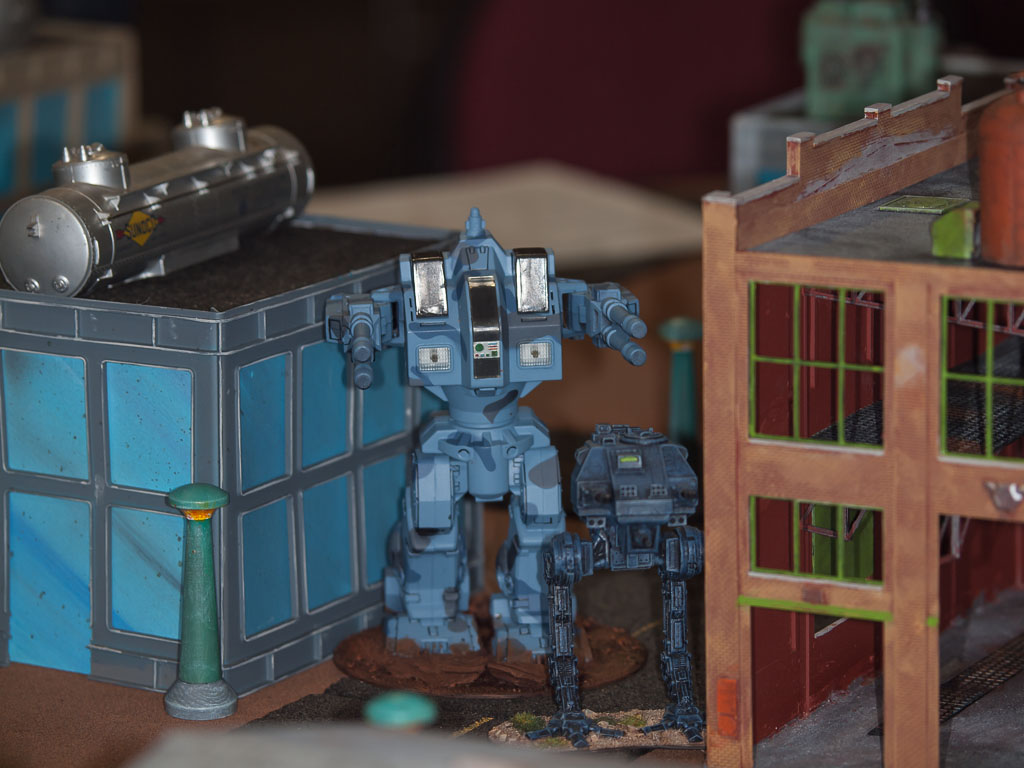
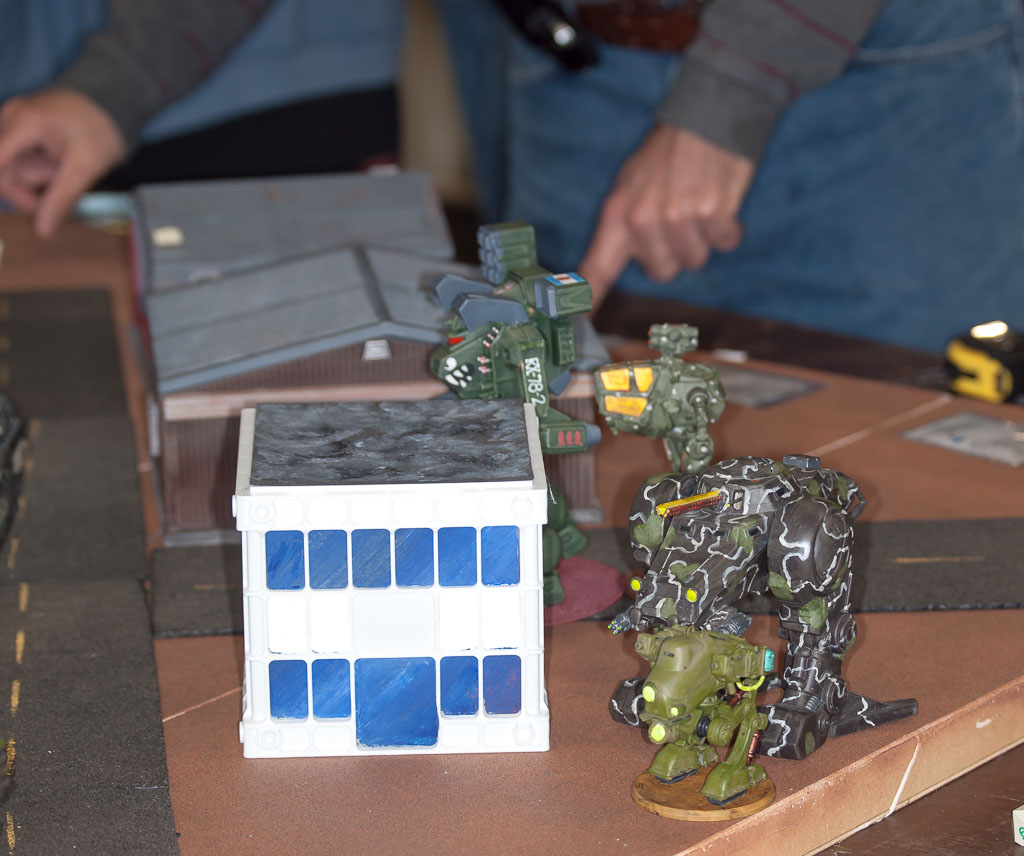
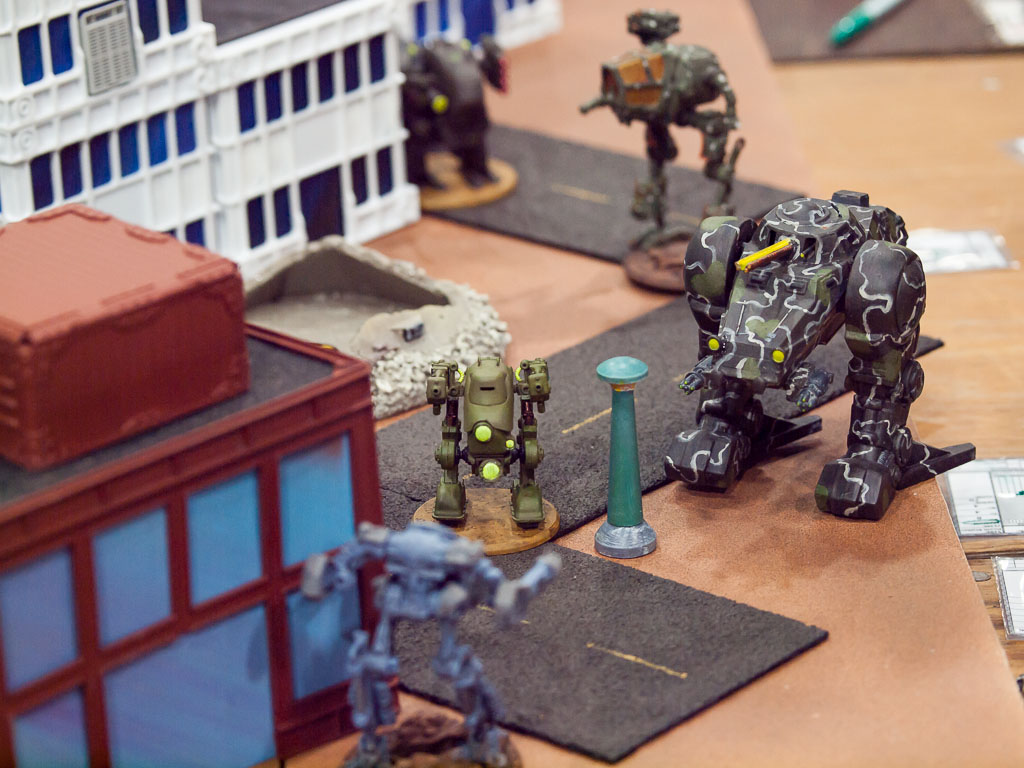
Last month, the club put on a game of Mech Attack at the Little Wars convention in suburban Chicago. As with last year's game, we again invited players to witness the spectacle of giant 28mm scale mechs stomping across the table blasting each other to pieces.
We made a few changes for this year's game. First, the new scenario focused not on destroying the enemy mechs (though there was plenty of that) but rather on destroying or defending key objectives. Also, we removed the 28mm infantry component, added more mechs, and included some new models.
This year's scenario was a continuation of last year's game. In the year 2166, with the Unified Colonies nearly driven from Melk 3, they again turned their wrath on St. Martin's Parish, a small outpost that had first blunted the UC's expeditionary elements in 2165.
With planetary occupation no longer feasible, this punitive raid of revenge sent an armored wedge of mechs and vehicles into combat along an urban industrial corridor.
This was a four-player team game, with each player controlling three or four units. The grey units represented the Melk Defense Command (MDC). The green units represented the Unified Colonies (UC) punitive expeditionary attackers.
Objectives
Each pillbox was able to take 30 points of damage before being destroyed.
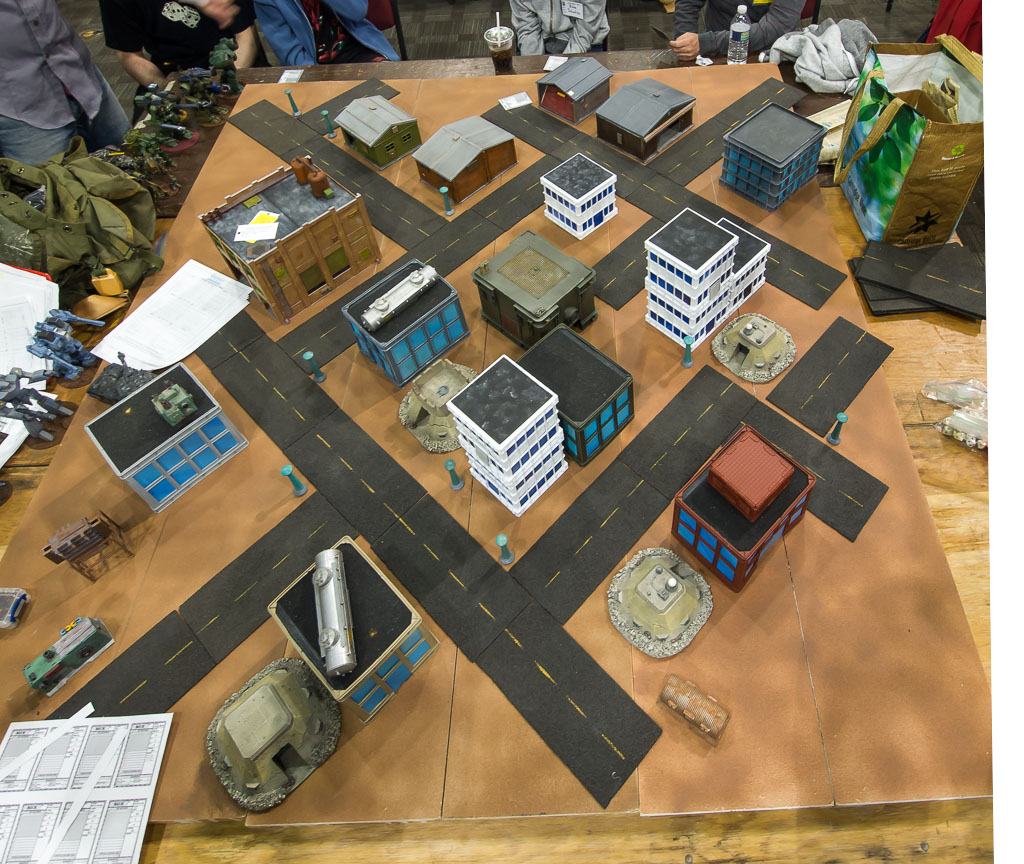
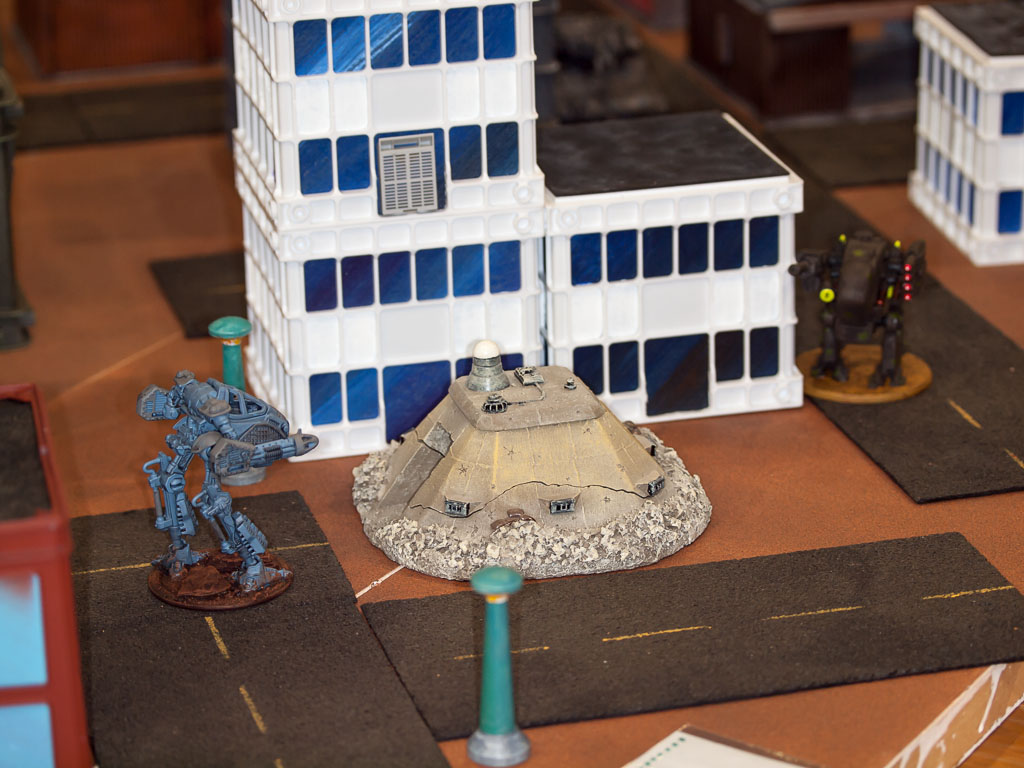
The picture below shows the layout of the terrain from the defender's position. Note the four pillboxes -- each was secretly assigned a value by the defenders before the game started. They were:
Defenders were also allowed to place their mechs anywhere in the city.
The UC set up on the opposite table edge. They were allowed to keep units off the board as reserves, though no one took advantage of this rule.
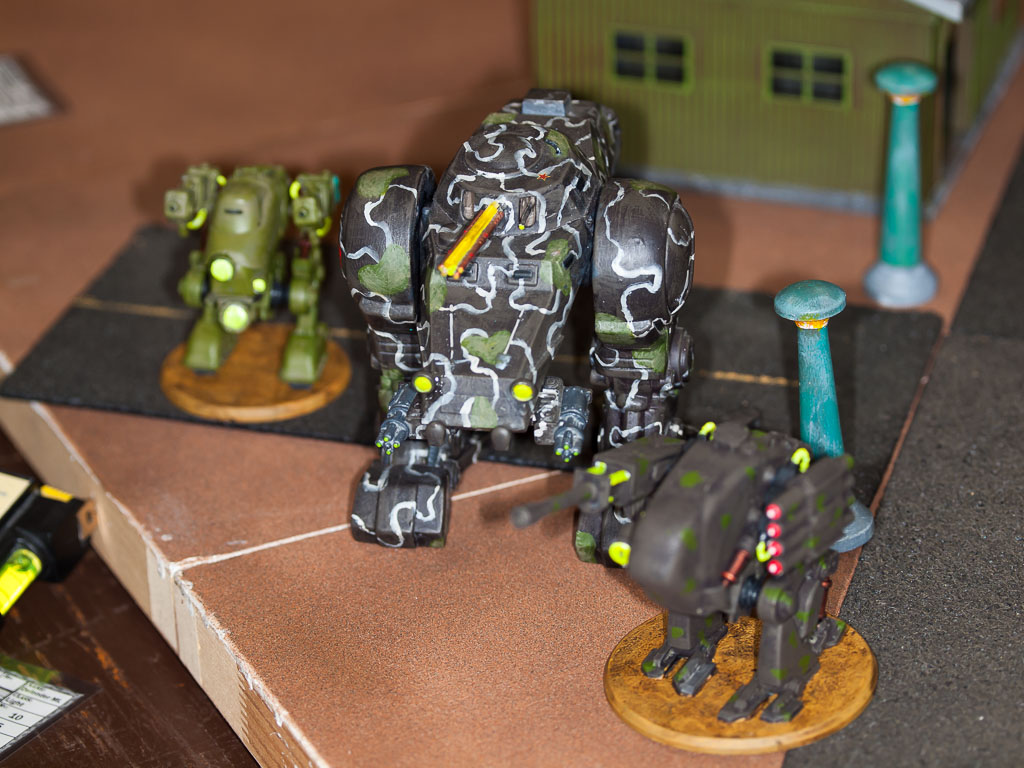
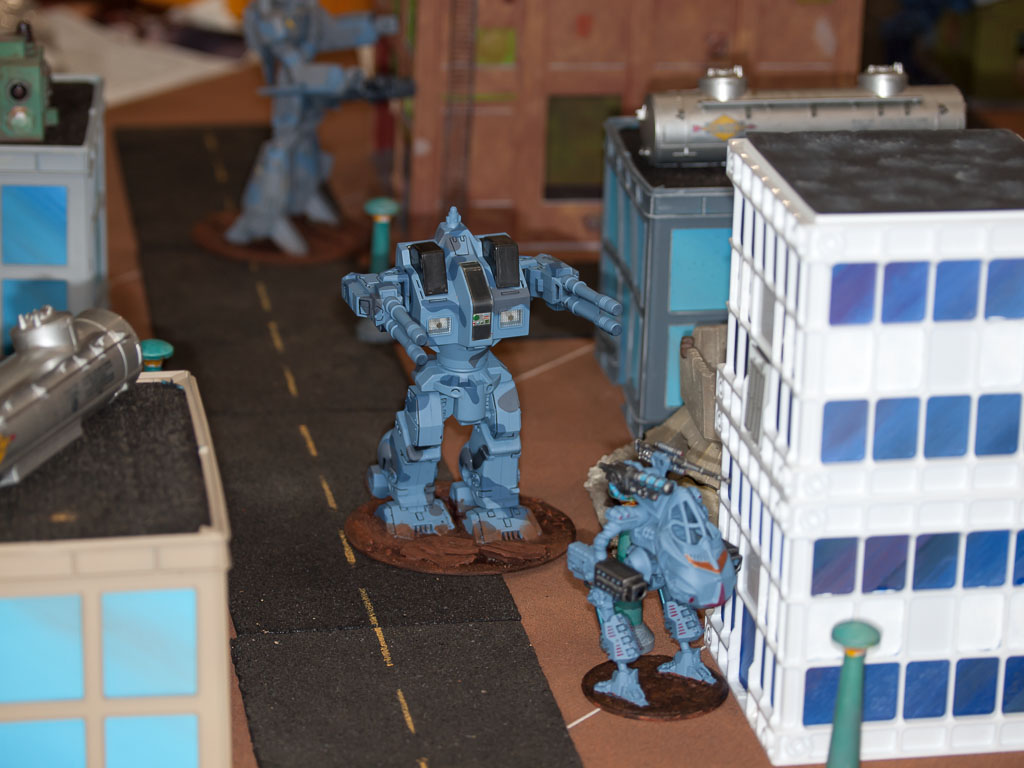
The UC controlling the slightly-lower-tech Conscript mech squad, shown below, deployed slightly deeper into the industrial corridor.
Here's a look at the start of the game (minus the Conscripts, which arrived moments later).
After a bit of rules explanation, we were off! Several players were returning veterans from last year's Mech Attack game, and they proved invaluable in helping the new players get up to speed quickly.
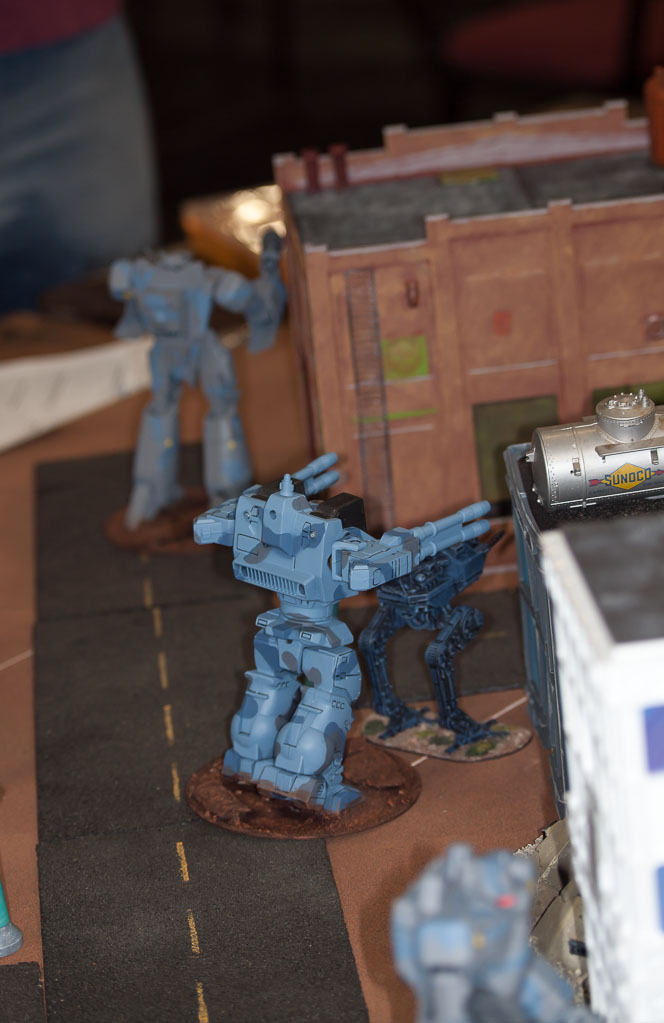
On turn one, the UC attackers advanced up the left flank.
A small UC contingent held the center of the table to discourage flanking by the defenders.
The MDC defenders were able to stymie any advance by the attackers in the center by committing just a few units to that area.
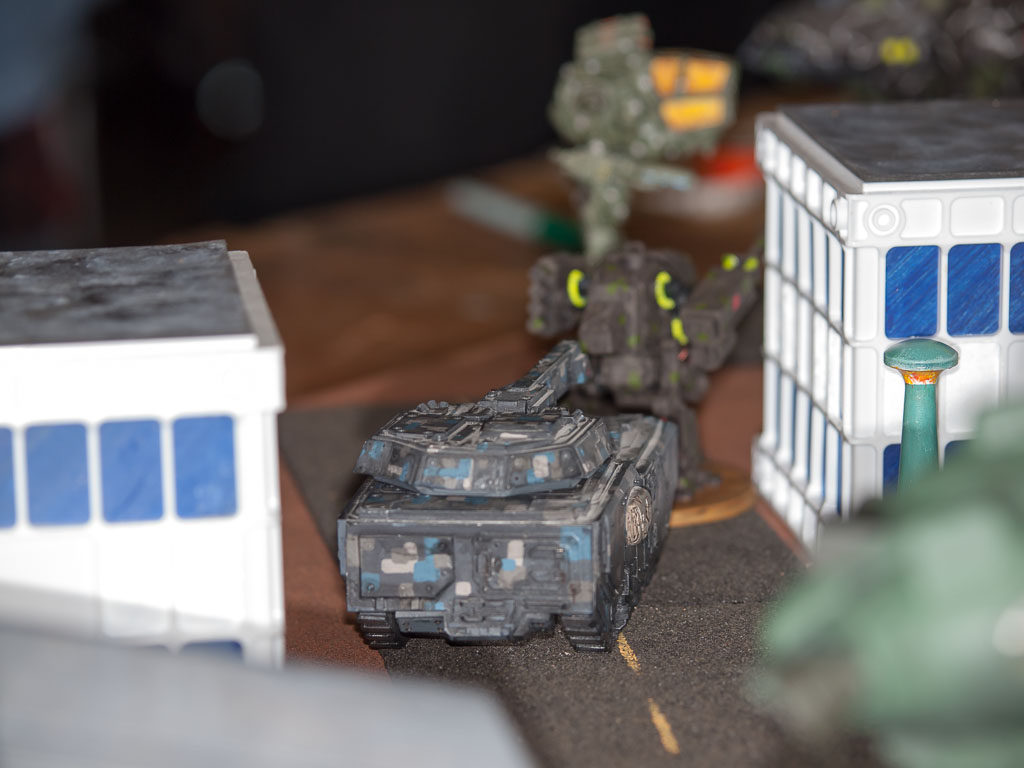
It wasn't long before a UC Centurion succumbed to enemy fire.
On the other side of the board, however, the UC pressed their attack with some success.
The lead conscript rounded an office building and brought his weapons to bear on the first pillbox.
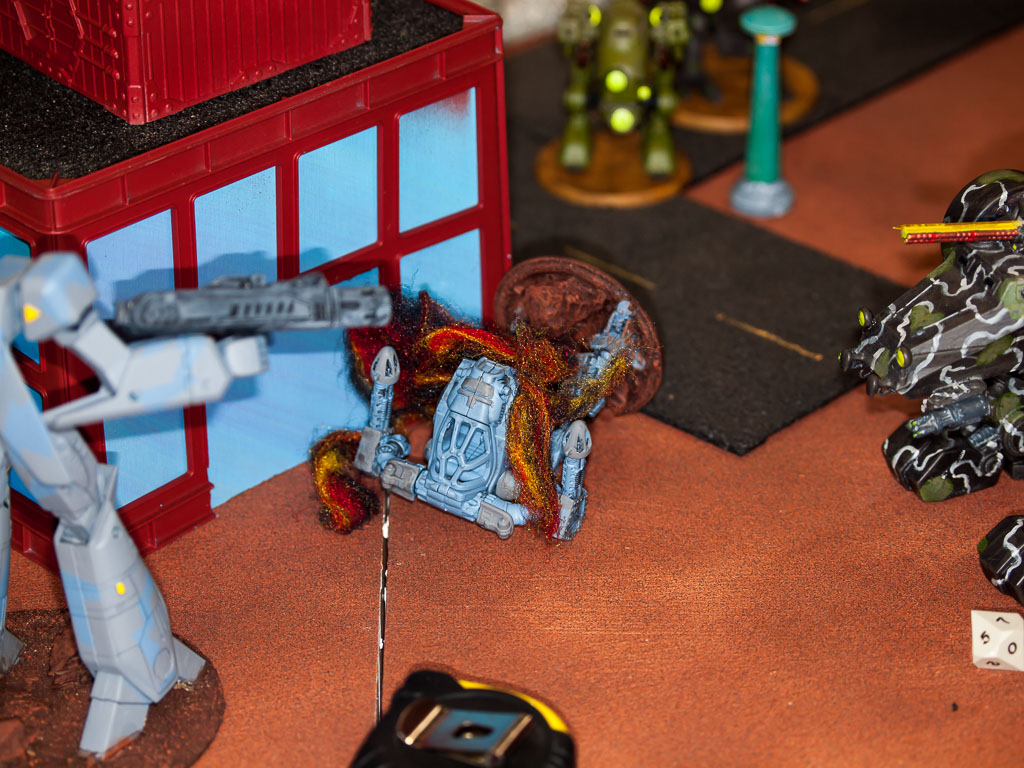
His comrades soon joined in and destroyed the pillbox, which turned out to be an ammo dump (worth 50 points). The explosion did only minimal damage to a few nearby mechs, and they continued their advance.
To counter this advance, the UC swept toward their right flank into the city, attempting to flank the attackers...
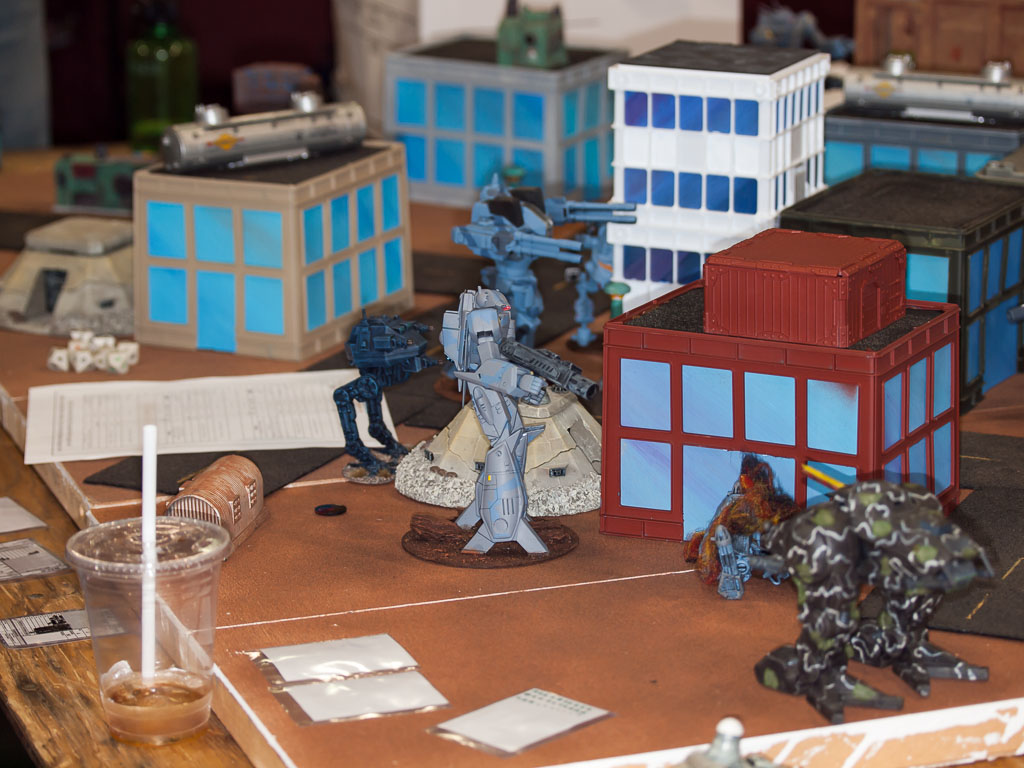
...and in some places they succeeded.
It wasn't enough, though. The UC pressed their advantage and directed intense firepower on a second pillbox.
The second pillbox exploded, and it turned out to be the Command Center (100 points) giving the UC players 150 points and the victory with just 10 minutes left in the game.
We were very happy with the way the game turned out. Had the Command Center been in a different pillbox, the defenders could well have held off the attack long enough to win the day. Also, the removal of infantry from the game resulted in a much faster scenario. For a game night, I'd probably put them back for more variety, but for a convention game this was definitely the right choice.
Once again, Mech Attack proved to be a fast playing and engaging ruleset that gives all of what you need and love about battlemech combat with none of what you don't. Most importantly, the players were able to quickly learn the rules and really enjoyed the game. All in all, it was a very successful morning.
Many thanks to the Little Wars organizers, HMGS, the players who participated and Armor Grid Games, which gave free copies of Mech Attack to the winners. And extra special thanks to the members of Chicago Skirmish Wargames, who took spent many hours leading up to the event playtesting this scenario and painting mechs. This year's game featured seven new mechs!
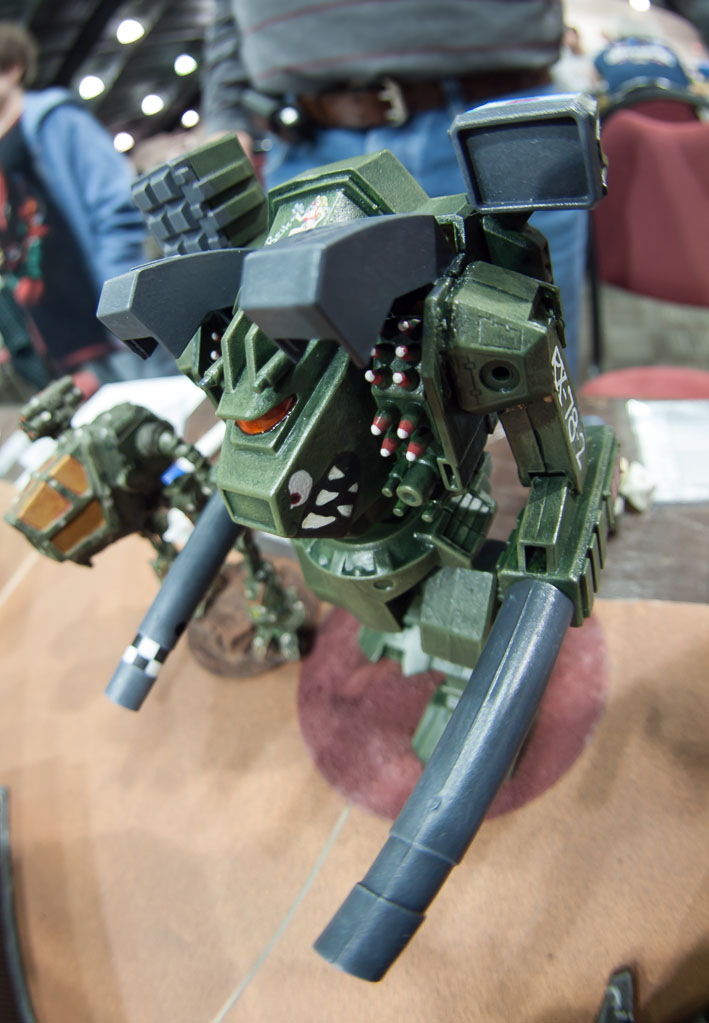
I'll leave you with a headshot of one such unit as painted by Mattias. Yep, that's a freehand pinup on a patch of armor smaller than a quarter!
Karl's Thoughts on Little Wars
This year Little Wars was slightly less than last year by most metrics. There were fewer attendees (at least as far as I could tell), vendors (about a third less) and flea market participants. Also, this year's convention lacked a paint-and-take booth, which is always a lot of fun and a great way to kill time between events. Still, it was a good time. I found some good stuff in the flea market, both for myself and to re-sell online to help fund my hobby. As with last time, we didn't have any empty seats at our game. I'll likely return next year with Mech Attack! We now have enough mechs, terrain, and experience that this is a pretty easy game to run at a convention.
Pat's Thoughts on Little Wars
I attended with Karl and the rest of the club and helped run the Mech Attack game.Each year I am surprised that Little Wars never seems to introduce a "Shopper" badge that lets people stroll through the vendor area and just spend money. It would cost them literally nothing and would be a great marketing bit to throw at potential vendors. "We let shoppers in for free, you'll be up to your elbows in grognards and cash-mad dads!"
Consider what happened to me: As a GM, I arrived late and had to haul stuff in the side doors at the last minute. Consequently I never got a badge -- and I didn't notice until our game was over and I was headed to the vendor area. I got stopped by a LW volunteer who told me I had to go register. I got a guest badge (because at that point I had about 45 left before I had to leave), but a guest badge doesn't officially allow you to shop in the vendor area. My wallet would have been $80 - $100 lighter if I had the opportunity to just buy some stuff on a guest badge. Again, why not? Open the floodgates to casual shoppers! Promote this on the web! I don't see how this can by anything but a master stroke for all involved.
I think there is a fundamental disconnect between the perceived customer base at Little Wars. Organizers believe that everyone who walks through the door is a player and should share the responsibility for planning and running Little Wars, not to mention renting out the DuPage Expo Center for the weekend. The vendors pay only for their table space. However, this calculus leaves no room for new blood -- casual gamers and suburban dads who might wander in after hearing about this "toy soldier show" taking place in town and think it might be a great place to take their 11-year-old sons for a few hours. These are the very elements that HMGS needs to attract if it is to remain relevant.
I'm not privy to the internal economics of Little Wars, and of course I'm grateful to the all-volunteer crew that puts it together. We're looking forward to next year's Little Wars -- just make it a little easier for us to buy stuff, please!
-- Karl and Pat, Chicago Skirmish Wargames club members
-- Photos by Josh, Chicago Skirmish Wargames club member
We made a few changes for this year's game. First, the new scenario focused not on destroying the enemy mechs (though there was plenty of that) but rather on destroying or defending key objectives. Also, we removed the 28mm infantry component, added more mechs, and included some new models.
This year's scenario was a continuation of last year's game. In the year 2166, with the Unified Colonies nearly driven from Melk 3, they again turned their wrath on St. Martin's Parish, a small outpost that had first blunted the UC's expeditionary elements in 2165.
With planetary occupation no longer feasible, this punitive raid of revenge sent an armored wedge of mechs and vehicles into combat along an urban industrial corridor.
This was a four-player team game, with each player controlling three or four units. The grey units represented the Melk Defense Command (MDC). The green units represented the Unified Colonies (UC) punitive expeditionary attackers.
Objectives
- UC Attackers - Score 150 points by destroying defender's pillboxes
- MDC Defenders - Keep the attackers from scoring 150 points within the two-hour allotted game time
Each pillbox was able to take 30 points of damage before being destroyed.
The picture below shows the layout of the terrain from the defender's position. Note the four pillboxes -- each was secretly assigned a value by the defenders before the game started. They were:
- Command Center (100 Points)
- 2 Ammo Dumps (50 points each) - When destroyed, they deliver a medium missile hit to a blast area determined by a d10 roll.
- Comms Center (50 Points) - When destroyed, the attacker gets a free standard move for all of his units to represent them taking advantage of the defender's lack of coordination
Defenders were also allowed to place their mechs anywhere in the city.
The UC set up on the opposite table edge. They were allowed to keep units off the board as reserves, though no one took advantage of this rule.
The UC controlling the slightly-lower-tech Conscript mech squad, shown below, deployed slightly deeper into the industrial corridor.
Here's a look at the start of the game (minus the Conscripts, which arrived moments later).
After a bit of rules explanation, we were off! Several players were returning veterans from last year's Mech Attack game, and they proved invaluable in helping the new players get up to speed quickly.
On turn one, the UC attackers advanced up the left flank.
A small UC contingent held the center of the table to discourage flanking by the defenders.
The MDC defenders were able to stymie any advance by the attackers in the center by committing just a few units to that area.
It wasn't long before a UC Centurion succumbed to enemy fire.
On the other side of the board, however, the UC pressed their attack with some success.
The lead conscript rounded an office building and brought his weapons to bear on the first pillbox.
His comrades soon joined in and destroyed the pillbox, which turned out to be an ammo dump (worth 50 points). The explosion did only minimal damage to a few nearby mechs, and they continued their advance.
To counter this advance, the UC swept toward their right flank into the city, attempting to flank the attackers...
...and in some places they succeeded.
It wasn't enough, though. The UC pressed their advantage and directed intense firepower on a second pillbox.
The second pillbox exploded, and it turned out to be the Command Center (100 points) giving the UC players 150 points and the victory with just 10 minutes left in the game.
We were very happy with the way the game turned out. Had the Command Center been in a different pillbox, the defenders could well have held off the attack long enough to win the day. Also, the removal of infantry from the game resulted in a much faster scenario. For a game night, I'd probably put them back for more variety, but for a convention game this was definitely the right choice.
Once again, Mech Attack proved to be a fast playing and engaging ruleset that gives all of what you need and love about battlemech combat with none of what you don't. Most importantly, the players were able to quickly learn the rules and really enjoyed the game. All in all, it was a very successful morning.
Many thanks to the Little Wars organizers, HMGS, the players who participated and Armor Grid Games, which gave free copies of Mech Attack to the winners. And extra special thanks to the members of Chicago Skirmish Wargames, who took spent many hours leading up to the event playtesting this scenario and painting mechs. This year's game featured seven new mechs!
I'll leave you with a headshot of one such unit as painted by Mattias. Yep, that's a freehand pinup on a patch of armor smaller than a quarter!
Karl's Thoughts on Little Wars
This year Little Wars was slightly less than last year by most metrics. There were fewer attendees (at least as far as I could tell), vendors (about a third less) and flea market participants. Also, this year's convention lacked a paint-and-take booth, which is always a lot of fun and a great way to kill time between events. Still, it was a good time. I found some good stuff in the flea market, both for myself and to re-sell online to help fund my hobby. As with last time, we didn't have any empty seats at our game. I'll likely return next year with Mech Attack! We now have enough mechs, terrain, and experience that this is a pretty easy game to run at a convention.
Pat's Thoughts on Little Wars
I attended with Karl and the rest of the club and helped run the Mech Attack game.Each year I am surprised that Little Wars never seems to introduce a "Shopper" badge that lets people stroll through the vendor area and just spend money. It would cost them literally nothing and would be a great marketing bit to throw at potential vendors. "We let shoppers in for free, you'll be up to your elbows in grognards and cash-mad dads!"
Consider what happened to me: As a GM, I arrived late and had to haul stuff in the side doors at the last minute. Consequently I never got a badge -- and I didn't notice until our game was over and I was headed to the vendor area. I got stopped by a LW volunteer who told me I had to go register. I got a guest badge (because at that point I had about 45 left before I had to leave), but a guest badge doesn't officially allow you to shop in the vendor area. My wallet would have been $80 - $100 lighter if I had the opportunity to just buy some stuff on a guest badge. Again, why not? Open the floodgates to casual shoppers! Promote this on the web! I don't see how this can by anything but a master stroke for all involved.
I think there is a fundamental disconnect between the perceived customer base at Little Wars. Organizers believe that everyone who walks through the door is a player and should share the responsibility for planning and running Little Wars, not to mention renting out the DuPage Expo Center for the weekend. The vendors pay only for their table space. However, this calculus leaves no room for new blood -- casual gamers and suburban dads who might wander in after hearing about this "toy soldier show" taking place in town and think it might be a great place to take their 11-year-old sons for a few hours. These are the very elements that HMGS needs to attract if it is to remain relevant.
I'm not privy to the internal economics of Little Wars, and of course I'm grateful to the all-volunteer crew that puts it together. We're looking forward to next year's Little Wars -- just make it a little easier for us to buy stuff, please!
-- Karl and Pat, Chicago Skirmish Wargames club members
-- Photos by Josh, Chicago Skirmish Wargames club member
Friday, April 18, 2014
Blood-Soaked Back Alleys: A Song of Blades & Heroes Game Report
This week a few of us got together to play a much-delayed game of Song of Blades & Heroes. I have been canceling and rescheduling this game just about every month since Christmas, due to a variety of factors beyond my control (including Chicago's brutal winter).
But this week the stars aligned, allowing Karl and Mattias to join me in my basement for our game. I created a scenario set in Vildeburg, the main city in our recent fantasy campaign. The game took place in the marketplace, an area of town frequented by merchants and dominated by Vildeburg's guild hall (the three-story building near the docks in the picture below).
In our scenario, four prominent traders and merchants have just concluded a deal outside the hall when they are set upon by two powerful chaos warbands (Karl's Servants of the Black Crown and Mattias's Wyrdwold denizens). In the ensuing mayhem, each personality attempted to escape the carnage by fleeing to a particular point on the tabletop. Here are the traders assembled in the guild hall's courtyard.
(From left)
- Trudebaran the master mage made for his stone tower, trusting in its arcane enchantments to repel the invaders.
- Prince Akim Lorespeaker, merchant of the southern desert, pledged to defend the guild hall.
- Brak Morn, barbarian fur trapper, attempted to sneak out of the city and seek refuge in the nearby woods.
- Torrhigan Elfbane, dwarf metalsmith and trader, sought to meet up with his escort at the docks.
The chaos raiders would win if they could neutralize 3 or more personalities as they raced through the marketplace. The Vildeburg guild would win if three or more personalities made it to their destinations unharmed. In addition to the fellows pictured above, a handful of Vildeburg militia were roaming the streets and would aid the traders if needed.
With those rules in place, we were off!
Karl and Mattias both deployed a portion of their warband inside the church atop the rocky plateau. They had infiltrated the crypts beneath the church (which linked into the sewers of Vildeburg), which allowed them to come boiling out of the holy site on the first turn. Here are some of Mattias's ghastly dudes doing just that.
Just around the corner, though, were four dwarf boar-riders. These fellows were meant to escort Torrhigan to the docks, but they were pressed into service early in the game to counter the demons in the church!
Closer to the docks, Karl deployed his heavy cavalry, the Beast Blood Riders, along with Horg the ogre and Valspan the half-giant, to meet the dwarves and perhaps thwart their advance.
Remember those militia I said were patrolling around town? Well, they drew the ire of the Lord of the Lichens and the Shivering King, two fearsome mounted warriors in Mattias's army. Here's a look at the scene right before the two plucky soldiers were ridden down on the cobblestone streets of Vildeburg.
Actually they weren't killed instantly. Song of Blades & Heroes has a pretty generic combat system -- there are no weapon stats and minimal armor, so combat rarely yields a full-on "dead" result. More often, figures are driven back or knocked down, which of course puts them in a more dangerous position for the inevitable follow-up attack. In this case, the two militiamen survived the initial charge and then sprinted down the alley to rejoin a larger group of militia that was congregating around Trudebaran the wizard.
Here's a look at the battlefield as the game approached its midpoint. Karl's red-armored chaos warriors at engaging the dwarves around the dock, while Mattias's demons have thoroughly defiled the church and are threatening a small knot of militia on the left side of the battlefield. (And all alone, ignored for the moment, Prince Akim Lorespeaker stands alone in the courtyard outside the guild hall.)
Back at the church, the dwarven boar-riders rallied for a charge. With swords a-wavin' and blunderbusses a-spewin', they raced up a walkway and crashed into the demons. This combat turned into a real grindfest! Both demons and dwarf cavalry were stuck in combat right here for most of the game.
Here's a closer look at the epic scrum that was developing around the docks. Torrhigan is the short, out-of-focus dwarf on the left side of the pic, watching the fight development from his perch on the guild hall steps. Karl's chaos warriors, the Servants of the Black Crown, were formidable, but my dwarves were able to defeat three horse-mounted warriors -- greatly evening the odds!
Across the table, Brak Morn the barbarian was making his way out of the village and was pretty much unnoticed -- until Karl's chaos warriors spotted the hulking fighter sneaking under a bridge. Drawing their weapons, they leapt down and engaged him in a swirling melee. The huge barbarian gave as good as he got but eventually went down in a flurry of blows.
Thus my first personality figure bit the dust. Alas, it would not be the last -- a short distance away from his tower, Trudebaran the mage (in the purple robe below) found himself in a heap of trouble. He had joined up with a pair of militiamen, but the Lord of Lichens and the Shivering King had circled around to cut off his escape route.
The rest of the brigands swarmed to his location and overwhelmed the gallant fighters protecting him. Trudebaran fled but was caught and skinned alive a short distance away by the gruesome Flayer of Shins (Mattias's awesome standard bearer). Here is his final stand.
At this point, two of my four personality figures had been killed. Thanks to some lucky dice rolls by the docks, Torrhigan the dwarf had secured the dock. Karl had once last chance to engage Prince Akim Lorespeaker, paladin of the southern desert, with his remaining chaos warriors. Grimly hefting his sword and shield, Prince Akim met his attackers in single combat -- and survived!
We called the game a tie at that point.
In our post-game discussion, we agreed that this was a fun scenario and we could definitely play it again with a few tweaks. The best part was the mobility -- each personality was essentially a "victory point with legs," so we got to use the entire battlefield for our game as the warbands moved through the streets and back alleys.
Also, this was a fairly big game -- 500 points for both Mattias and Karl, and 1,000 points for me as the defender. We had about good number of figures per side (9 each for Karl and Mattias, and 19 for me). Gaming at this level is rapidly becoming our favorite way to play, since we're all quite adept at SBH after several years of playing it regularly.
This session was a good warm-up for our upcoming summer fantasy campaign. In a couple short months we will return to Qaarra and see what devastation has been wrought there. Stay tuned!
-- Patrick, Chicago Skirmish Wargames club member